
The sorting of America’s states into blue and red, with the one-way population transfers that have followed, is the biggest political and cultural story of this century. In the abstract, one might have expected that blue states would trend redder and red states would trend bluer, toward a purple consensus, based on regression to the mean if nothing else. But that isn’t happening. Instead, red states are generally getting redder, and blue states are generally getting bluer.
You can track this in a variety of ways, but the Wall Street Journal applied a simple criterion: what has been happening to each state’s top personal income tax rate?
U.S. politics are getting more polarized and, increasingly, so are state income-tax systems.
Republican-led states are racing each other to flatten, cut and eliminate individual income taxes, with 23 states lowering their top income-tax rates since 2021. Mississippi and Oklahoma, among others, put themselves on paths to eliminate personal income taxes. South Carolina is setting a course this year to drop its top income-tax rate to 1.99%, and Missouri residents may vote this November on a plan to phase out income taxes and allow lawmakers to expand sales taxes.
Democratic-controlled states are moving the opposite way, pushing to increase taxes on top earners to combat inequality and plug budget holes expected from Republicans’ cuts to federal health and nutrition assistance programs. Washington state’s legislature last week sent Gov. Bob Ferguson a bill that would create a 9.9% income tax on earnings over $1 million. New York City Mayor Zohran Mamdani is pushing state lawmakers to raise income taxes on high-income households. Hikes on top earners are a priority for some Democrats and progressive groups as they head to elections this fall in Rhode Island and Colorado.
The middle ground is quickly disappearing.
This chart shows top income tax rates over the last 20 years. It is imperfect, as it classifies states as red or blue based on the party of the current governor. It is nevertheless instructive:
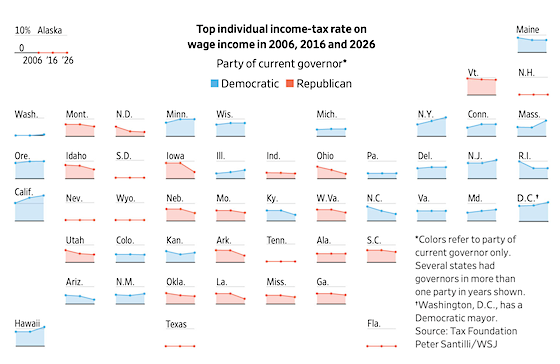
You can see the declining top rates in most red states; some fortunate states, of course, have been at zero for a while, and continue there. “Blue” states are a little more mixed, although the ones that have reduced rates are actually purple, like North Carolina, Kentucky and Arizona. The salient point is that the blue states that are doing the worst, economically–California, New York, Massachusetts, Illinois, Minnesota–have all increased their personal income tax rates.
The cause and effect connection is obvious, so: is there any blue state where a serious effort to cut taxes is underway? Not that I know of. On the contrary, Washington, a bluish state that has benefited greatly from not having an income tax, is poised to adopt one. And in New York, Governor Hochul is not proposing to cut taxes, but rather is imploring former New Yorkers who have fled to Florida and other destinations to return, so that they can pay New York’s absurd taxes. I’m guessing that appeal will fall on deaf ears.
If liberals were rational people who respond to data, Democrats in blue states would be advocating tax cuts–especially, cuts in top personal income tax rates. But they are ideologically incapable of doing that, so, unless voters turn Democrats out of power, the continuing decline of blue states is inevitable.