OVERSIGHT of Bishop’s Mission Orders (BMOs) and other mission initiatives was tightened up by the General Synod on the Wednesday afternoon. In the wake of the Soul Survivor scandal, amendments to the Mission Initiatives Code of Practice were carried.
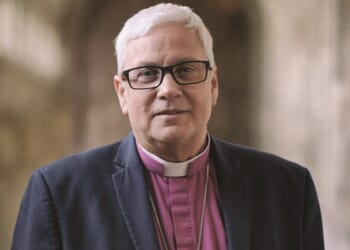
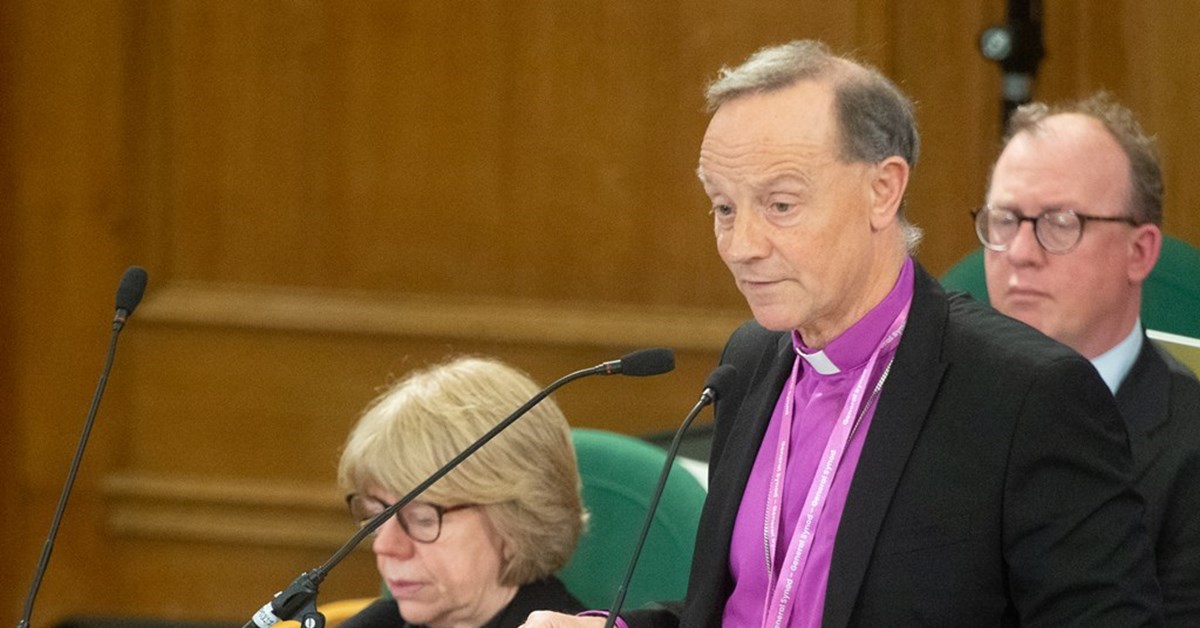
The Bishop of Exeter, Dr Mike Harrison, told the Synod that the House of Bishops’ Code of Practice had not been updated since 2018. The Scolding review of the Mike Pilavachi scandal had prompted a working group to consider amendments to the Code in light of weaknesses identified in the review. He said that the amendments proposed were to combat “unhealthy patterns of power” which could arise. Bishops would now have to ensure that leaders of a proposed BMO set up a plan to adhere to safeguarding procedures before the BMO was established.
Other changes would include making the set-up of BMOs akin to that PCCs, and the BMO’s Visitor would by default be an archdeacon, who who would also be the first port of call for all complaints about safeguarding, bullying, or whistle-blowing. The C of E was committed to a being “mixed-ecology” Church, and mission initiatives were helping to reach a variety of people, Dr Harrison said. The amendments, therefore, should be perceived not as trying to stifle BMOs, but as trying to strengthen them. “They are central to our ongoing work to make the Church a safe place for all.”
The Bishop of Southwark, the Rt Revd Christopher Chessun, welcomed the new Code, which would not threaten the “entrepreneurial” spirit of BMOs, but give them “appropriate accountability”, he said. His diocese had the second largest number of BMOs, and the Code would be helpful. He said that the initiatives were positive and complementary to parish ministry, and often created evangelistic opportunities. Southwark diocese sought to mirror as much as possible parish structures in BMOs, giving them the equivalent of PCCs and appointing archdeacons as their Visitors. He would be supporting the forthcoming amendments.
Adrian Greenwood (Southwark) moved his first amendment, to emphasise that “unhealthy patterns of power” could arise, not just in mission initiatives, but in any kind of church. There was nothing particularly “pernicious” about “entrepreneurial leadership”, he said.
Dr Harrison said that the intention was not to criticise entrepreneurs in particular: “Thank the Lord for planters and pioneers.” While he did not support the amendment, he was happy for it to be debated.
The Revd Mike Tufnell (Salisbury) said that a BMO in his deanery had taken the gospel to people in “creative, prophetic, one might say, entrepreneurial” ways. He spoke in favour of the “helpful” amendment, as he agreed that entrepreneurial leadership was not necessarily susceptible to an unhealthy exercise of power. Any of God’s gifts could be misused without proper accountability, he said.
The Revd Ayo Audu (Oxford) resisted the amendment; it would stop the Code from highlighting the risks involved in the “gift” of entrepreneurial leadership. A greater “risk appetite” than average was necessary for pioneers like this, he suggested.
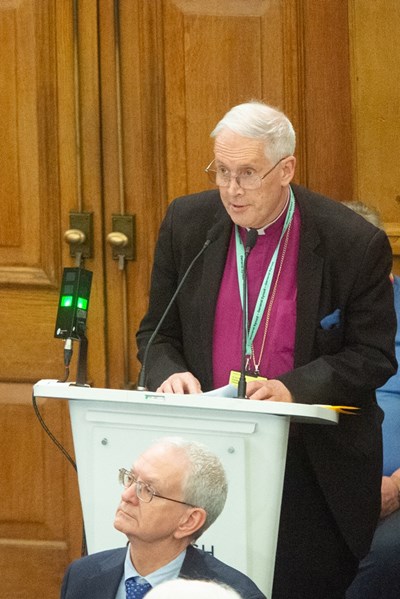 Geoff Crawford/Church TimesThe Bishop of Southwark, the Rt Revd Christopher Chessun
Prebendary Pat Hawkins (Lichfield) also urged the Synod to resist the amendment. As the Church felt its way into new patterns of worship, it would throw up new patterns of power, she said.
The Bishop of Tewkesbury, the Rt Revd Robert Springett (Southern Suffragans), who is the deputy lead bishop for safeguarding, thanked those with experience of abuse who were a significant part of the group implementing the Scolding review. Of course, unhealthy patterns of power could happen in any church, he said, but there were special vulnerabilities when starting new things. He resisted the amendment.
Clive Scowen (London) said that, while he was not an entrepreneurial leader, he cherished what they did. He feared that, without the amendment, the language in the Code would send a message that the Church was “a bit doubtful” about pioneers. Backing the amendment, he invited Dr Harrison to give further thought to how the clause could be rewritten.
The Revd Adrian Clarke (London) said that his experience as an “entrepreneurial leader” in the C of E had been very positive, and he praised, in particular, the archdeacon Visitor of his BMO. He was worried that BMOs were being picked on because of their history, even though abuse had been uncovered in every corner of the Church. He backed the amendment.
The amendment was carried.
Mr Greenwood then moved his next amendment, to specify that the chair of trustees of a BMO could not normally, without the approval of the bishop, be a licensed minister. Currently, the Code said that the chair must be a lay person, which, he warned, was too restrictive and could cause problems down the line (although he backed the original intention of preventing the BMO leader’s chairing the trustees).
Bishop Harrison supported the amendment.
The Revd Fraser Oates (Worcester) said that spiritual leadership and governance must be integrated with safeguarding, which was fundamental to mission. BMOs were designed for new creative initiatives, and the Church must invest in a broader piece of work to see how BMOs could grow in a safe, valued way, he argued.
The Archdeacon of West Cumberland, the Ven. Stewart Fyfe (Carlisle), declared an interest as both an archdeacon and a Visitor for a BMO. He said that whoever chaired the board of trustees should be the person who would best understand the misappropriation of the BMO. Some lay leaders might not be best placed to do this: “their gifts could be better deployed in other missional actions in support of the BMO.” The amendment provided for flexibility and discretion.
The Archbishop of Canterbury was initially unsure how to vote on the amendment. She contemplated where accountability might lie in the future leadership of BMOs, and how boards of trustees could be better chaired. She wanted to hear the views of the Synod.
Supporting the amendment, Dr Andrew Bell (Oxford) said that his son was the minister of a “fairly long-established BMO”. He highlighted inconsistencies in the paper, such as the eligibility to be a PCC member: “Either we can make these changes or we can mirror PCCs: we can’t have both,” he said. He questioned whether a clearly defined separation of government, governance, and leadership bodies would be beneficial.
The Archdeacon of Leeds, the Ven. Paul Ayers (Leeds), also supported the amendment, noting the differences between PCC structures and typical charity regulations (which had clear separation between the trustees and the staff of a charity, whereas clergy always chaired PCCs). It would be better to allow the minister potentially to be the chair of the trustees, he suggested, just as an incumbent chaired a PCC.
The Bishop in Europe, Dr Robert Innes, backed the amendment. He warned that, from his own experience of trying to model European chaplaincies on English ecclesiastical law, some of the biggest problems had come with boards of trustees which did not have the chaplain as their chair. At worst, this led to fights over money, property, and access to websites. “Please don’t think separating the minister from the trustee body is the answer to all our issues,” he concluded.
The amendment was carried.
Mr Greenwood moved his next amendment, to require BMOs “normally” to include references to the Charity Governance Code and commit trustees to operating policies as required by the Charity Commission. This would “soften” the language in the proposed Code.
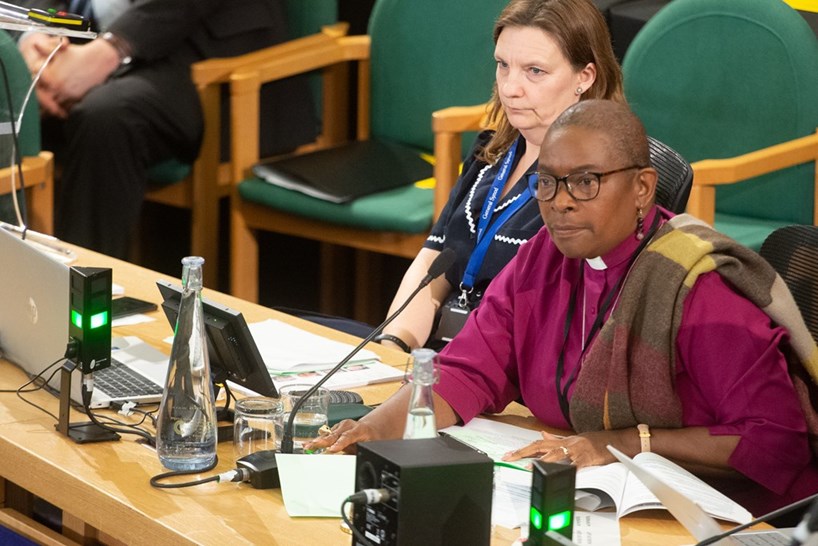 Geoff Crawford/Church TimesThe Bishop of Dover, the Rt Revd Rose Hudson-Wilkin (Canterbury)
Dr Harrison was, “on balance”, supportive of the amendment.
Dr Phillip Rice (London) supported it, but said that BMOs were growing quickly — there was a plan to start 10,000 of them — and that this would create a lot of work for bishops and visitors.
The Archdeacon of Southend, the Ven. Dr Sue Lucas (Chelmsford), supported the amendment for providing “needed flexibility” without accidentally “crushing” an initiative with excessive governance requirements. She also wished the Church to consider more deeply how “out of step” it was with good charity governance to have a cleric chairing the PCC.
The Archdeacon of Totnes, the Ven. Douglas Dettmer (Exeter), usually liked the word “normally”, as it provided flexibility, but he was uncomfortable about its presence in this amendment.
The amendment was carried.
The Archdeacon of London, the Ven. Luke Miller (London), spoke of the integration of BMOs into the full structures of the Church, and welcomed steps towards this in the Code of Practice. He also welcomed the clarity of the part played by Visitors (he is one for four BMOs). If there were tens of thousands of BMOs outside the parish system, however, this would cause huge ructions in the existing economy and structures of the C of E, he warned, even if that challenge was healthy.
Ed Shaw (Bristol), the leader of what he believed to be the second ever BMO in the country, said that he had learned to pay attention to the power that he had as the founding leader of his church. He welcomed the extra levels of accountability and support being put in place for BMOs. He said that being a BMO increased the amount of vulnerability. Also, his church had no funding or buildings from the diocese, and its place in the diocese was up for review every five years. There had been scandals involving BMOs, but not enough attention had been given to how many BMO leaders had been burned out by the experience, Mr Shaw said. He questioned whether archdeacons were the best people to act as Visitors, given that they were often very busy.
The Revd Janie Cronin (Manchester) was “blessed” to have a BMO and was grateful for the discussion about how to keep these safe. She was, however, frustrated about how they were generalised: “My church is a church; it’s just not in a church building,” she said. Rules that were being put in, she argued, needed different structures.
Simon Friend (Exeter) had been part of large and Charismatic churches for the past 40 years. Leaders of BMOs were usually people with large personalities and power; it was highly unlikely that a lay person would be the chair when the leader would want to chair the board of trustees. “We need to pay attention to power,” he said.
The document provided a “good basis”, the Dean of the Arches, the Rt Worshipful Morag Ellis KC, said, but she emphasised that BMOs took many different forms. Some were under a “mother church”; others were, in effect, independent of parishes. Because of these diversity of models, Ms Ellis argued that there should be a clear understanding of where the responsibilities for the diocesan safeguarding officers lay.
The Bishop of Rochester, Dr Jonathan Gibbs, referred to Archbishop Mullally’s question about the position of trustees. There were large expectations of trustees of charitable bodies in the Church of England in relation to what they and dioceses were expected to know about the activities of their charities. He expected these questions to return to future Synod meetings.
Describing herself as the woman in the Synod “who speaks about the elephant in the room”, the Bishop of Dover, the Rt Revd Rose Hudson-Wilkin (Canterbury), said that some BMOs did not wish to be identified as Anglican and Church of England, but to be separate from the Church. She was also concerned about the way in which BMOs were sometimes discussed: “This is my thing: it has nothing to do with you. Worse yet that you’re a woman: you stay over there!”
Archdeacon Ayers argued that there remained a problem over the relationship between trustees and the leadership of the BMO.
The amended motion to approve the Code of Practice was carried.
Read more reports from the General Synod Digest here