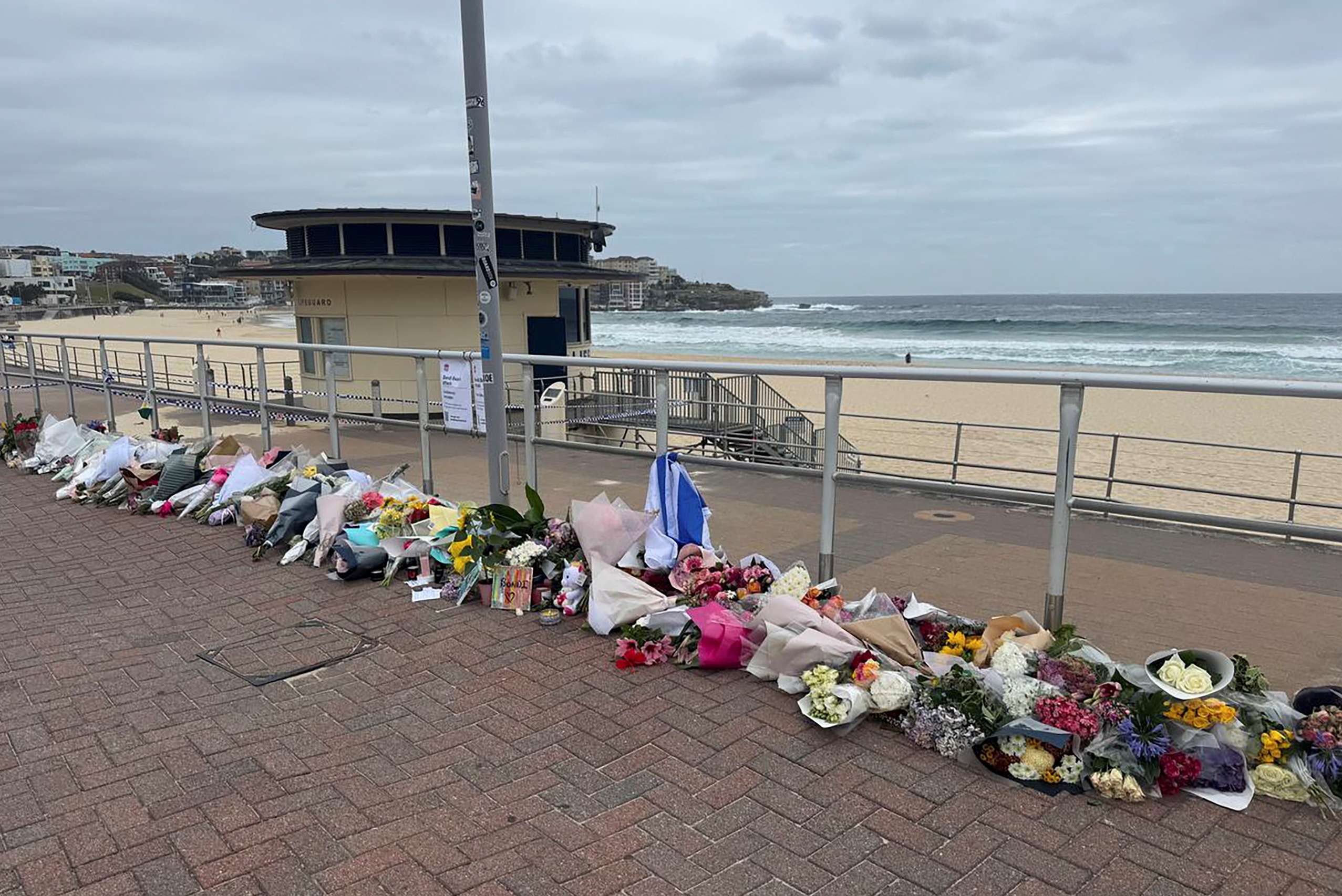
At Bondi Beach in Sydney, Australia, a father-son team of ISIS-inspired terrorists murdered attendees at a celebration of the first day of Hanukkah. One of the attackers was disarmed by a heroic civilian who was shot in the process, while others lost their lives trying to help.
You are reading The Rattler from J.D. Tuccille and Reason. Get more of J.D.’s commentary on government overreach and threats to everyday liberty.
Australia’s Prime Minister Anthony Albanese responded to the shooting with promises to further tighten gun laws in the already restrictive country—a measure more likely to disarm potential victims than to inconvenience those planning a homicidal attack. In the U.S., by contrast, Jews stepped up security by themselves and alongside police. At the request of my wife’s rabbi, I recruited a friend who served as a Force Recon Marine. We strapped on armor and pistols to patrol the crowd at the menorah lighting in Sedona, Arizona. Members of the congregation carried concealed weapons of their own.
Nothing happened, but we were there to deter problems and respond if necessary. There’s a big difference between doubling down on failed state policies and taking responsibility for your own safety.
According to Prime Minister Albanese’s office, after the attack, “leaders agreed that strong, decisive and focused action was needed on gun law reform as an immediate action” and promised “to strengthen gun laws” with further restrictions. Of course, that’s what Australia did in 1996 after the Port Arthur mass shooting. The government banned a variety of firearms, with compensation for their surrender. Compliance was limited and the effort spawned a significant black market for guns.
But Australia’s millions of guns didn’t kill 15 people at Bondi Beach. Two men with known Islamist ties who traveled last month to the Philippines for training at terrorist summer camp committed the murders. They chose guns as their tools, but they could just as easily have used explosives, vehicles, incendiaries, or something else to cause mayhem.
“The issue is not gun laws. It’s hatred of Jews,” Rabbi Daniel Greyber of Durham, North Carolina commented after the Bondi Beach attack.
And there’s little reason Australian Jews should trust the Australian government.
At a December 14 press conference responding to the Bondi Beach terrorist attack, Prime Minister Albanese denounced the perpetrators and assured Jews “you have every right to be proud of who you are and what you believe.” But then a journalist pointed out inconvenient facts:
“In September, your government recognized a Palestinian State. Your ministers have attacked the Israeli Government. Senior ministers refused to visit the sites of the October 7 massacres. And you created a Special Islamophobia Envoy alongside an Antisemitism Envoy. Have you taken the threat of antisemitism seriously? And can you guarantee the safety of Jewish Australians?”
Albanese’s reply wasn’t impressive and didn’t matter anyway. Rabbi Eli Schlanger, among those murdered at Bondi Beach, wrote to Albanese in September as his government rewarded Hamas’ attack on Israel by recognizing a Palestinian state: “As a Rabbi in Sydney, I implore you not to betray the Jewish people.” Schlanger wasn’t alone in his concerns—other members of the community share them.
Whether or not the Australian government’s policy choices promote the country’s interests in the long run, it’s clear the country’s Jews can’t look to the state for protection. It’s not especially sympathetic to their situation to begin with. Nor does the Australian government much care for people defending themselves. As JB Solicitors, a Sydney law firm, advises: “In Australia, the law generally forbids an individual to carry or use weapons for self-defence.” Had Ahmed al Ahmed, the brave man who was wounded while disarming one of the Bondi Beach attackers, used a knife or a pipe to take down the terrorist, he might have faced charges himself.
And yet, Albanese’s government plans to further tighten laws that might be obeyed by the peaceful citizens of Australia but will have little effect on people who plan mass murder.
Even citizens of the United States, where self-defense rights are better recognized than in most other countries, can fall afoul of demands that we rely on the authorities to protect us. As I write, police in Rhode Island are still looking for a shooter who killed two students and injured nine others.
Brown University policy infamously dictates that “the possession, use, or storage of Weapons or Firearms is strictly prohibited on all University Property and at University-sponsored events.” Instead of carrying the means of self-defense, students, faculty, staff, and visitors are expected to defer to the university’s extensive surveillance camera system and the help it will supposedly summon in case of emergency.
Not only did help not arrive on time on Saturday, but the cameras apparently didn’t capture a clear picture of the attacker. Brown University officials may (or may not) be better-intentioned than those of the Australian government, but their promises of protection are just as empty.
Such promises are inevitably empty. The only people well positioned to respond to a homicidal attack are those there when it happens. If they have the tools and training to do something, they can deter some people with bad intentions and react appropriately to the crimes of others.
In 2019, Jack Wilson shot a gunman who opened fire in the West Freeway Church of Christ in Texas. At the time he commented, “I don’t feel like I killed a human. I killed an evil” when he stopped the attack.
Ideally, nobody would ever have to rise to such an occasion. But we should all consider Ahmed al Ahmed and Jack Wilson as inspirations if it’s necessary. Like Boris and Sofia Gurman, who were killed at Bondi Beach, they engaged attackers when the situation called for intervention.
Wilson’s big advantage is that he was armed and prepared for such a situation.
Jews in Australia and elsewhere should draw on that lesson; they are the only people they can count on to have their own backs. But so should everybody, even if they trust their local authorities. They will be the people on the scene if something happens—not police or politicians with dedicated security details.
And so, my friend and I will soon be at another menorah lighting, along with armed members of the congregation. I’m confident nothing will happen. But we’ll be ready if it does.