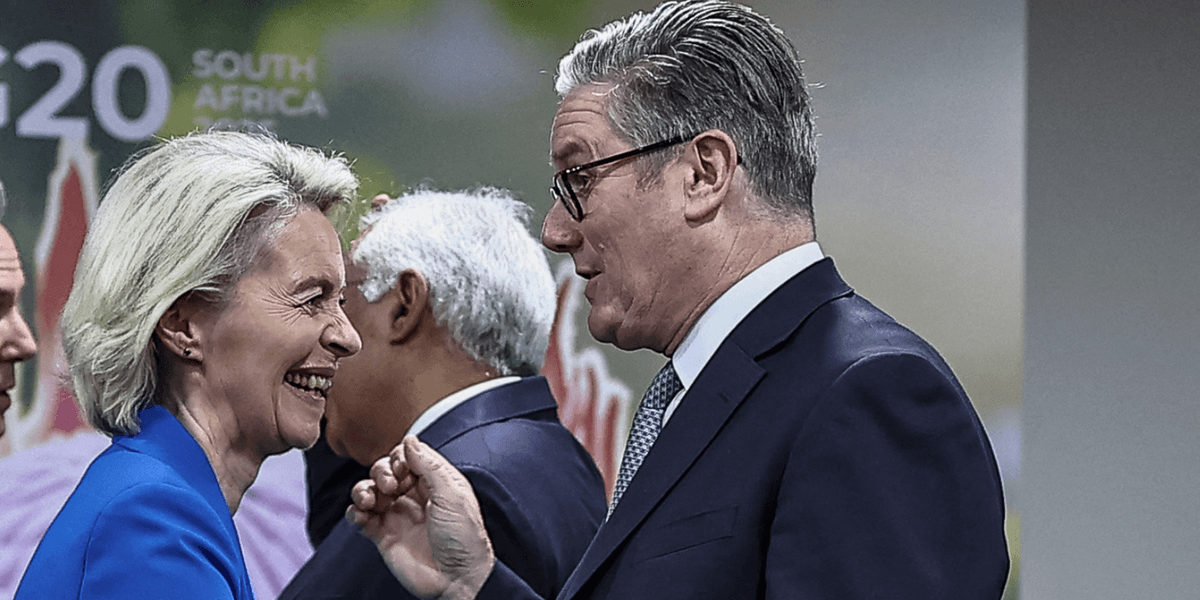
Sir Keir Starmer is thought to have signalled willingness to ramp up the number of young people allowed into the UK from the EU.
British negotiators involved in talks on the EU youth mobility visa numbers are understood to be ready to accept a built-in review system on the numbers involved in the scheme.
The “balancing mechanism” would permit periodic reassessment of any cap on participants.
It would enable both sides to agree on expanding or reducing numbers based on actual demand and uptake from young people seeking to live and work abroad.
A Government representative told The Times: “We’ve been clear that any scheme will be capped, and should be based on existing schemes.”
The compromise approach aims to bridge the gap between European demands for unlimited access and Downing Street’s firm insistence on restrictions on numbers
The proposed framework draws inspiration from arrangements already secured in other EU negotiations, particularly the Erasmus student exchange programme which the UK rejoined last month.
That deal included a ten-month break clause permitting both parties to evaluate whether Britain’s £570million contribution represented fair value, given concerns that European students might participate in greater numbers.

Sir Keir Starmer is understood to be ready to accept frequent reviews on the numbers allowed into the UK under the EU youth mobility scheme
|
GETTY
Officials believe a comparable model could resolve the youth mobility impasse, with regular reviews allowing either side to argue for adjustments based on proportionality.
British negotiators have consistently noted the demand from EU citizens would substantially exceed interest from countries with existing agreements, such as Australia, where the annual cap stands at 40,000 visas.
Disputes also persist over visa duration, with ministers favouring two-year limits while Brussels seeks terms of up to four years.
Speaking to reporters during his visit to China, Prime Minister Sir Keir Starmer maintained that numerical limits remain non-negotiable for the Government.

Speaking in China, Sir Keir Starmer said ‘there has got to be a cap and there has got to be a duration agreed’
|
GB NEWS
“We are negotiating a scheme and I’m pleased about that because we want young people to have the opportunity to travel, to work and be in EU countries if they are British citizens and the other way round,” he said.
“The principles are that there has got to be a cap and there has got to be a duration agreed. It will be a visa-led scheme.
“All of our schemes are similar to that. We are negotiating.”
Britain currently operates youth mobility arrangements with roughly a dozen nations, including Australia, New Zealand and Canada, all featuring annual caps.

Britain’s Brexit ‘reset’ – How Labour has brought the UK back into the EU’s orbit
|
GB NEWS
The Home Office is additionally seeking access to EU policing and security databases as part of any final agreement.
Nick Thomas-Symonds, the cabinet minister overseeing negotiations, has positioned the youth mobility scheme as central to the broader reset with Brussels.
He has previously stated: “On youth mobility, we believe that giving the opportunity for young people to learn and get experience is vital, giving young people across the UK and EU a chance to study, work, live abroad build friendships, understanding and creating opportunities.”
Maros Sefcovic, his European counterpart, is expected in London next week alongside the EU’s economy commissioner for discussions with senior Government figures.
The delegation will hold talks with Rachel Reeves among other ministers, focusing on the wider UK-EU relationship and prospects for deeper cooperation between the two sides.
Beyond the youth mobility discussions, Sir Keir used his China trip to outline his broader vision for EU relations, firmly rejecting any return to customs union membership.

Nick Thomas-Symonds has positioned the youth mobility scheme as central to the broader reset with Brussels
|
PA
“It’s not that it might hamper trade deals, it’s that we’ve already done trade deals, which would then have to be unpicked,” he explained, pointing to agreements with the US and India as reasons to maintain the current arrangement.
However, the Prime Minister expressed appetite for deeper single market alignment, suggesting future summits should build progressively on existing commitments.
Sir Keir said: “I think we should not just follow through on what we’ve already agreed. I think the relationship with the EU and every summit should be iterative. We should be seeking to go further.”
He declined to exclude potential new arrangements covering the chemical and automotive sectors.