I WOULD not have recalled the name of Edwin Austin Abbey RA (1852-1911) had not a friend taken me to the Broadway Museum and Art Gallery in the Cotswolds last year. On a typical English June day of grey cloud, chill winds, and then persistent rain, a carefully curated exhibition of John Singer Sargent (1856-1925) and the “Broadway Colony” offered shelter.
The damp cobbled street echoed with Americans voicing their disappointment with the day. Little change: the group around Sargent was largely of American expats, artists and authors, who summered regularly there from 1883 to 1889.
Among them was “Ned” Abbey, an illustrator for Harper’s Weekly, who had been so struck by English painting at the 1876 Centennial exhibition of French and English art in Philadelphia that he moved to England two years later. Apart from one year, he lived and worked here until he died of cancer in 1911.
I should have remembered his name, as his first major commission, obtained for him by his ambitious wife, was for Boston City Public Library (1890), where I worked forty years ago. I overlooked his 15 sub-Burne-Jones scenes of the Holy Grail surrounding the central hall, my eyes drawn instead to Sargent’s figures.
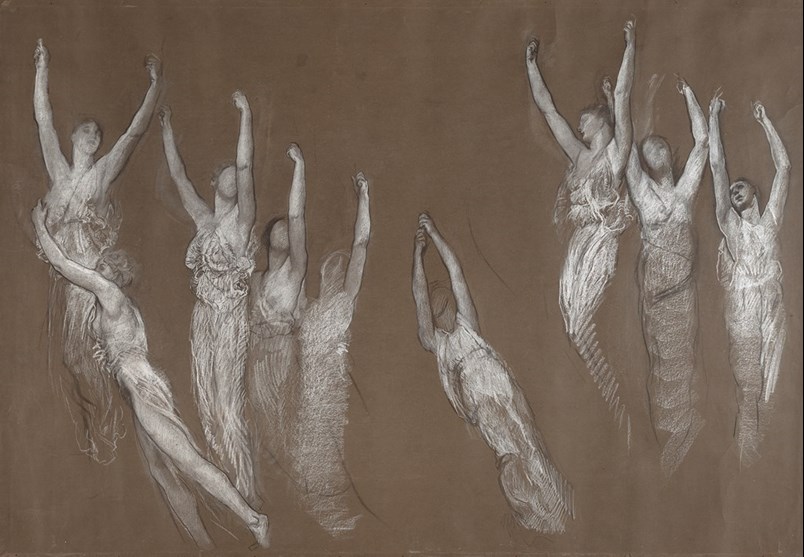 Yale University Art Gallery, Edwin Austin Abbey Memorial Collection. Image courtesy the Yale University Art GalleryEdwin Austin Abbey, Compositional study for “The Spirit of Light,” lunette in the rotunda of the Pennsylvania State Capitol at Harrisburg, (c.1902-08),
chalks and graphite on dark brown wove paper
Readers of Vanity Fair would have had no such difficulty of recognition. On 28 December 1898, “Spy” lampooned “Fairford Abbey”. It depicts a portly, self-satisfied gent in tweeds and plus-twos who, in place of a broken gun, holds a palette and brushes, capturing the new American squirearchy perfectly. Abbey’s dollars had bought into the Cotswolds at Fairford. There, the newly elected Royal Academician leased the 17th-century, now Grade II listed, Morgan Hall and built his large studio.
Abbey’s relationship with Sargent, with whom he once shared a Chelsea studio, was complex. When Sargent rejected a royal commission to portray the 1902 coronation, Thomas Agnew paid Abbey to paint the monumental scene of plutocrats and aristocrats crowding round the sick monarch in Westminster Abbey (Royal Collection, RCIN 404612). With more than 100 figures, it is as dull as reading the Almanach de Gotha.
But this was the beau monde of American money buying into the British Court. The likes of the Bostonian Edith, Lady Playfair, of Consuelo Vanderbilt, who was married in 1895 against her will to the 9th Duke of Marlborough, and of one of the king’s mistresses, Consuelo Yznaga del Valle, the Duchess of Manchester, were each incisively observed by Sargent, appearing in last year’s English Heritage centenary exhibition “Heiress”, at Kenwood House (May-October).
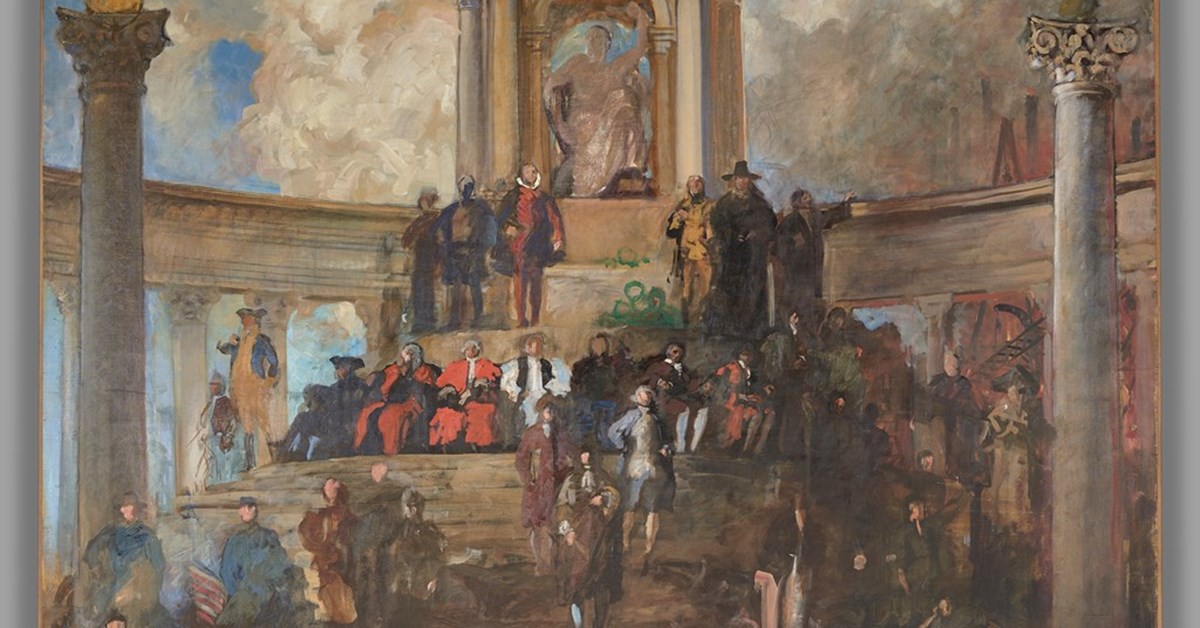
Seven sketches here concentrate on Abbey’s 1902 commission from his home state for the newly rebuilt Beaux Arts Capitol building in Harrisburg (Joseph Miller Huston), which uniquely in the United States incorporates all three branches of government, housing a Supreme Court alongside the Senate and House Chamber.
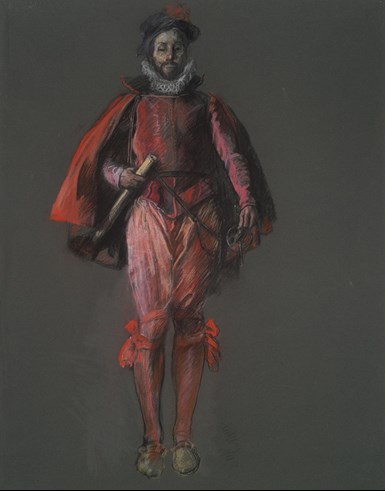 Yale University Art Gallery, Edwin Austin Abbey Memorial Collection. Image courtesy the Yale University Art GalleryEdwin Austin Abbey, Study for the figure of Sir Walter Raleigh in “The Apotheosis of Pennsylvania” mural in the House of Representatives Chamber of the Pennsylvania State Capitol at Harrisburg (c.1907), pencil, black chalk, and pastel on dark grey-green paperFor the walls of the chamber, where 203 members meet, Abbey painted the past heroes of the state in The Apotheosis of Pennsylvania with figures such as Daniel Boone, Walter Raleigh, Benjamin Franklin, and the statuesque William Penn. The architect designed a cupola to shed natural light on the proceedings, but when a false floor was added and the skylight was closed off, Abbey was asked to paint the ceiling rotunda as well.
Just 24 feet in diameter (the newly restored sketch shown here is half-size), the Dance of the Hours depicts 24 semi-classical robed figures, including Religion, Justice, Science, and Art. Behind them are the Milky Way, the inaccurately observed constellations, a litter of stars, and the sun and a full moon.
In the 20th century, Time, and not God, oversees the business of government. The morning figure of dawn’s early light, at six o’clock, is not just yawning as she wakens, but is holding up her cloak to prevent a horned figure — the devil of Corruption — from entering the Chamber. Natural light would have made that much more apparent.
“Edwin Austin Abbey: By the Dawn’s Early Light” is at the National Gallery, Trafalgar Square, London WC2, until 15 February. Phone 020 7747 2885. www.nationalgallery.org.uk