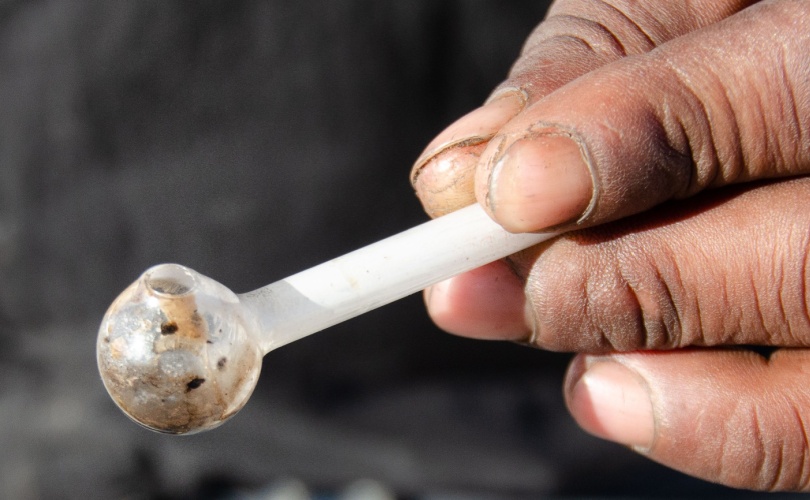
OTTAWA (LifeSiteNews) — Canada’s own Department of Health has confirmed that taxpayer dollars were used to fund the purchase of drug paraphernalia such as crack pipes and other items permitted under the Liberal government’s “Safe Supply” program.
When pressed by Conservative MPs, federal managers at the department had flatly denied that free drug paraphernalia was being funded by taxpayer money.
However, Assistant Deputy Health Minister Kendal Weber recently testified at a House of Commons health committee meeting that he wanted to “clarify” that local community groups had indeed used federal dollars to buy crack pipes as “harm reduction supplies.”
Conservative MP Dan Mazier asked Weber directly if “any of the funding from Health Canada [is] being used to purchase crack pipes?”
In reply, Weber said, “Yes, we do provide funding to community organizations for harm reduction tools, including pipes, yes.”
Mazier also got confirmation from Weber that taxpayer money was also used to fund “smoking kits” which are used for a variety of hard drugs, including the deadly fentanyl, and not tobacco.
The Liberal federal government’s push for free drug paraphernalia under its “Safe Supply” drug program has also been used to fund crack pipe vending machines, which dispense them for free.
Mazier, who witnessed such a machine in the British Columbia city of Kelowna, said it was “quite remarkable.”
“I could just walk up, hit a number, just like a regular vending machine,” he said.
One Liberal MP, who is also an emergency room physician, claimed that the free crack pipes help “decrease the incidence of infections due to intravenous use.”
The Canadian government has no fewer than 31 “Safe Supply” drug injection sites all over the nation, mostly in big cities.
A recent Inquiry Of Ministry has shown that Canada’s health department has received multiple complaints that public drug injection sites located in downtown areas cause social disorder, negatively affecting businesses.
Conservative Party leader Pierre Poilievre has called such sites “drug dens” and has blasted them as being “disasters” and not “safe.”
Official figures show that overdoses went up during the decriminalization trial, with 3,313 deaths over 15 months, compared with 2,843 in the same time frame before drugs were temporarily legalized.
As recently reported by LifeSiteNews, so-called “safe” drug injection sites do not require a minimum distance from schools, daycares, or even playgrounds, Health Canada has stated.
Records show that the Liberal government, under former Prime Minister Justin Trudeau, had spent approximately $820 million from 2017 to 2022 on its Canadian Drugs and Substances Strategy. However, even Canada’s own Department of Health admitted in a 2023 report that the Liberals’ drug program only had “minimal” results.
Recently, LifeSiteNews reported that the British Columbia government decided to stop a so-called “safe supply” free drug program in light of a report revealing that many of the hard drugs distributed via pharmacies were resold on the black market.
British Columbia Premier David Eby recently admitted that it was a mistake to allow the decriminalization of hard drugs in British Columbia via a federal pilot program.
Former Prime Minister Justin Trudeau’s loose drug initiatives were deemed such a disaster in British Columbia that Eby’s government asked Trudeau to re-criminalize narcotic use in public spaces, a request that was granted.