(LifeSiteNews) — Cardinal Willem Jacobus Eijk explained his reasons for celebrating a Pontifical Mass in the Tridentine Rite and described its reception among the faithful.
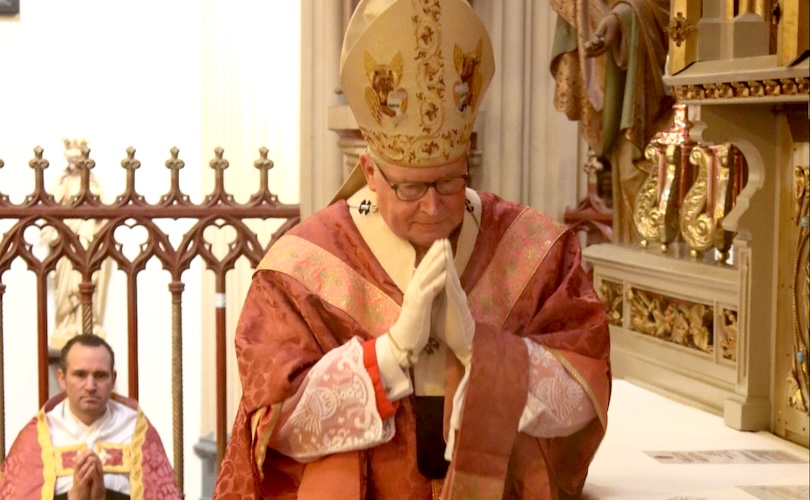
On March 25, the Italian blog Messainlatino published an exclusive interview conducted by Father Marco Begato with Cardinal Eijk, archbishop of Utrecht and primate of the Netherlands, who celebrated his first Pontifical High Mass in the extraordinary form of the Roman Rite at the Grote Kerk in Oss, the Netherlands.
“The Eucharistic celebration at the Grote Kerk in Oss was my first Pontifical Holy Mass in the extraordinary form: I found it a very impressive and unforgettable experience,” the cardinal said.
In the interview, Eijk stated that the presence of the Priestly Fraternity of Saint Peter (FSSP) in the Archdiocese of Utrecht played a decisive role in his involvement. The cardinal explained that his decision was motivated by pastoral support for a newly established FSSP community, which had “purchased a church that had been relinquished by one of the archdiocese’s parishes due to a lack of active parishioners and financial resources.”
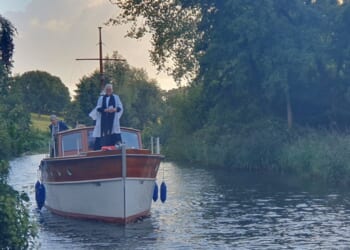
PHOTOS: Dutch Cardinal Eijk celebrates first public Traditional Latin Mass
“I am very pleased that this church will therefore remain a Roman Catholic church,” the cardinal said.
Eijk also clarified that his familiarity with the Tridentine Rite is recent. Earlier invitations from the FSSP, including a request to confer a diaconate ordination at their seminary in Wigratzbad, had been declined because he had not yet learned the rite. “That is why, at the beginning of this year, during a short stay at a monastery of the Institute of Christ the King and High Priest in Germany, I learnt how the Holy Mass is celebrated according to the Tridentine Rite,” he added.
Regarding the celebration in Oss, Eijk described the liturgy as carefully organized, with the assistance of clergy and ministers experienced in the rite. He noted the presence of a master of ceremonies, acolytes, and altar servers familiar with the ceremonial requirements, which contributed to what he characterized as a “truly beautiful ceremony” and “a very impressive and unforgettable experience.”
The cardinal also provided specific observations about attendance and participation: “There was considerable spiritual interest in this celebration, as evidenced by the large number of attendees, including Germans and Belgians, [and] Catholics who usually take part in Eucharistic celebrations according to the Novus Ordo.”
Furthermore, “[m]ost were young, and there were also many families. There was widespread recourse to the sacrament of penance and reconciliation. The Tridentine Rite is very solemn and offers many moments of silence, thereby providing ample opportunity for personal prayer.”
READ: Pope Leo signals openness to Latin Mass celebration in message to French bishops
Eijk also addressed a commonly cited perception regarding the orientation of the priest, explaining that the celebrant is “not as is often claimed, with his back to the people, but facing the altar and thus Christ.”
When asked about reactions from non-believers, the cardinal reported no observable interest from atheist segments of society in this specific event. However, he provided a broader observation based on the past five years: “we have seen an increasing number of young people joining the Church each year, or young Catholics who were baptised as children but not raised in a religious household, and who later – usually via social media – come to know the Catholic faith and then embrace it.”
The cardinal made a point of specifying that “[i]t is striking that a not inconsiderable number of them find their way to Christ and His Church through the Tridentine liturgy.”
Over the years, Eijk has adopted an increasingly firm and explicit commitment to orthodoxy. Long known for his doctrinal clarity and his strong pro‑life stance — supported by his background in medicine and bioethics — he has also promoted Eucharistic devotion as the center of Christian life, a focus that gradually led him toward a renewed appreciation of the Traditional Rite.
The author of an important manual of Catholic medical ethics and a consistent opponent of euthanasia, abortion, artificial reproduction, and gender theory, he has repeatedly criticized the doctrinal ambiguity of certain synodal processes and some decisions of Pope Francis, even warning of the risk of an “apostasy from the truth.”
He also stands apart from most European bishops for several countercultural positions, such as his view that migrants must respect the values of the host country and that states are not morally obliged to accept all categories of immigrants.