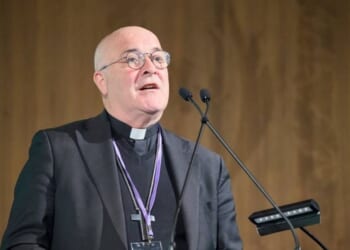
(LifeSiteNews) – The Archbishops of Chicago, Newark, and Washington D.C. issued a joint statement expressing concern over U.S. foreign policy under President Donald Trump, albeit without delving into specifics and instead calling for applying general Church principles to a “Moral Vision of American Foreign Policy.”
The statement, published Monday and signed by Cardinals Blase Cupich of Chicago, Robert McElroy of Washington and Joseph Tobin of Newark, begins by declaring that the new year has found America in the “most profound and searing debate about the moral foundation for America’s actions in the world since the end of the Cold War,” with events in Venezuela, Ukraine, and Greenland having “raised basic questions about the use of military force and the meaning of peace.”
“The sovereign rights of nations to self-determination appear all too fragile in a world of ever greater conflagrations,” they said. “The balancing of national interest with the common good is being framed within starkly polarized terms. Our country’s moral role in confronting evil around the world, sustaining the right to life and human dignity, and supporting religious liberty are all under examination. And the building of just and sustainable peace, so crucial to humanity’s well-being now and in the future, is being reduced to partisan categories that encourage polarization and destructive policies.”
The archbishops did not mention Trump by name or identify any specific actions to which they objected but instead urged U.S. foreign policy to be generally guided by an “enduring ethical compass” articulated by Pope Leo XIV. He lamented the rise of a “diplomacy based on force, by either individuals or groups of allies,” and the erosion of norms against nations “using force to violate the borders of others.” The pope stressed the “protection of the right to life” as the “indispensable foundation for every other human right.”
The signatories said they hoped to “build a truly just and lasting peace, that peace which Jesus proclaimed in the Gospel. We renounce war as an instrument for narrow national interests and proclaim that military action must be seen only as a last resort in extreme situations, not a normal instrument of national policy. We seek a foreign policy that respects and advances the right to human life, religious liberty, and the enhancement of human dignity throughout the world, especially through economic assistance.”
The Trump administration’s actions regarding the three areas identified in the letter have been subjects of intense debate transcending conventional partisan lines. On January 3, the U.S. orchestrated a military excursion into Venezuela to arrest socialist dictator Nicolás Maduro, ostensibly for his country’s role in exporting narcotics into America.
The action was cheered by many, both for the humanitarian hopes of returning freedom to the country, and the long-term strategic advantage of potentially denying Venezuelan oil to other hostile regimes. On the other hand, critics have raised concerns about the legal basis for the strike, and questions remain over whether there is a long-term plan for regime change. Trump has downplayed opposition leader Maria Corina Machado as a potential replacement while touting interim President Delcy Rodríguez, Maduro’s former vice president, as a “terrific person.”
During the 2024 election campaign, Trump famously vowed to end Russia’s war on Ukraine in the first 24 hours of his new term, yet little progress has been made in the following year. The status of U.S. military aid to Ukraine has at times been ambiguous, as Trump has alternated between periods of sympathy and hostility toward both countries’ respective leaders. Speaking this week at the World Economic Forum in Davos, Trump reiterated his recurring framing of the conflict as a dispute between two morally equivalent sides, declaring, “I believe that they can come together and get a deal. If they don’t, they are stupid — that goes for both of them.”
Greenland, a large territory of Denmark northeast of Canada and the United States, is the most recent and arguably most explosive point of concern given Trump’s recent intensification of his demands to acquire the landmass. Trump has claimed the U.S. needs the landmass as a strategic bulwark against China and Russia but let slip in a recent interview he also considers ownership “psychologically important to me.” Critics argue the U.S. already has a more than adequate military presence on the land, with the latitude to expand if deemed necessary, under existing agreements.
Irrespective of the strategic argument, fears boiled over in recent weeks when multiple administration officials refused to rule out the possibility of seizing Greenland by military force, which would have been a seismic departure in the longstanding use of the armed forces and America’s relationship with her allies. Trump finally closed the door on that option in his Davos speech, declaring, “I don’t have to use force. I don’t want to use force. I won’t use force.” He subsequently announced the “framework of a future deal with respect to Greenland and, in fact, the entire Arctic Region” with NATO Secretary-General Mark Rutte.
While such controversies have inspired genuine objections and debate among the faithful, some critics have perceived a distinct left-wing bias when leading U.S. bishops choose to weigh in on politics, beyond straightforward doctrinal questions such as abortion and biological sex. In November, for example, the U.S. Conference of Catholic Bishops cast illegal immigrants as wrongly targeted victims of the Trump administration’s immigration enforcement policies. Even on clear moral issues, the USCCB has been caught donating money to pro-abortion, pro-LGBT organizations.