THE flagship measure of last week’s Budget was, perhaps, the removal of the two-child limit on Universal Credit, which will lift hundreds of thousands of children out of poverty, and for which the Church of England and charities have long campaigned (News, 28 November).
Yet it is not a particularly popular move with the general public. YouGov polling from July showed fewer than 30 per cent supported abolishing the two-child limit, despite the lack of evidence that the policy reduced family size or increased employment —its stated aims — and despite the clear hardship that it caused. More broadly, a record proportion of adults believe that reducing benefit generosity helps people to “stand on their own two feet”, the poll suggests.
The Leader of the Opposition, Kemi Badenoch, recently argued, in a speech to the Conservative Christian Fellowship, that “the Christian thing to do” would be to keep the two-child limit and curb welfare spending. She rooted her argument in themes of duty, responsibility, and stewardship, referring to 1 Timothy 5.8.
Against this backdrop, the Government’s decision to remove the limit was politically courageous. But it also shows the need to articulate more clearly the moral and theological case for reducing child poverty.
THIS is not to say that I wholly disagree with Ms Badenoch, or that there is a single “Christian” stance on the welfare system. Yes, duty and stewardship are essential, but so are protection of the vulnerable and recognition of people’s interdependence.
In this highly individualistic age, I think it is useful to put the emphasis on the latter — and, indeed, I think that much of the Bible does, as well. If Ms Badenoch turned a few pages back from 1 Timothy, she would encounter Acts 4, in which we read that the Early Church pooled its resources so that everyone’s needs were met.
Throughout the Old Testament, too, there is the call to take collective care of “the widow, the foreigner, and the fatherless”. Children remain one of the most vulnerable groups in society: they cannot earn, defend their rights, or influence public policy. A just society, therefore, must care for all children, not only its own. Using children as leverage to influence parental behaviour, or allowing them to bear the consequences of their parents’ misfortunes, is profoundly unjust.
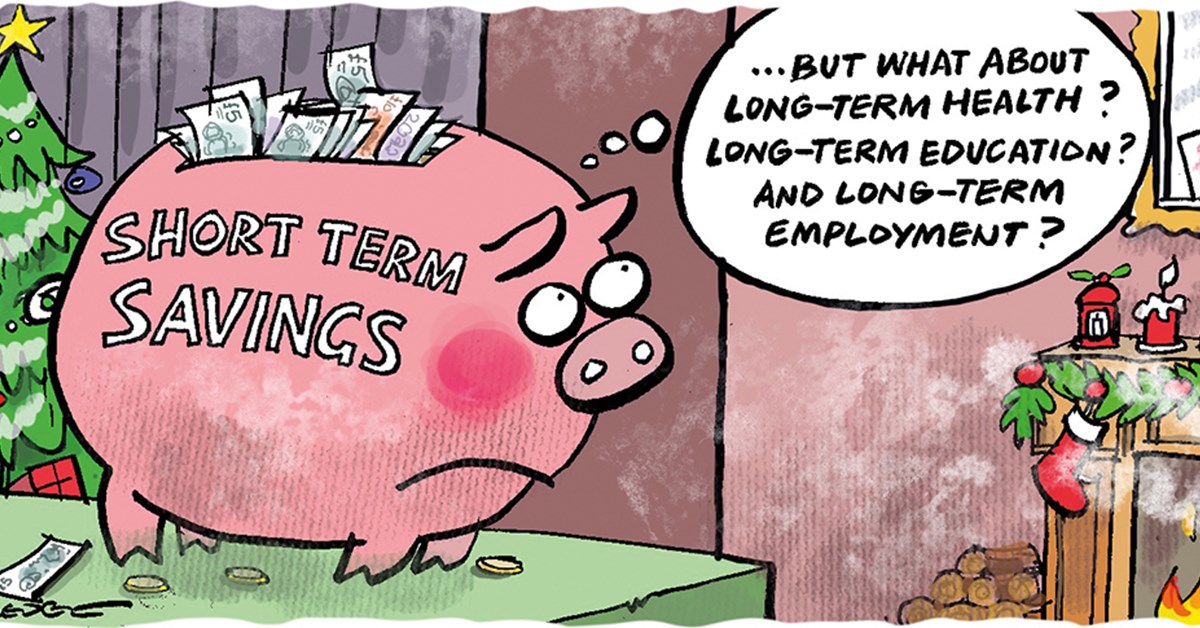
The short-term savings created by policies such as the two-child limit can be outweighed by long-term costs: poverty in childhood affects lifelong health, educational outcomes, and employment prospects. This means greater pressure on the NHS, reduced productivity, and lower tax revenues.
But a compelling vision for society goes beyond the economic: we do not belong to each other merely as stakeholders in UK plc. Here, the Church can offer a distinctive contribution. St Paul describes the Church as a body, unable to say that one part has “no need” of another. The “weaker” members are indispensable, and, when one member suffers, all suffer.
THIS image offers a helpful way of imagining society more broadly. When one section of society is harmed, there is a negative effect on the whole. For instance, evidence consistently shows that when groups are marginalised or excluded, society as a whole suffers. Countries with lower inequality enjoy higher trust, stronger civic participation, and lower crime; high inequality undermines long-term economic growth.
And, on the flip side, just as a healthy Church is one in which every member’s gifts are recognised and harnessed, so a flourishing society is one in which everyone participates and can fulfil their potential. This is exactly what the social-security system should aim for, whether that potential is realised in paid work, caregiving, or volunteering.
As discussions about welfare often devolve into debates about merit — who “deserves” help — it is important to remember the gifts received from previous generations, such as the education system, the NHS, workplace protections, and democratic rights. Gratitude for these inheritances should inspire people to pass them on to future generations. Here, again, the Church has a part to play in shaping society’s moral imagination, since at the heart of Christian faith is grace.
The Church of England has more to do in relation to tackling poverty. Several reports have noted its middle-class bias and tendency to think of poverty as something “out there” rather than recognise how it affects members of the Church’s communities. The Church can unintentionally create barriers to the full participation of people from low-income backgrounds, which Trussell’s Walk Humbly resources can help to address.
If the UK is to tackle child poverty decisively, it needs a renewed societal vision rooted in generosity, interdependence, and gratitude — but that vision must also be expressed clearly and courageously in public life. The moral case for reducing child poverty needs to be made far more explicitly and boldly, even when it is unpopular: that a fairer society strengthens trust, prosperity, and security for everyone; and that policies that protect the most vulnerable ultimately serve the common good.
The Rt Revd Martyn Snow is the Bishop of Leicester and the C of E’s lead bishop for child-poverty issues.