IT IS said that we are heading towards a cliff edge. But that image no longer captures the gravity of our predicament: we are already off the edge. Only a furious pumping of our legs over the abyss, in the manner of Wile E. Coyote, keeps us from recognising this.
Collapse may come through climate, artificial intelligence, geopolitics, or the cascading tangle of all three. At root, this civilisational unravelling is a spiritual crisis: of what we live for, what we hold sacred, what we dare (or do not dare) to face.
Any spirituality fit for this late hour must be engaged with the lived world and not retreat into abstraction. As AI rises around us, it is more vital than ever to honour our embodied, creaturely being. Recall Christian Aid’s succinctly splendid old line: “We believe in life before death.”
The great question is how each of us will make meaning in this tragic time. Everyone must face the abyss and seek where their gifts meet the world’s crying need. For religion, and Christianity especially, this question is doubled. As a long-time critical friend of Christianity, I note that making meaning out of difficulty is the Church’s vocation; and so its voice — pastoral, prophetic — becomes indispensable.
This is not about changing light bulbs. The real light-bulb moment is realising that such sensible signals of willing are barely the beginning. Solar panels persuade few. Light bulbs cannot preach. You can.
The Church’s historic part in this epochal moment is to reclaim spiritual leadership, to speak clearly of the ecological and civilisational forms of darkness which society is entering, and to evoke an eco-spirituality that refuses false comfort.
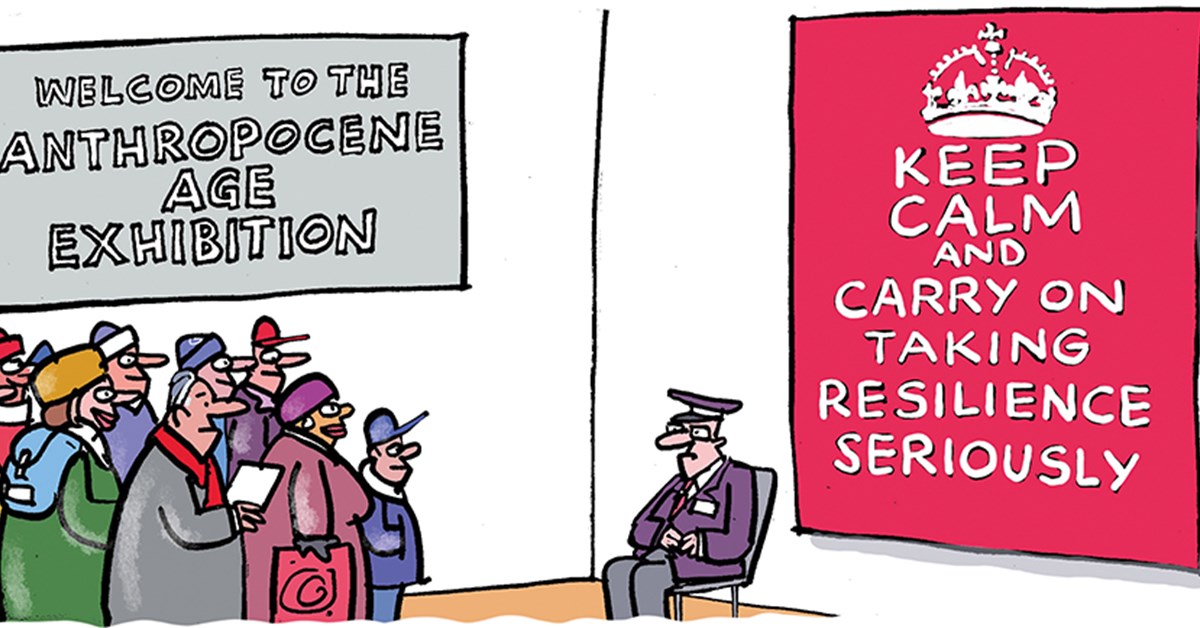
THIS leads into the second great calling of the Church in the “anthropocene” era: becoming a locus of community resilience. When churches shift from just centring carbon reduction to centring preparedness for emergencies, they show that they understand that the age of consequences is here. Adaptation is no longer optional. Taking resilience seriously is a lived wake-up call that validates everything spoken from the pulpit.
And resilience is not abstract. People already feel the climate-driven rise in food and energy prices, the growing risks of fire and flood, the strain of a polycrisis. Churches can meet this reality with vision and help that is visible (and thus appreciated).
Reducing a church’s carbon footprint is a beautiful drop in the ocean. The good that is done will be seen in the eyes of God, but it will not be visible to parishioners; whereas becoming a community-resilience centre, a lifehouse, is a cup of water offered in a parched land: it is tangible.
This process is already under way, in small but luminous exemplars. During the flooding disasters of 2019, St Cuthbert’s, Fishlake, in Sheffield diocese, provided a base for first responders, access to food and clothes, and emotional and spiritual support (News, 15 November 2019). The church acted as a rescue centre for five months, and it remains a pivotal part of future flood resilience.
During the record heatwave in July 2022, Pudsey Parish Church answered a call to action from Leeds Public Health. They advertised the building as, quite literally, “the coolest place in town” — something that they expect to do more regularly as the climate crisis deepens (News, 22 July 2022).
This is what it looks like to centre vulnerability honestly, and to respond with practical love. It is how preaching and practice can fuse, making churches the brave hearts of their communities again.
When a church is a lifehouse, talking intelligibly about the need for the community to come together in a spirit of love, neighbourliness, and preparedness, and manifesting a live sense of the terrible trouble that our species has got itself (and everyone else) into, they are doing God’s work; for this earth is still an Eden, though we are being pushed further from the garden by our own actions — and more so by those of our elites.
The desecration of creation is not a metaphor: it is a spiritual truth. We are called, as the biblical prophets were, to name it, and act on it as if we mean it.
MANY will seek spiritual succour in the coming time of trial. Some will find it in AI’s coming pseudo-religions. But a religious revival is on its way, regardless. The open question is whether mainstream Christianity will help lead it or be bypassed by it.
What is needed now is spiritual adaptation: the courage to face the abyss, refusing false hope, labouring together for transformative adaptation. Collapse-events are now near-certain; the task is not to flinch but ever to persist.
That is how we can return to the garden — or, at least, a garden well in the ruins.
This is a time of testing. Yet, if the Church leads with humility and boldness, then, amid the coming carnage, something great may begin: a renewal of Christianity as a dark-green, world-engaged faith, a bearer of prophecy and revelation, a keeper of awe — a faith that refuses to let this good earth go gentle into endless night.
Dr Rupert Read is an Emeritus Professor of Philosophy at the University of East Anglia, a co-director of the Climate Majority Project, and a member of the Religious Society of Friends. This is an edited version of a public lecture given to the campaign group Green Christian at St Mark’s, Peterborough, in November. He thanks Paul Bodenham for research assistance.