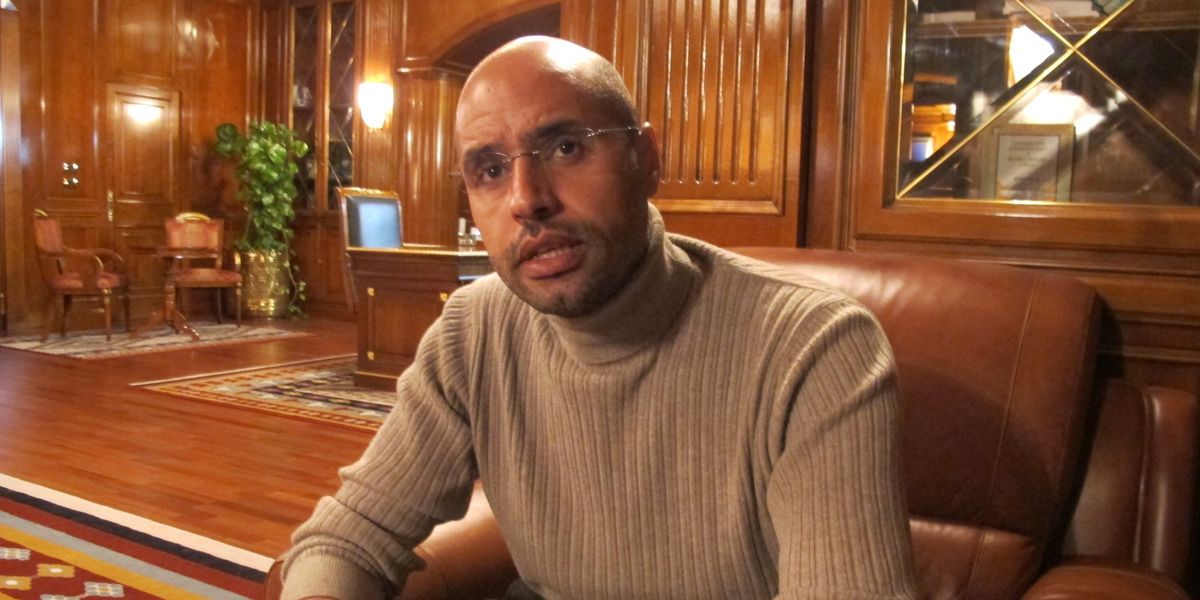
Saif al-Islam Gaddafi, the 53-year-old son of former Libyan dictator Muammar Gaddafi, was gunned down at his residence in Zintan on Tuesday by four attackers wearing masks.
His political team condemned the killing as a “cowardly and treacherous assassination” in a statement confirming his death.
The assailants reportedly disabled security cameras at the property before the attack, according to reports suggesting Gaddafi confronted the intruders.
His lawyer Khaled al-Zaidi verified the death on Facebook, whilst family sources and Libyan media outlets also confirmed the killing.
Gaddafi’s cousin Hamid Kadhafi described him as having “fallen as a martyr” and revealed the compound’s location had been kept secret.
Born in Tripoli in June 1972, Saif al-Islam was the second child of the dictator and his second wife, Safia Farkash.
He was regarded as the most powerful among Muammar Gaddafi’s sons and had long been considered the likely successor to his father’s rule.
An English speaker, he pursued doctoral studies at the London School of Economics and cultivated an image as a modernising influence within the regime.

Throughout his father’s time in power, he occupied a position within the inner circle
|
GETTY
Throughout his father’s time in power, he occupied a position within the inner circle and carried out diplomatic functions on behalf of the Libyan government.
His prominence lasted until the October 2011 uprising that toppled and killed his father.
Following his father’s overthrow, anti-Gaddafi fighters captured Saif al-Islam in November 2011 and he was subsequently imprisoned by a militia group in Zintan for nearly six years.
He was freed in June 2017 after receiving amnesty from one of Libya’s competing governments and had remained in Zintan since his release.

Gaddafi set his sights on the presidency
|
GETTY
A Libyan court sentenced him to death in absentia in 2015 for his role in crushing peaceful demonstrations and killing protesters during the revolution that ended his father’s four-decade rule.
The International Criminal Court also sought his arrest on charges of crimes against humanity connected to the 2011 uprising.
In November 2021, Gaddafi declared his intention to stand for the Libyan presidency, a move that provoked fierce opposition from anti-Gaddafi factions across both western and eastern regions of the country.
The High National Elections Committee, established to oversee voting following the 2011 civil war, barred him from participating in the contest.
The planned elections were ultimately abandoned due to disagreements between rival administrations and armed groups that have controlled Libya since Muammar Gaddafi’s violent removal from power.
The country has remained politically fractured ever since, with the UN-backed unity government, various militia organisations and eastern-based factions all vying for control, whilst efforts at elections and reconciliation have repeatedly faltered.