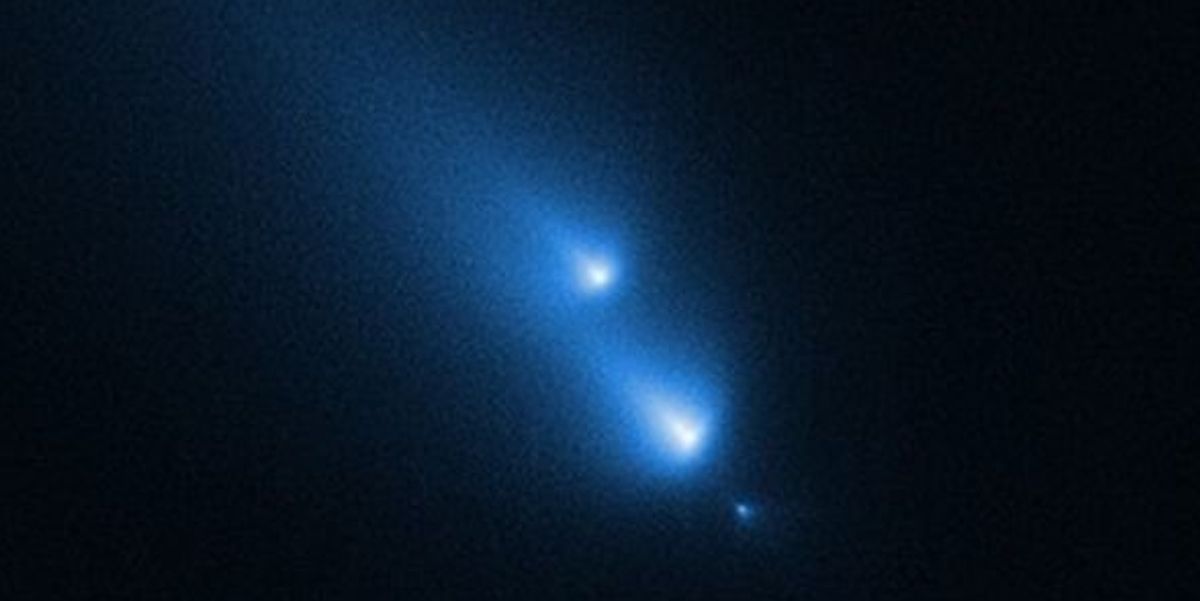
Nasa’s Hubble Space Telescope has inadvertently captured extraordinary images of a comet fragmenting into four distinct pieces, offering scientists an unprecedented glimpse into the early solar system.
Researchers at Auburn University in Alabama had originally intended to study an entirely different celestial object, but technical limitations preventing the spacecraft from manoeuvring quickly enough forced them to select an alternative target.
“Sometimes the best science happens by accident,” said John Noonan, a research professor in Auburn’s Department of Physics.
“This comet was observed because our original comet was not viewable due to some new technical constraints after we won our proposal. We had to find a new target — and right when we observed it, it happened to break apart, which is the slimmest of slim chances.”
The space telescope recorded the disintegration of comet C/2025 K1 (ATLAS) across three consecutive days, capturing 20-second exposures on November 8, 9 and 10, 2025.
Each fragment displayed its own distinctive coma — the fuzzy envelope of gas and dust surrounding a comet’s icy core — which Hubble resolved with far greater clarity than ground-based observatories could achieve.
The comet reached perihelion, its closest point to the Sun, in October 2025, passing inside Mercury’s orbit at roughly one-third of Earth’s distance from the Sun.
Scientists estimate the breakup commenced approximately eight days before Hubble’s observations began, likely triggered by the extreme heating and stress experienced during its solar encounter.
 Comet disintegration allows astronomers to see one in more detail than ever before |
NASA, ESA, DENNIS BODEWITS, JOSEPH DEPASQUALE
Prior to fragmenting, K1 measured roughly five miles across, somewhat larger than a typical comet.
Comets represent remnants from the solar system’s formation, composed of ancient materials that predate the planets themselves.
However, their surfaces have been altered over billions of years through exposure to solar radiation and cosmic rays, making it difficult for scientists to determine which properties are original and which result from this processing.
When a comet fractures, it exposes interior ices that have remained shielded from such degradation, providing researchers with access to genuinely primitive substances.

The incredible display was picked up by the Hubble telescope
|
Getty“By cracking open a comet, you can see the ancient material that has not been processed,” explained Dennis Bodewits, principal investigator and professor at Auburn University.
Yet the observations have presented an unexpected puzzle. Following K1’s fragmentation, there was a two-day delay before the comet brightened — a phenomenon typically associated with sunlight illuminating sublimated gas and dust.
Scientists theorise that the brightness delay may relate to the accumulation of dust on freshly exposed ice.
One possibility is that a dry dust layer must first form over the pure ice before being blown away, or alternatively, heat penetrating beneath the surface could build pressure before ejecting an expanding shell of particles.

‘Never before has Hubble caught a fragmenting comet this close to when it actually fell apart’
|
NASA, ESA, DENNIS BODEWITS, JOSEPH DEPASQUALE
“Never before has Hubble caught a fragmenting comet this close to when it actually fell apart,” said Professor Noonan.
“This is telling us something very important about the physics of what’s happening at the comet’s surface.
“We may be seeing the timescale it takes to form a substantial dust layer that can then be ejected by the gas.”
The comet’s fragments now lie approximately 250 million miles from Earth in the constellation Pisces, heading out of the solar system with no prospect of return. The findings were published in the journal Icarus.