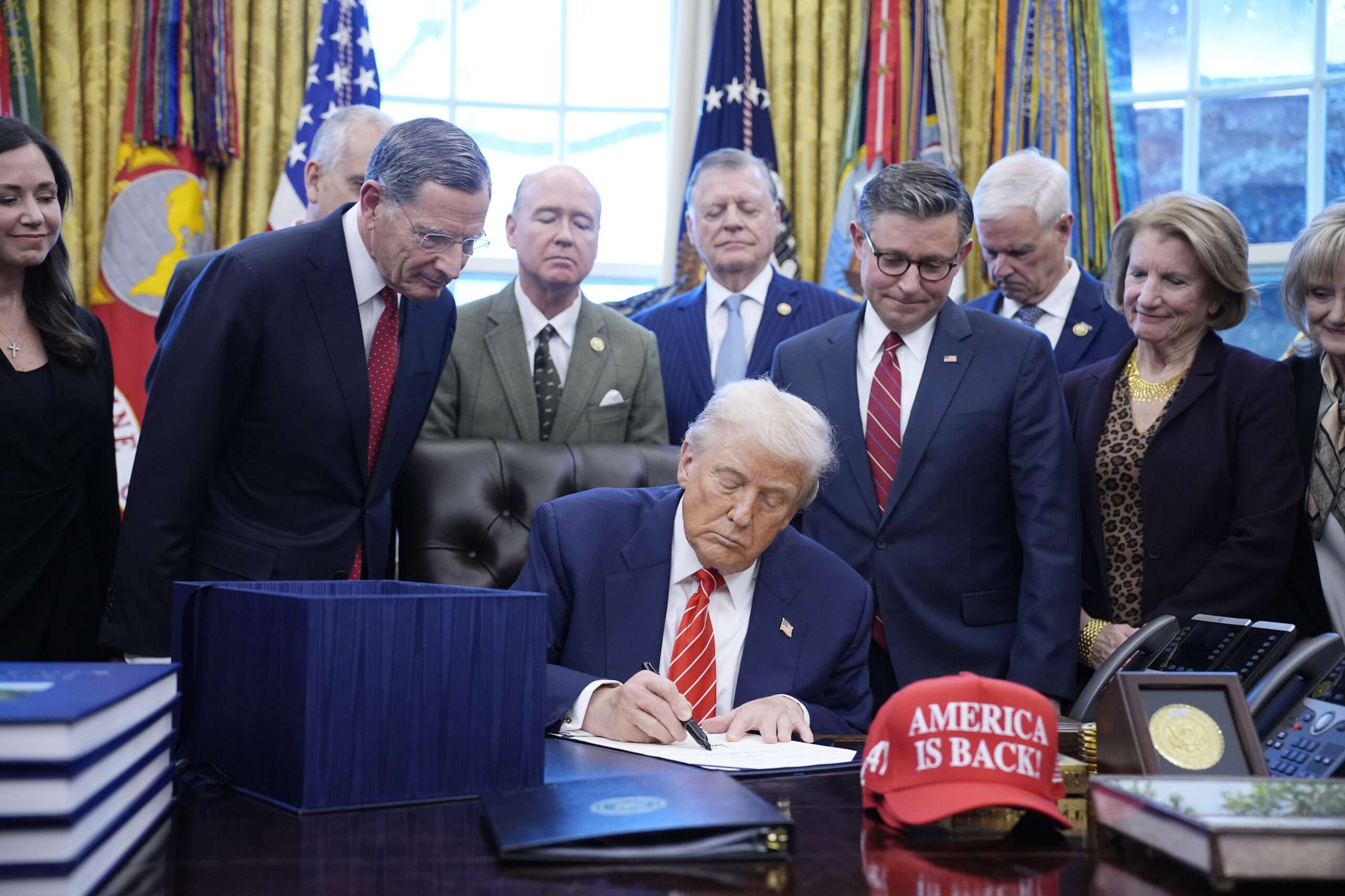
The mini shutdown is over, for now. On Tuesday, President Donald Trump signed a spending bill to end a brief, partial government shutdown and fund the federal government through the rest of this fiscal year—with one crucial exception.
Funding for the Department of Homeland Security (DHS) is set to lapse at the end of next week after lawmakers stripped the DHS appropriations out from the broader funding package. That maneuver creates a brief opportunity for lawmakers to negotiate reforms to Immigration and Customs Enforcement (ICE) and Border Patrol tactics in response to public outcry over the Trump administration’s heavy-handed, bloody crackdown in Minnesota and elsewhere.
It’s still unclear what those reforms might look like, however. House Minority Leader Hakeem Jeffries (D–N.Y.) says immigration enforcement needs to be “dramatically reformed” and has called for ICE to “conduct themselves like every other law enforcement agency in the country,” which means not wearing masks or behaving like unaccountable thugs. That’s a good place to start.
The Reason Roundup Newsletter by Liz Wolfe Liz and Reason help you make sense of the day’s news every morning.
Some Republicans seem to be conceptually on board with ICE reforms that require officers to ditch the masks or receive better training. Speaker of the House Mike Johnson (R–La.) does not seem to be among them. At a press conference on Monday, Johnson said he opposed unmasking ICE agents and added that it is “not necessary” to require immigration agents get judicial warrants for arrests and searches.
Q: You’re a constitutional lawyer. Can you detail the 4th Amendment protections someone has if an ICE agent approaches their home with an administrative warrant?
MIKE JOHNSON: When ICE goes to execute a warrant, it’s an administrative warrant and it’s issued by an immigration… pic.twitter.com/805boNlop0
— Aaron Rupar (@atrupar) February 3, 2026
With so much disagreement over what should be done, some lawmakers are skeptical a deal can be reached in 10 days. “I think DHS is going to be shut down for a while,” Sen. John Kennedy (R–La.) told The Hill.
Seriously, though, it’s good to see Congress at least considering the possibility of getting off the couch. If it takes more than two weeks to accomplish some meaningful changes to DHS and ICE policy, then Democrats (and sober Republicans) should not blink.
Combined with polls showing that the public largely rejects Trump’s immigration tactics and a court ruling this week that blocked the administration’s attempt to revoke temporary protected status for Haitians (as Reason‘s Elizabeth Nolan Brown detailed in this newsletter on Tuesday), it feels like the tide might be starting to turn in the war on immigrants.
Speaking of those immigrants, a new study from the Cato Institute’s David Bier shows that immigration has been of fiscal benefit to the United States in every year since at least 1994. In other words, immigrants contribute more in taxes (across all levels of government) than they consume in taxpayer-funded services.
Today @CatoInstitute published our report providing the first look at the fiscal effects of the wave of legal & illegal immigration over the last 3 decades. It shows immigrants created surpluses every year, by a combined $14.5 trillion, even as deficits grew pic.twitter.com/0HHFZWvtwN
— David J. Bier (@David_J_Bier) February 3, 2026
Overall, immigrants have reduced budget deficits by over $14 trillion in the past 30 years, Bier calculates. That hasn’t been sufficient to cancel out the massive amount of debt the federal government has piled up during that period, but it would have had to borrow even more heavily in a world where immigration was severely curtailed.
“Immigrants are subsidizing the US government,” Bier concludes.
Scenes from Washington, D.C.: Trump has been saying he wants to “nationalize” elections, and Speaker Johnson is now echoing that idea.
Here’s the president on Tuesday trying to clarify what he means by nationalizing elections—though he gets some very basic facts wrong, like claiming that “a state is an agent of the federal government in elections.” That is simply not true, as the Constitution gives states control over elections.
Collins: What exactly did you mean when you said that you should nationalize elections?
Trump: If you think about it, a state is an agent for the federal government in elections. I don’t know why the federal government doesn’t do them any way. pic.twitter.com/MM369u8rBY
— Acyn (@Acyn) February 3, 2026
Johnson is previewing how Republicans will try to sell this idea: by spreading more conspiracies about election results.
Mike Johnson on Trump calling for Rs to “nationalize” elections: “We had 3 Republican candidates who were ahead on election day in last cycle, and every time a new tranche of ballots came in they just magically whittled away until their leads were lost. It looks on its face to be… pic.twitter.com/wmeatnYZcF
— Aaron Rupar (@atrupar) February 3, 2026
If Johnson watches the Super Bowl on Sunday, will he turn it off at halftime and declare whichever team is leading to be the winner? This argument would be laughably silly if it weren’t intended to undermine the most basic function of a federalist republic.
Nationalizing elections: A bad idea when Biden proposed it. Still a bad idea now.
Thankfully, not all Republicans are willing to indulge Trump’s nonsense. “I opposed nationalizing elections when Speaker Pelosi wanted major changes to elections in all 50 states. I’ll oppose this now as well,” Rep. Don Bacon (R–Neb.) posted on X.