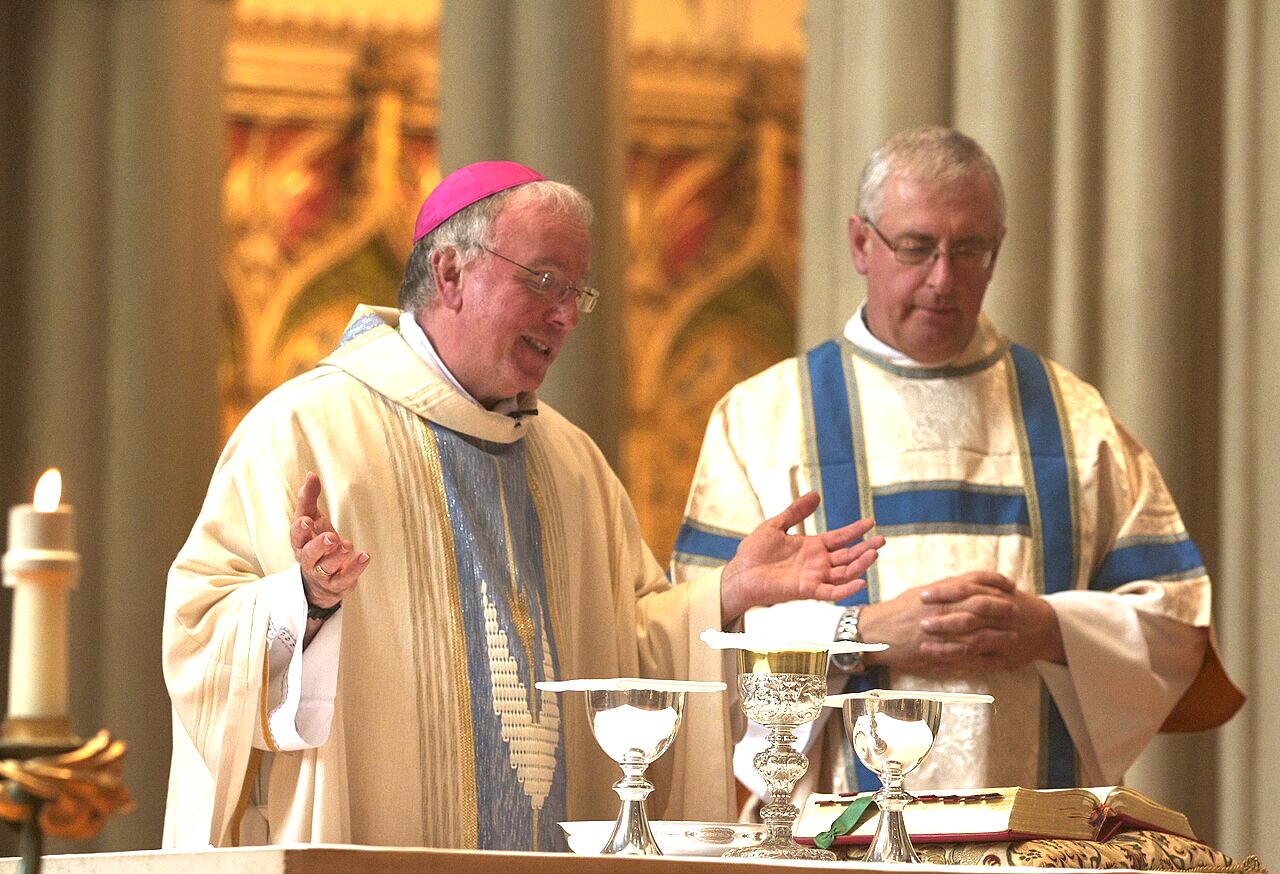
PORTSMOUTH, England (LifeSiteNews) — Bishop Philip Egan of Portsmouth said that Catholics cannot fulfil their Sunday obligation by attending Mass celebrated by priests of the Society of St. Pius X (SSPX), citing the group’s “irregular” status.
In comments given to Niwa Limbu of The Catholic Herald, Egan addressed questions about whether attendance at SSPX chapels satisfies the obligation for Mass on Sundays and holy days.
“Schism is a great sadness for the Church,” Bishop Egan said. “Let us pray for an outpouring of the Holy Spirit that the bonds of communion might be healed, strengthened and restored.”
An insinuation of schism is extremely grave. Pope Pius XII wrote in Mystici Corporis Christi:
For not every sin, however grave it may be, is such as of its own nature to sever a man from the Body of the Church, as does schism or heresy or apostasy. (n. 23)
The Council of Florence also infallibly taught:
(A)ll those who are outside the Catholic Church, not only pagans but also Jews or heretics and schismatics, cannot share in eternal life and will go into the everlasting fire, which was prepared for the devil and his angels, unless they are joined to the Catholic Church before the end of their lives (…)
The SSPX denies the charge of schism, and well-known clergymen can be found taking a variety of positions on the question.
Asked directly whether attendance at an SSPX Mass fulfils the Sunday obligation, Bishop Egan claimed that the Society’s current canonical status prevents its priests from having normal faculties:
As the Society of St Pius X is in an irregular or impaired situation with the Roman Catholic Church at the moment, its priests do not have the explicit faculties from the Ordinary to celebrate the Mass.
Egan pointed to Canon Law, which states that the obligation is fulfilled when a person attends Mass celebrated in a Catholic rite.
“Canon 1248 §1 speaks of fulfilling one’s obligation if a person ‘attends Mass in a Catholic Rite,’ which implies in communion with the Catholic Church,” the bishop said, adding that “numerous Catholic Masses” are available for the faithful.
This includes several locations in which the 1962 liturgy is used, offered by diocesan clergy and groups such as the Fraternity of St. Peter and the Marian Franciscans. However, in 2025, Egan spoke positively about Traditionis Custodes, again in The Catholic Herald:
One of the good things with Traditionis Custodes is that it put the local bishop back in charge, but it has also meant that there are now fewer celebrations of the EF liturgy in the diocese. In my view, the real challenge is not the celebration of the EF liturgy, but the proper, solemn and beautiful celebration of the Ordinary Form liturgy.
Bishop Egan also said that he was “happy to encourage the Latin Mass within a wide and diverse ‘repertoire’ of liturgy across the diocese,” so long as this “repertoire” is “beautiful and awe-inspiring, and faithful to the norms.”
In his article on Egan’s recent comments, Limbu detailed a series of conflicting statements on the question by Vatican officials, concluding that most of these statements indicated that the Sunday obligation could be fulfilled at an SSPX chapel.
He expressed “surprise” at Egan’s comments due to earlier gestures that “appeared to signal a willingness to maintain cordial relations with the Society.” However, LifeSiteNews has also confirmed that Egan has been asked questions about attendance at SSPX Masses previously, and that his office has given similar answers in response.
Egan’s ‘cordial relations with the Society’
Egan had previously visited St. Michael’s School in Burghclere, a school run by the SSPX within the diocese; Portsmouth diocese also told Limbu that Egan sent the Society oils from the diocesan Chrism Mass as “a gesture of goodwill in order to build closer bonds of communion.”
Egan’s statements on attending Mass at an SSPX chapel are indeed difficult to reconcile with sending such oils and these comments – as well as with Francis’ 2015 extension of faculties for the Sacrament of Penance and the 2017 arrangement for the celebration of marriage.
The Oil of Catechumens and Chrism are both used in the administration of Baptism, and the latter in Confirmation. The administration of these sacraments ordinarily requires the permission of the diocesan bishop. Can. 863 (CIC 183) states:
Except in a case of necessity, no one is permitted to confer baptism in the territory of another without the required permission, not even upon his own subjects.
Can. 886 § 2 states:
To administer confirmation licitly in another diocese, a bishop needs at least the reasonably presumed permission of the diocesan bishop unless it concerns his own subjects.
Neither the bishops nor the priests of the SSPX have subjects in the sense relevant to this canon. Regarding Confirmation, Can. 887 states:
A presbyter who possesses the faculty of administering confirmation also confers this sacrament licitly on externs in the territory assigned to him unless their proper ordinary prohibits it; he cannot confer it validly on anyone in another territory (…)))
LifeSiteNews contacted Bishop Egan for clarity on the following points:
- Whether Bishop Egan sent all three oils to the SSPX, or just the Oil of the Sick;
- Whether he intended or expected the SSPX to use the Oil of Catechumens and Chrism in the administration of the sacraments;
- Whether this meant
- a) that Bishop Egan had given the SSPX permission to administer these sacraments licitly;
- b) that he believed the SSPX could administer these sacraments licitly without his permission (e.g. “a case of necessity” as per Can. 862 CIC 1983), and whether this would also apply to Holy Mass too; or
- c) that he was facilitating what he saw as the illicit administration of the sacraments by providing these oils as “a gesture of goodwill” and and to build “closer bonds of communion.”
Unfortunately, Bishop Egan’s executive assistant informed LifeSiteNews that the bishop was “away at present” and thus “unable to respond” to the questions.
LifeSiteNews also reached out to the SSPX District of Great Britain and asked whether its priests use oils blessed and consecrated by SSPX bishops exclusively. Fr. David Sherry, the District Superior, said that “only oils consecrated according to the traditional rite are used by the priests of the Society in the administration of the sacraments.”
Another priest of the same district clarified further, telling LifeSiteNews that the oils used in Great Britain were indeed exclusively those blessed or consecrated by SSPX bishops at the Ecône Seminary, Switzerland.
Bishop Egan’s inter-religious activities
The SSPX is not the only group with whom Egan has shown a “willingness to maintain cordial relations.”
In 2017, Egan wrote in a diocesan news article:
Last Friday I went to the Abu Bakr mosque in Southampton and joined them for Friday prayers.
The article linked to the address that he gave, but it is no longer available. Reaching out to the Diocese of Portsmouth for comment, LifeSiteNews also sought clarity as to the nature of Egan’s involvement in these Islamic prayers, and why the address has been removed. As stated, LifeSiteNews was informed that he was currently away and unable to respond.
More recently, Egan visited another Islamic center in his diocese. In 2024, he (and what appear to be a number of his priests) attended an “interfaith iftaar” (the evening meal in Ramadan) at the Wessex Jamaat.
Also in 2024, Egan took part in a pilgrimage to the ecumenical community of Taizé, France.
Welcome to e-News – our 450th issue – which I am sending to you from Taizé, France. I am here on a short ecumenical pilgrimage with Bishop Jonathan and 45 youngsters from the Isle of Wight. Read more about this and all the latest news from @PortsmouthRC: https://t.co/6R2PsVi1Og pic.twitter.com/Q5mDvfn0Lq
— Bishop Philip Egan (@BishopEgan) June 25, 2024
In a diocesan news article, he explained how he and Jonathan Frost, the Anglican bishop of Portsmouth, took 45 students from the joint Church of England and Catholic school Christ the King College.
Frost is on record as advocating for the blessing of same-sex couples (see also here). In a subsequent diocesan newsletter, Egan expressed hope that this ecumenical pilgrimage “might become an annual fixture.”
Whether Bishop Egan was aware of Frost’s advocacy at the time of the college pilgrimage, and whether it would give him any pause in making it “an annual fixture,” were among the questions submitted to Portsmouth diocese for clarification.
Only a few weeks ago, Bishop Egan attended and preached at an Anglican service of Choral Evensong at Oriel College, Oxford:
Last Sunday I was invited to preach at Choral Evensong in Oriel College, Oxford as part of as special series of sermons dedicated to the BVM commemorating the 700th anniversary of the foundation of the College. Read more in today’s @PortsmouthRC e-News: https://t.co/RWVrcqCSw1 pic.twitter.com/8DvZLxzz4w
— Bishop Philip Egan (@BishopEgan) February 10, 2026
In light of Egan’s involvement with non-Catholic groups, his comments about the SSPX are hardly cause for “surprise.” The “cordial relations” that he has appeared willing to maintain are in keeping with his general ecumenical and inter-religious outreach. LifeSiteNews asked Bishop Egan to confirm whether he saw visits to SSPX properties in a similar light, but the bishop’s office was unable to reply due to Egan’s absence.
What are the implications of actively participating in the rites of non-Catholics? As an example, St. Thomas Aquinas stated that “if anyone were (…) to worship at the tomb of Mahomet, he would be deemed an apostate” (Summa Theologica, IIa IIae, Q12, A1, Obj. 2).
According to traditional Catholic discipline, “(i)t is not licit for the faithful by any manner to assist actively or to have a part in the sacred (rites) of non-Catholics” (Can. 1258 § 1 CIC 1917). “(C)ommunicating in sacred things” with heretics or schismatics (and, a fortiori, those who do not profess the name of Christ at all) made someone “suspect of heresy” (cf. Can. 2316 CIC 1917).
Those who failed to rectify the suspicion after having been warned more than once were considered suspended a divinis; if they continued in such a state for six months, they were to be considered as heretics (Can. 2315 CIC 1917).
Even if the 1917 Code were no longer in force, and even without the imposition of canonical warnings, the principles contained within these canons would remain instructive.
Bishop Egan’s denunciation of Marian Franciscan sermon against LGBTQ+ ideology
Egan himself has spoken out against same-sex unions and marriages on several occasions over the years. Five years ago, Egan himself criticized the influence of LGBTQ+ advocacy groups on the UK’s Catholic Education Service’s documents. In 2014, he had stated that Catholic MPs who voted for the UK’s same-sex “marriage bill” should be denied Holy Communion – a statement later rejected by the Catholic Bishops Conference of England and Wales.
However, a few years ago, Egan himself issued a very harsh condemnation of a priest’s sermon about the dangers of the LGBTQ+ ideology.
In the spring of 2022, Fr. Rosario Ebanks of the Marian Franciscans – a group in good standing with the Portsmouth diocese, which uses both the traditional Roman and the Novus Ordo Missals – had denounced the presence of “gender ideology” in Catholic schools. Fr Rosario was actually ordained by Egan in 2019.
Speaking of teachers who promote transgenderism and same-sex unions in Catholics schools, Fr. Rosario said:
It’s very sad, dear brothers and sisters, that we have opened up a door to the devil in our catholic schools, embracing all of this gender ideology, and this rainbow flag revolution. (…)
Dear brothers and sisters, those teachers are a bunch of Devils. What a scandal! What an abomination to think that, in some so-called Catholic schools, these abominations are being presented and promoted — promoting sin, promoting a sin against chastity, promoting a sin against nature.
And you wonder why there’s an increase of parents who are taking their children out of these so-called Catholic schools, and they’re home-schooling them?
And those who are responsible for Catholic education have let the faithful down. They have betrayed the faithful, they have betrayed Our Lord Jesus Christ, because they are not faithful to his teaching. And they behave like serpents and politicians (…)
The sermon caused uproar among LGBTQ+ activists, including national advocacy group Stonewall and Conservative MP Caroline Dinenage. This outrage included racial abuse for Fr. Rosario based on his Afro-Caribbean origins.
Instead of defending Fr. Rosario and Catholic doctrine, a spokesman for Portsmouth diocese stated:
The Catholic Diocese of Portsmouth is very sorry to learn about the details of a homily preached recently and the inflammatory language has caused great offence to many. […]
We disagree with the statements that have been made and would emphasise that the Catholic Church respects and welcomes all people.
We are investigating the matter and will consider what appropriate action is required.
Egan himself also responded to the outrage by sending an ad clerum letter to his clergy denouncing Fr Rosario’ sermon in defense of parental rights. In this text, published by blogger Mark Lambert at the time, Egan wrote:
I was very sorry indeed to learn the details of a homily preached recently in one of our parishes that was critical of our Catholic leaders and the way in which schools approach relationships and sex education. This has caused great offence to many. (…)
We have done all we can to reduce people’s exposure to this homily although sadly it has been shared widely across the digital sphere and has been picked up by local and national media. I have taken action and there may be further consequences following an investigation of those involved.
Citing Vatican II’s Sacrosanctum Concilium, Egan claimed that sermons “should be pastoral emphasising God’s mercy.” He concluded by saying:
A homily is never a place for a preacher to air his own theories about the ills of the Church.
Deacon Nick Donnelly commented on the incident in reference to Bishop Egan’s recent comments on the SSPX, concluding that “There are no ‘conservative’ bishops in England & Wales. They are all liberals or liberal adjacent.”
Bishop Philip Egan of Portsmouth is praised for being one of the few ‘conservative’ bishops in England.
In 2022 he publicly rebuked one of his priests for saying in a homily that teachers who advocated the LGBT agenda to Catholic children were ‘devils’ and the schools that… pic.twitter.com/qQaPrW78o4
— Deacon Nick Donnelly (@ProtecttheFaith) March 13, 2026
Egan’s handling of the affair illustrates precisely why traditionalist groups are necessary. While he may say that “(t)here are numerous Catholic Masses available to fulfil one’s obligation” in his diocese – including those offered according to the traditional rite – Portsmouth Catholics seem to have no guarantee that they will receive the Catholic faith there.
Fr. Rosario’s treatment sends the message that, far from enjoying Bishop Egan’s support, ministers who preach the faith and denounce evil could be publicly denounced themselves and made the subject of investigations and suppression.
In November of the same year, the Marian Franciscans relocated much of the operation to Dunkeld, Scotland, maintaining a base in the North of Portsmouth. In 2025, they were instructed to leave and return to Portsmouth.
Ave Maria!
Dear Friends, not a happy news to share. We have been told to leave the Diocese of Dunkeld.
Very soon 50 people (counting friars and sisters resident) will be homeless. To find another accommodation for both communities is not easy. Please pray for us and help us. pic.twitter.com/6nsONMZAL5
— The Marian Franciscans (@marianfriars) February 22, 2025
Although Egan welcomed them back, Dr. Joseph Shaw, chairman of the Latin Mass Society, stated on X that “The friars were asked to leave the parish in Gosport by Bishop Egan.”
The friars were asked to leave the parish in Gosport by Bishop Egan.
— Joseph Shaw (@LMSChairman) February 22, 2025
Egan had previously told The Pillar in February 2025 that “We were no longer able to accommodate them here in the diocese.”
When LifeSiteNews contacted Bishop Egan for clarity, he was asked whether Dr. Shaw was correct, and whether Fr Rosario’s sermon was a factor in asking them to leave.
‘Happy’ to give his permission to ‘dissent movement’ in Portsmouth
In 2016, a conference by ACTA (A Call to Action) took place within Egan’s diocese at St. Peter’s RC Church, Winchester.
Deacon Donnelly, writing around that time at Protect the Pope, described ACTA as a “dissent movement” and documented what he called its “dissent from the doctrines and discipline of the Church” for years. At the time of writing, one of ACTA’s most recent articles is on the alleged priestly vocation of Soline Humbert.
The 2016 conference was billed as having “input from ACTA’s The smell of the sheep survey” that found 85% of Catholics rejected the Church’s teaching on contraception, 88% were in favor of Holy Communion for the divorced and remarried, and that “there is a shift in views towards same-sex relationships.”
The event featured Bishop Peter Doyle, who was then bishop of the Diocese of Northampton, England. In 2015, Doyle suggested to Vatican Radio that Catholic teaching could develop so as to accept same-sex relationships. He later attended a conference organized by the UK-based LGBTQ+ group Quest, along with Fr. James Martin.
Doyle also welcomed Amoris Laetitia, saying that he was “thrilled” the Holy Communion for divorced and remarried persons was to be dealt with on a “case by case” basis.
This conference also featured he late Fr. Daniel O’Leary, who wrote in his final article before his death:
I now believe, with all my heart, that compulsory celibacy is a kind of sin, an assault against God’s will and nature.
I’m just pointing out that one of the fall-outs of mandatory celibate life is the violence it does to a priest’s humanity, and the wounds that it leaves on his ministry.
In spite of this, ACTA claimed that the event “has the blessing of Bishop Philip Egan, RC Bishop of Portsmouth.” Torch of the Faith relates that Egan, through his secretary, replied to complaints as follows:
The word “blessing” is strong and Bishop Philip would perhaps not have chosen this word himself. He did give his permission for this event to take place and was happy to do so.
This appears to be another example of Bishop Egan’s “willingness to maintain cordial relations.”
Conclusion: Egan’s mixed record
In spite a reputation as a conservative or friend to the traditional Latin Mass, Bishop Egan’s record is very mixed.
Although he has taken orthodox positions on controversial issues on some occasions, he has spoken or acted in a contradictory way on others.
While he permits the traditional Latin Mass in his diocese, he has sided with the LGBTQ+ activists against priest who preaching traditional doctrine – and has been “happy” to give his permission to a conference organized by A Call to Action.
While he presents a hard canonical line against the SSPX based on schism and the unity of the Church, he has visited mosques (and even “joined them for Friday prayers”), taken Catholic school children on ecumenical pilgrimages with Anglican advocates of same-sex blessings, and preached at Anglican services. In addition to these points detailed, we note the following:
While Bishop Egan condemned the practice of locking churches as “hypocrisy” in 2018, claiming that they should be available for the faithful to enter throughout the day, he allowed his churches to be locked during the COVID-19 period.
While he wrote an open letter to the UK prime minister about the suppression of public worship, his arguments were based on largely naturalistic grounds and framed as a request of the government, rather than an assertion of the Church’s rights and liberty.
In light of this mixed record, Egan’s strictures against the SSPX (and Fr. Rosario) seem to be examples of the “weaponized orthodoxy” phenomenon – the selective instrumentalization of Catholic principles against those who seek to keep the faith while others are left free to lead souls into error and sin.
If Egan’s conduct represented an integral profession of the Catholic faith, it would be easier to take these strictures more seriously. But in the meantime, he himself seems to be subject to the same criticisms which Archbishop Carlo Maria Viganò leveled against Cardinals Raymond Burke, Gerhard Müller and Robert Sarah:
Müller, Sarah, and Burke effectively constitute a controlled opposition. Their role is to contain the hemorrhage of Catholics caused by the conciliar revolution, deluding the faithful into thinking that it is possible for two opposing entities to coexist within the same institution and under the same Hierarchy: the Catholic Church and the conciliar-synodal Church. (…)
Unity is not primarily institutional but doctrinal, rooted in the immutable Deposit of Faith. It is the discipline of the Church that is ordered to the preservation and transmission of the Depositum Fidei, and not vice-versa.
The pathetic efforts of these Cardinals represent moderate conservatism’s attempt to bridge divisions — which they acknowledge but deny the causes — through an impossible dialogue.