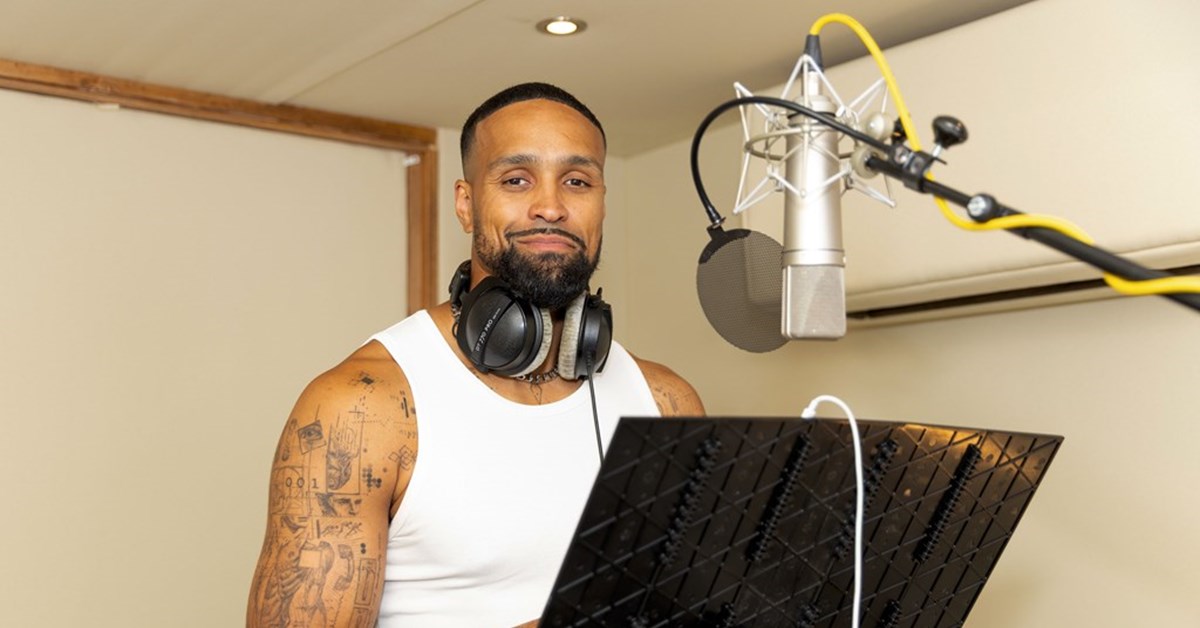
ASHLEY BANJO, the dancer and TV presenter who found fame with his dance group Diversity on Britain’s Got Talent in 2009, is having a full day. Following a morning of press promotion for Pilgrimage: The road to Holy Island, this year’s instalment of the BBC series, he is being driven 84 miles to Ipswich for a performance, including a fan “meet and greet”, of Diversity’s new touring production, Soul. Soul’s 60-date tour means that Mr Banjo will be on the road in the UK and Ireland from February to May. The show follows an appearance in Robin Hood, a pantomime, over December and January, at the New Wimbledon Theatre.
On Sundays, however, Mr Banjo can be found in the congregation of St Michael’s, Westcliff, near Southend. Reflecting on the competing time pressures of the entertainment industry and Christian worship, he says: “On this tour, I’m away three months working, six days a week, but I come back every Sunday. Sometimes, it’s a long trip, but it’s worth it.
“When I step into church after six days away, it’s what I need every week. It makes you feel uplifted. It’s great to see people and get that grounded feeling, and step back into what you need. On tour, you spend all that time projecting outwards and performing; so it’s nice to be in an environment that isn’t performative: it’s just genuinely uplifting. And, in that moment, you just get to do what everyone else is doing, in the presence of God. It’s just a really uplifting, beautiful thing to be a part of.”
The dancer’s links to St Michael’s and its Vicar, Canon Tom Loh, predate his joining the congregation. The church is near the former United Reformed church, which was converted to Diversity’s dance studio in 2022. “I’m quite lucky, because I’ve had a unique journey, because before we actually went to the service, we knew the area. The church building shown in Pilgrimage’s first episode, is next door to the church I go to. I bought the church building next door years before I went to the church. Also, my dad is friends with the Vicar. Then we met, and we’ve been friends for years and years. I would invite him over to pray for our shows and bless the tours and come into the studio.”
Mr Banjo had watched St Michael’s services on livestream, before taking the plunge to attend in person: “I had a lot of worries about walking into a new group and a new community of people. I didn’t want it to be ruined for me or taken from me, because I wanted to be, for want of a better term, just a normal person, looking to deepen their faith.” He has now attended for almost a year.
Familiarity with the church leadership helped him to take the leap of faith. “I already knew the church crew and the community crew; so I didn’t make the decision to go out of thin air. The Vicar is a really gifted speaker and preacher. He’s just full of light and full of the Spirit. He’s turned out to be a good friend, and, as a church leader, he’s great, really gifted. You can see from the size of the congregation, and how popular his church is.”
In an interview in 2020, Canon Loh’s wife, Claire, said that, since they arrived in 2014, the congregation had grown from only 40 on a Sunday to 120, including 60 children.
SINCE Mr Banjo and his wife, Francesca Abbott, separated in 2022, they have co-parented their children, Rose and Micah. He speaks of the decision to attend church as a family as a “conviction”, linked to his awareness of the responsibilities of fatherhood. “One day, I just felt the conviction of ‘Right, we’re just going do this.’ We went as a family, and I planned a little day around it. We went to get some breakfast, and went to the 10.45 service. The moment I walked in for that first time, I knew it was the right choice.”
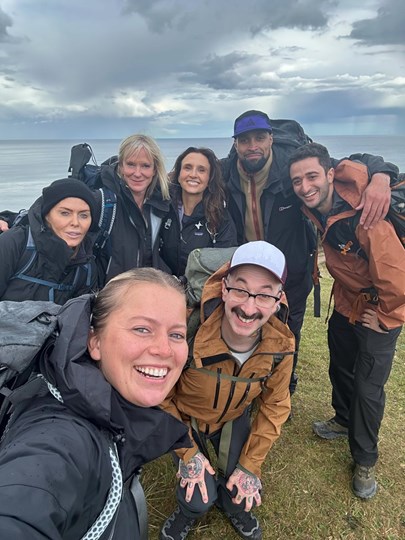 BBCThe pilgrims in series eight of the BBC series Pilgrimage
When Micah and Rose were baptised, Mr Banjo was rebaptised, having received the sacrament at 14. A part of his church community accompanied Mr Banjo as he filmed Pilgrimage, and Canon Loh gave him a copy of the New International Bible for his travels. “My reading plan was a psalm a day, as a minimum. I would try and pick bits and pieces to go through different moments. When I woke up, I’d always try and go through more, to read a couple of psalms a day.”
Psalm 136, read on Holy Island, was especially resonant. “When I got to the top of Holy Island, the psalm that really stuck with me, that encompasses my journey, my pilgrimage, is Psalm 136. I was sitting at the top of the cliff edge, and . . . it’s just a really beautiful moment.
“It was the culmination of the whole trip, crystallised in this beautiful place, and when I was reading the words ‘His love endures for ever,’ I can’t explain how it made me feel. I felt lucky and blessed to have that encounter, and to feel those words almost came to life. I believe God’s got a plan for us all, and that plan will ultimately always bring us back to him. But it’s our free will that dictates how we get there, and if we get there.”
The fitness required to be a dancer also came to the fore during filming. While fellow pilgrims took the 224 “Steps of Doom” to Durham Cathedral, on St Oswald’s Way, slowly, Mr Banjo simply bounded up the muddy incline at the side. “It definitely helps being used to pushing through and doing long stints on your feet. The physical challenge of the 390-kilometre trail was not too much at all. If anything, it would have been nice to have more physical challenges.”
ONE of the highlights of the series is Mr Banjo’s interfaith encounters with the stand-up comedian Hasan Al-Habib, who is Muslim. “Hasan was interesting, because I anticipated there would be moments — especially if there was someone who was strictly part of another faith — I’d have to defend the ideas that I stand by. But it wasn’t like that at all. It was more of a case of the stronger you stand in what you believe, the more we completely respected each other from the first time we spoke.
“I would try to learn more about what he believes, and why. Obviously, that’s something we’re never going to get to the bottom of completely, in a few conversations. It was interesting, figuring out more about him and his faith, and him making me laugh, and getting to know him more as a human being, because he’s so funny, and so likeable.”
He says that the pair had “some great chats, most of which weren’t about faith, and sometimes we would dip into faith”. He adds: “Conversion was never the mission. Hasan would always joke about it, but there was nothing like that.”
The two performers shared the experience of being from underrepresented ethnicities in school. Mr Al-Habib was an Iraqi refugee; Mr Banjo’s father is Nigerian. He says that there were four other Nigerian students at school, some of whom have gone on to be pastors.
Although Mr Banjo did not attend church as a child, he says that the expression of Nigerian culture and Christianity were, for him, closely linked. “My dad had been to Sunday school, and could cite lots of verses from the Bible, but he never spoke about religion as such. We wouldn’t eat meat on Good Friday, for example. We would observe a lot of the holidays and follow a lot of the core Christian principles. We would talk about having God in our life, but we didn’t live religiously.”
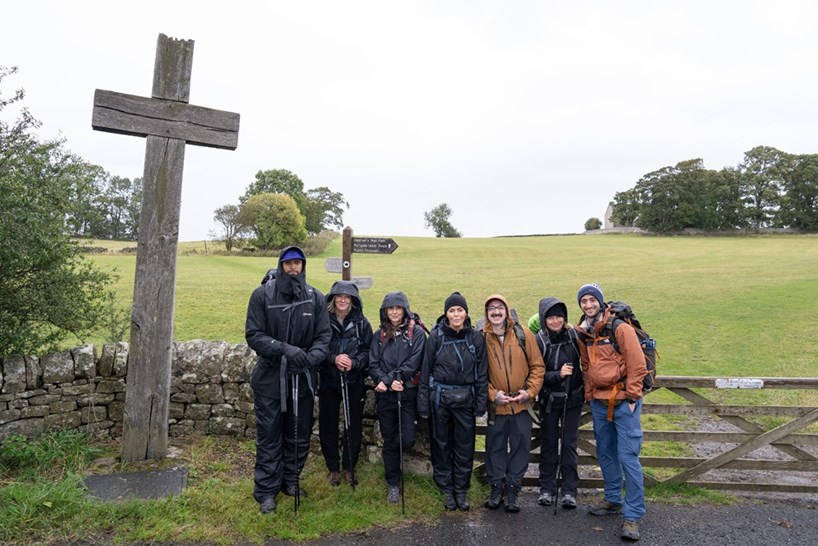 BBCThe pilgrims in series eight of the BBC series Pilgrimage
Having abandoned his physics degree at the age of 19 to pursue a showbusiness career with Diversity, after the group’s big break on Britain’s Got Talent, he hasn’t ruled out returning to university to study theology. He is also open to the idea of a future calling within the Church, and has been considering volunteer roles. “When you reach a crossroads, you try new things, and you go into new chapters. I don’t necessarily think that what I’m doing now is going be what I do always. I think that will change and will grow.”
For the moment, though, Mr Banjo sees his creativity as the best expression of his faith. Through dance, his new production Soul looks at what it means to be human in the age of artificial intelligence. He has received hundreds of messages from audience members, thanking him for encapsulating their concerns about the future in an enlightening and entertaining way.
When Diversity referred to the killing of George Floyd, and Black Live Matters, in a 2020 performance on Britain’s Got Talent, Ofcom received 24,500 complaints about the ITV primetime show. But the regulator dismissed the complaints, stating that Diversity’s routine was “a call for unity”.
Looking back on his 17-year journey from talent-show hopeful to sold-out UK tour, Mr Banjo says that, on balance, he would not change a thing. “It’s catch-22: there’s things I would change, like anybody, I’m sure. But at the same time, if they changed, I wouldn’t be where I am now, and I wouldn’t change that for the world. I am 100 per cent happy.”
Pilgrimage: The Road to Holy Island is on BBC2 and BBC iPlayer.