THE designer of a church that is being built using 3D-printing technology in the Czech Republic has spoken about the decorative and acoustic possibilities of this method of construction.
“At first, our team planned to print only the church tower. They then resolved to produce the church interior as well,” said Michal Macuda, who is adapting the plans for 3D printing.
“There’s a hollow cavity with no structural function inside each element, into which we inserted a small steel tube when we printed the prototype. Sound travels through these tubes into the cavity, which is filled with dense wool, and the movement in the wool absorbs the energy, reducing echoes inside the church.”
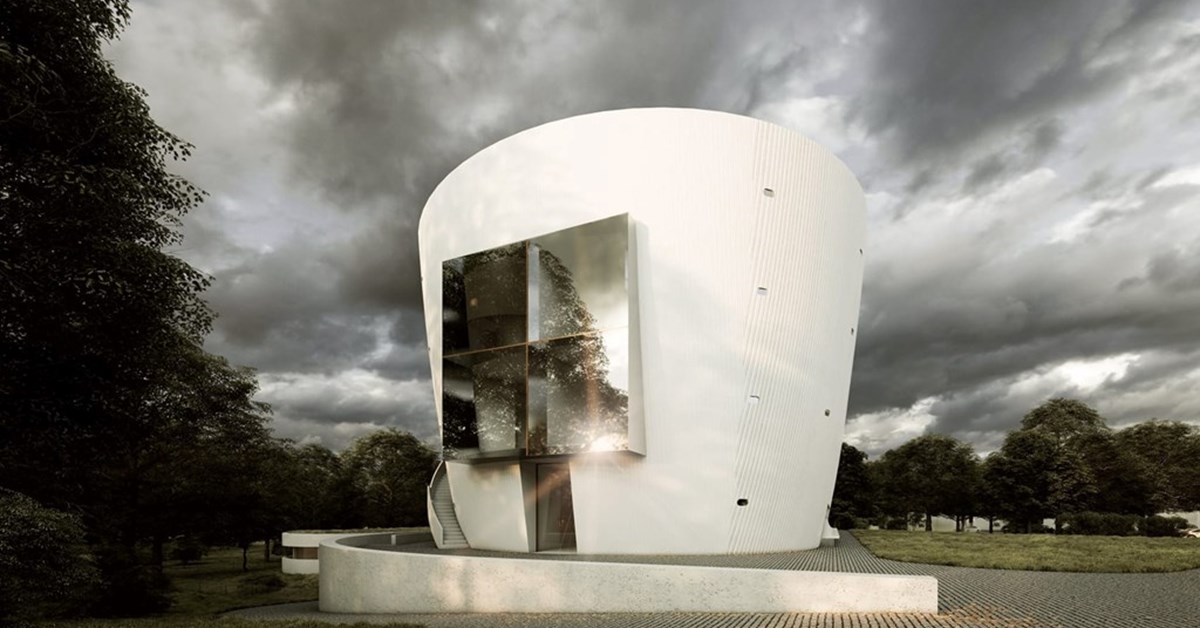
The architectural designer, from the international Purposia Group, was speaking at a presentation of plans for Holy Trinity, a Roman Catholic church under construction since autumn 2024 in the industrial town of Neratovice, on the river Elbe, in the country’s Central Bohemian Region.
He said that most of the church’s structure would be assembled like a jigsaw from 520 computer-generated concrete blocks, which produced decorative waves that also “functioned as acoustic features”.
Construction of the nave would begin this month, he said, at a cost of 204 million Kc (£7.338 million), one third of which had already been raised from donations.
The parish said that the new, ark-shaped church, resembling a Gothic sculpture of the Madonna and Child, would meet pressing community needs, three and a half decades after the collapse of communist rule.
“The communists founded Neratovice in 1957 as a town without a church — they wished to prove this was possible, and the church is still very much missing,” the parish website says.
“If you say Neratovice today, everyone thinks of a chemical-industry town full of chimneys, with a main square formed by tall prefabricated buildings. A dominant, dignified element is missing, and the new church will fill this gap.”
Three-dimensional architectural designs are an innovation in the Czech Republic, where Holy Trinity’s award-winning main architect, Zdenek Fránek, has also designed churches for the Church of the Brethren at Litomyšl and Cernošice.
Speaking at the presentation in the Czech Technical University in Prague, Mr Macuda said that Holy Trinity’s lower floor would include decorative grooves and embossed wall details that could be achieved only through 3D technology. Three-dimensional printing, using image generation from artificial intelligence, reduced concrete consumption by up to 70 per cent, he said, and offered “unlimited design possibilities”.