Two dozen states are suing to stop President Donald Trump’s new legal justification for tariffs, two weeks after the Supreme Court ruled that Trump could not use an emergency law to impose the tariffs.
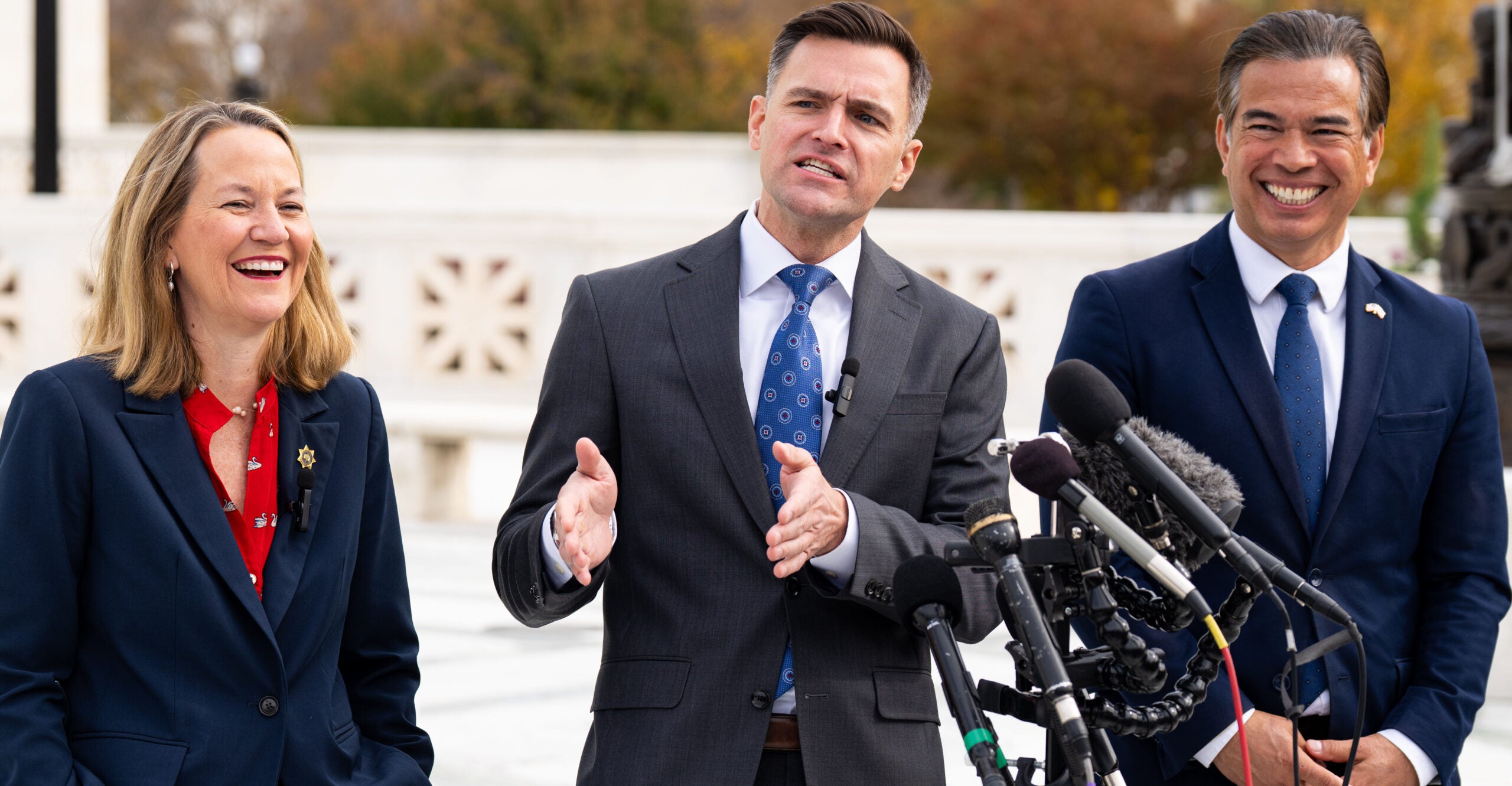
The mostly Democrat-led states are suing in the U.S. Court of International Trade, and Oregon Attorney General Dan Rayfield is the lead plaintiff. Trump, the Department of Homeland Security, and U.S. Customs and Border Protection are named as defendants in the lawsuit.
“The focus right now should be on paying people back, not doubling down on illegal tariffs,” Rayfield said in a public statement.
“People are already making hard choices about what to put in their shopping cart. Prices on basics like groceries, clothing and other essentials have all been skyrocketing. At some point, the bills become unmanageable.”
Trump initially imposed the tariffs, which he said were reciprocal, under the International Emergency Economic Powers Act. The high court, in a 6-3 ruling, determined he couldn’t use the 1977 law to impose tariffs without congressional authorization.
The Trump administration on Friday responded to a court order to refund tariffs that it had illegally imposed under the emergency act. While saying it could not issue immediate refunds, CBP said it was preparing a system within 45 days by which to process refunds, Reuters reported.
The states’ lawsuit, however, focuses on the administration’s new legal method of imposing tariffs.
After the ruling, Trump turned to a separate law, Section 122 of the Trade Act of 1974, to impose 10% tariff for 150 days. That maintained most of the tariffs in place before the court ruling, to address trade deficits.
In their lawsuit, the states argue Section 122 is meant to address “large and serious balance-of-payments deficits,” and not trade deficits.
A trade deficit is a measure of a country purchasing more goods and services from abroad than it sells. A balance-of-payments deficit includes trade but also accounts for all the money flowing back into the country through foreign investments and capital.
During his State of the Union address, Trump talked about the “unfortunate ruling” from the Supreme Court against the tariffs.
“The good news is that almost all countries and corporations want to keep the deal that they already made … knowing that the legal power that I, as president, have to make a new deal could be far worse for them, and, therefore, they will continue to work along the same successful path that we had negotiated before the Supreme Court’s unfortunate involvement,” Trump said.
Trump said the tariffs would continue under “tested alternative legal statutes.”
“They’re a little more complex, but they’re actually probably better—leading to a solution that will be even stronger than before,” Trump said. “Congressional action will not be necessary. It’s already time-tested and approved.”
The high court ruling only pertained to the use of the international emergency law to justify tariffs. In his dissent, Justice Brett Kavanaugh mentioned other laws that a president could use to temporarily impose tariffs through executive action.
Plaintiffs joining Rayfield include states led by two expected Democratic presidential hopefuls, Kentucky Gov. Andy Beshear and Pennsylvania Gov. Josh Shapiro. Both states have Republican attorneys general.
“The Supreme Court ruled his tariffs aren’t legal and he doesn’t have the authority to impose them. Now he’s trying to do a workaround to push his own agenda—we suggest he stop, and we’re fighting back,” Beshear said in a public statement.
The rest of the plaintiffs are Democrat state attorneys general from Arizona, California, New York, Colorado, Connecticut, Delaware, Illinois, Maine, Maryland, Massachusetts, Michigan, Minnesota, Nevada, New Jersey, New Mexico, North Carolina, Rhode Island, Vermont, Virginia, Washington, and Wisconsin.
In a separate case, CBP filed a motion Friday with the U.S. Court for International Trade, saying it was unable to comply with an order directing it to refund tariffs.
However, the agency then appeared to reverse course, telling the court it is preparing a system to process refunds, Reuters reported.
That matter involves the refund of $166 billion in tariff payments to around 330,000 importers, Reuters reported.