DIOCESAN apportionment — under which dioceses made financial contributions to cover the costs of centralised services, including clergy retirement housing — officially ended this month.
Its abolition formed a key plank of the financial package set out by the Triennial Funding Working Group (TFWG) last year, heralded as a means to ease dioceses’ financial woes (News, 27 January 2025). It was produced after a diocesan-finances review that painted a stark picture of the Church’s financial and mission health: 35 dioceses expected to report deficits in 2023, totalling £62 million by 2024. A further 23 held less than three months’ cash reserves (News, 21 June 2024).
The review warned of complex financial flows that, being a “mystery to many”, contributed to “resentment and confusion”. The Archdeacon of Liverpool, the Ven. Dr Miranda Threlfall-Holmes, observed last year that Liverpool was in receipt of emergency short-term sustainability funding of £750,000 to £1 million while paying £450,000 in apportionment.
Apportionment was covered by five separate “votes” in the General Synod: training for ministry, the Archbishops’ Council’s operating budget, grants to bodies including the Anglican Communion, mission-agency pension contributions, and clergy retirement housing). The amount had been frozen or capped in recent years, and, in 2025, the total was set at £32 million: about half the total cost of the five items. The sum that individual dioceses were asked to pay was determined by a formula that included local income levels and diocesan and parish investment income. For 2025, the total ranged from £280,000 from Portsmouth diocese to £2.2 million from London diocese.
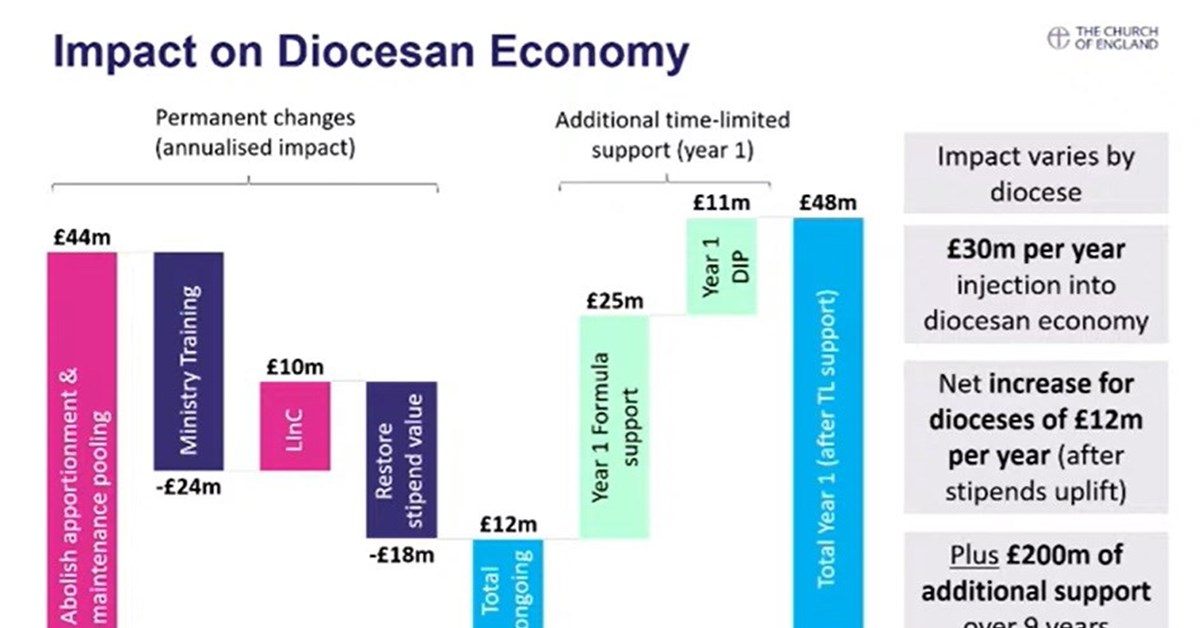
From this year, four of the five areas will be covered by distributions from the Church of England’s national endowment fund (managed by the Church Commissioners). A single Ministry Training Fund to cover ordination training costs — including all fees, living allowances, and expenses — is being established and will be largely funded by dioceses. Contributions will be set to reflect clergy numbers, investment assets per capita, and population income. Dioceses will contribute about £24 million a year in total.
The abolition of apportionment is expected to save the dioceses about £20 million in total, helping them to cover the £18-million cost of increasing stipends from April 2026 to catch up with historic inflation.
In addition to this, 28 dioceses will benefit from a £10-million increase in Lowest Income Communities Funding, while short-term financial support of £200 million will be distributed to dioceses over nine years to “ease pressures”, totalling £25 million this year. A further £11 million will be available to be awarded as additional time-limited support through the Diocesan Investment Programme “to help dioceses to sustain ministry whilst waiting for their longer-term plans to develop missional health and financial sustainability to bear fruit”.
Last year, the Bishop of Hereford, Dr Richard Jackson, suggested that there was “a certain amount of smoke and mirrors going on” when it came to the package’s offer (News, 13 June 2025). Calculations he had made with his diocesan secretary suggested that his diocese would be just “£1000 better off”. The £200-million transitional support was set to taper “really quite savagely”, and he estimated that, “in three to five years, we will be worse off than we are at the moment.”
At a meeting of the General Synod last year, the chair of the Archbishops’ Council’s finance committee, Carl Hughes, said that, before the £200-million time-limited support, dioceses as a whole would be £12 million better off, but that this level varied by diocese, and seven would be “slightly worse off”.
This week, he said: “Whilst we know that these new mechanisms will not automatically solve dioceses’ financial challenges, this is an important step in simplification of financial structures and in ensuring more diocesan funds are spent on local ministry. We expect that the total net benefit to dioceses in 2026 will be over £50m, which we hope will both ease financial pressures and support the stipend increase.”