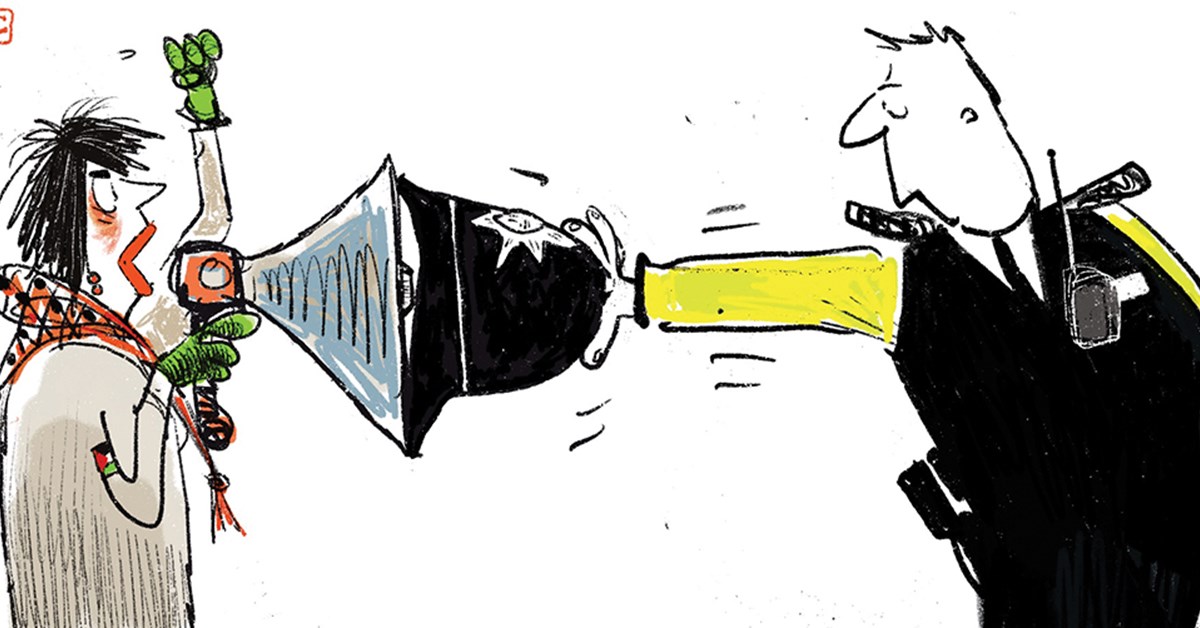
LISTENING to the Home Secretary, Shabana Mahmood, argue in the House of Commons last month that cracking down on protests was necessary to keep my community safe, I felt a familiar sense of dread.
The Crime and Policing Bill, which is going through Parliament, would allow the police to block protests that “may intimidate” worshippers “in the vicinity” of their place of worship. While this may sound reasonable, the Public Order Act already allows police to block protests that are intended to intimidate anyone exercising their rights.
But the new provision eliminates the need to establish intent and widens police powers to restrict demonstrations even when intimidation is not the purpose of those protesting. Furthermore, “in the vicinity” is so vague that it could apply to much of central London during the weekend, when both religious services and protests take place.
WHEN the Government announced this measure, it referred to the rise in anti-Semitic hate crimes as justification.
As an American Jew and alumna of Columbia University, I have seen at first hand the dangers of weaponising concerns about anti-Semitism as a pretext to police free expression and assembly. As a recent law graduate with an interest in human rights, when I tell people that I have moved to London, they often joke that it was to escape the Trump administration. My sincere response is that I fear that that the UK is on a similar path.
In March 2025, the US government froze billions of dollars of research funding to Harvard and Columbia universities, alleging “failure to protect students on campus from anti-Semitic discrimination”.
Harvard sued. Months later, the judge who dismissed the initial action as a violation of the freedom of speech wrote: “A review of the administrative record makes it difficult to conclude anything other than that Defendants used antisemitism as a smokescreen for a targeted, ideologically motivated assault.”
The US government also used anti-Semitism as a pretext to target my classmates. In the wake of an Executive Order that made it the “policy” of the US government to “prosecute, remove, or otherwise hold to account the perpetrators of unlawful anti-Semitic harassment”, the government cancelled the visas of nearly 2000 students, many of whom had participated in pro-Palestine protests or posted about Gaza online.
Last spring, friends from Columbia told me that they would not join me at peaceful protests for fear of losing their jobs (in the case of US citizens) or of being detained and deported (in the case of those on student visas). Others accompanied me, but felt safe doing so only while wearing face coverings, a practice that the UK is also trying to ban. This is the chilling effect that the weaponisation of concerns about anti-Semitism has had in a country with some of the strongest speech protections in the world.
ANTI-SEMITIC hate crimes in the UK have risen in recent years, but there is no clear evidence linking that rise to protests. Over 18 months, the Palestine Solidarity Campaign organised demonstrations against the war in Gaza which drew hundreds of thousands of people, including large numbers of Jews, with, according to their evidence to Parliament, no reported incidents of a threat toward a place of worship linked to the demonstrations.
The anti-Semitic attack at a synagogue in Manchester in October resulted in the killing of two Jewish worshippers and the attacker (News, 3 October 2025). But the Government’s response was to target protests. Ms Mahmood proposed creating “cumulative impact” powers, also being debated in Parliament, which would allow police to ban protests that they expect, on the basis of previous experiences, to cause disruption. Justifying this proposal, Ms Mahmood spoke about “the considerable fear within the Jewish community”.
In the wake of the anti-Semitic massacre in Australia in December (News, 19 December 2025), London and Manchester police responded by targeting speech and demonstrations. They pledged in a joint statement to “be more assertive” about “the words and chants used, especially in protests”. They also stated that “current laws are inadequate.”
These refrains were all too reminiscent of my own government’s commitments to “protecting” Jewish students like me, at the expense of human rights.
Recent developments in the US have also taught me that widely framed discretionary powers are ripe for abuse, both by the government that introduces them and by others to come.
Anti-Semitism can lead to terrible crimes. Nearly every Jewish family, including mine, has experienced persecution in its history. If this history has taught me anything, it is how precarious Jewish safety — and the safety of everyone — can become when state power is unchecked.
That is why, if you care about your freedom of speech and your right to express it in public spaces, do so. We are all safest when we are able to hold our governments accountable — and that includes exercising the freedom to protest.
Lindsay Saligman is the UK advocacy fellow at Human Rights Watch.