DR STEFAAN HAUTEKEETE is the Curator of Old Master Drawings at the Royal Museums of Fine Arts of Belgium (KMSKB). His own research concentrated on contemporary art, but a job came up in the collection of Old Master drawings 37 years ago. There cannot be a brush stroke or pen line that he does not recognise in any of these works on paper.
Over more than two decades, he has produced five outstanding scholarly catalogues with new research. For this exhibition in middle England, he has allowed Jane Simpkiss to select 65 masterpiece drawings. Only 13 have been exhibited in the UK before, a dozen of them more than 50 years ago.
Dr Hautekeete last month was crating up these rarely seen works — too fragile to be exposed to the light for any long period — but had generously found time to put out 25 of them, already in their box-frames ready for shipping to England later that week, making it possible to appreciate that drawing really is “the door through which one gains admittance to many arts”, as Karl van Mander (1548-1606) wrote.
If you are still kicking yourself for not taking my recommendation to see the Ashmolean exhibition “Breugel to Rubens: Great Flemish Drawings” (Arts, 26 April 2024), Jane Simpkins, the curator of this lively show, offers you a chance to catch up. Unlike then, here we also get to see Dutch works of art.
For a more detailed history of the wars of religion which scarred the landscape, readers will want to turn to the first part of Andrew Graham-Dixon’s recent book Vermeer: A life lost and found (2025). Caveat lector: ignore his increasingly maverick readings of the presumed religious hidden iconography of the paintings, presented with little hard evidence and much supposition.
As this exhibition demonstrates, artists travelled between the north (the seven provinces that had rejected the authority of the Habsburg Empire) and the southern provinces that formed the Spanish Netherlands, and the show therefore offers a comprehensive overview of the Low Countries.
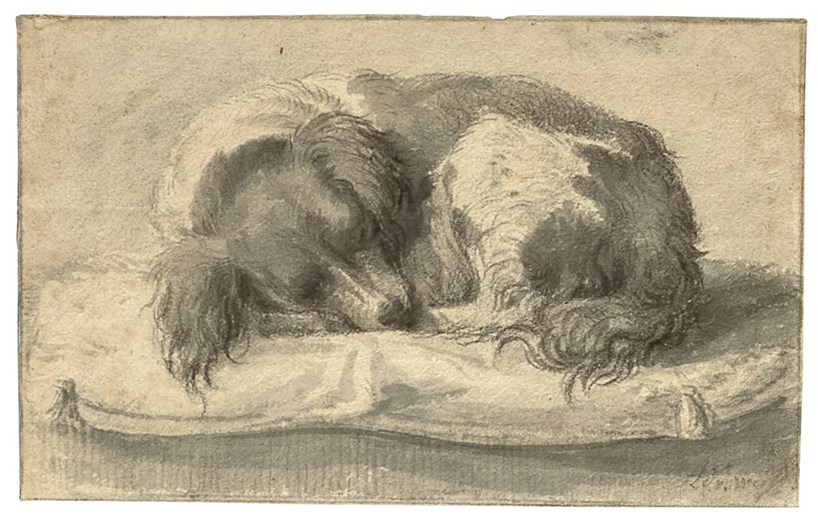 Royal Museums of Fine Arts of Belgium, Brussels / photo Grafisch Buro Lefevre, HeuleAdriaen van der Werff (1657-1722), Spaniel on a Cushion
It was an age of fear, famine and flood, a period of wealth, wonder, and wisdom, and an era that came to an end, or to a new beginning, with the millenarian dashed hopes of 1666. It is a fitting exhibition for our own day.
Drawing from life became increasingly important for artists across the period as a river view of his home town of Dordrecht by Aelbert Cuyp (1620-91), for once without a single cow in sight, shows. That informed a small oil painting of the same subject which has been loaned from the Dulwich Picture Gallery. By emphasising the foreground and offering the perspective of a low horizon, the artist draws us into the landscape. Birds fly off from a tree as a storm wind blasts through the branches of one tree drawn in brown ink by Adriaen Hendriksz Verboom from Rotterdam.
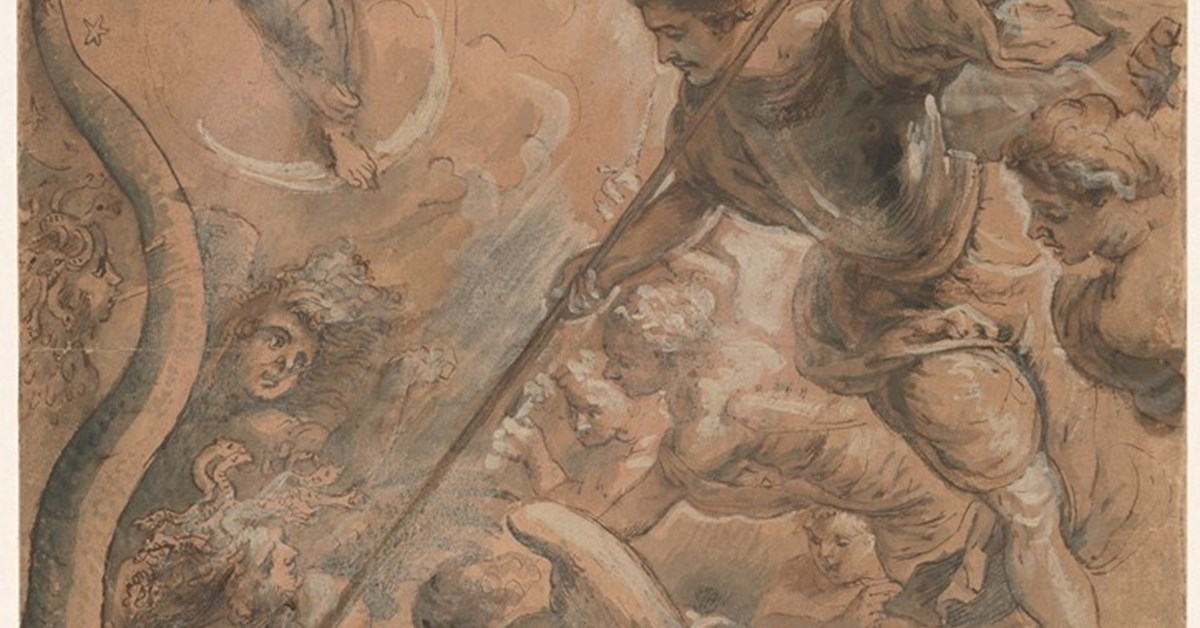
Artists continued to make academic copies of earlier works; one of the more extraordinary drawings that Hautekeete had left unpacked was an anonymous one, retouched by Peter Paul Rubens around 1620. In it, the Archangel Michael slays the rebel angels that, hydra-like, surge up from the lowest depths beneath the Virgin and Child. The original drawing was based on an altarpiece of the early 1590s by Jacopo Tintoretto which Rubens might well have seen in Venice when he travelled across Italy.
The exhibition is curated in sections that focus on life studies, landscapes, rural and urban life, views from outside the Low Countries, including Frans Post’s late 1630s observation of slave workers in a sugar press in the Dutch colony in Brazil, mythology, with a riot of male and female nudes, religion, and a final section celebrating the surrealist mad world of Bruegel.
If this exhibition does not persuade you to visit Flanders I do not know what else might, just as the permanent display of Neapolitan arts from 1600 to 1800 should send us all off to Partenope.
“Bruegel to Rembrandt: Drawing Life, Sketching Wonder” is at Compton Verney, Warwickshire CV35 9HZ, until 28 June. Phone 01926 645 500. comptonverney.org.uk