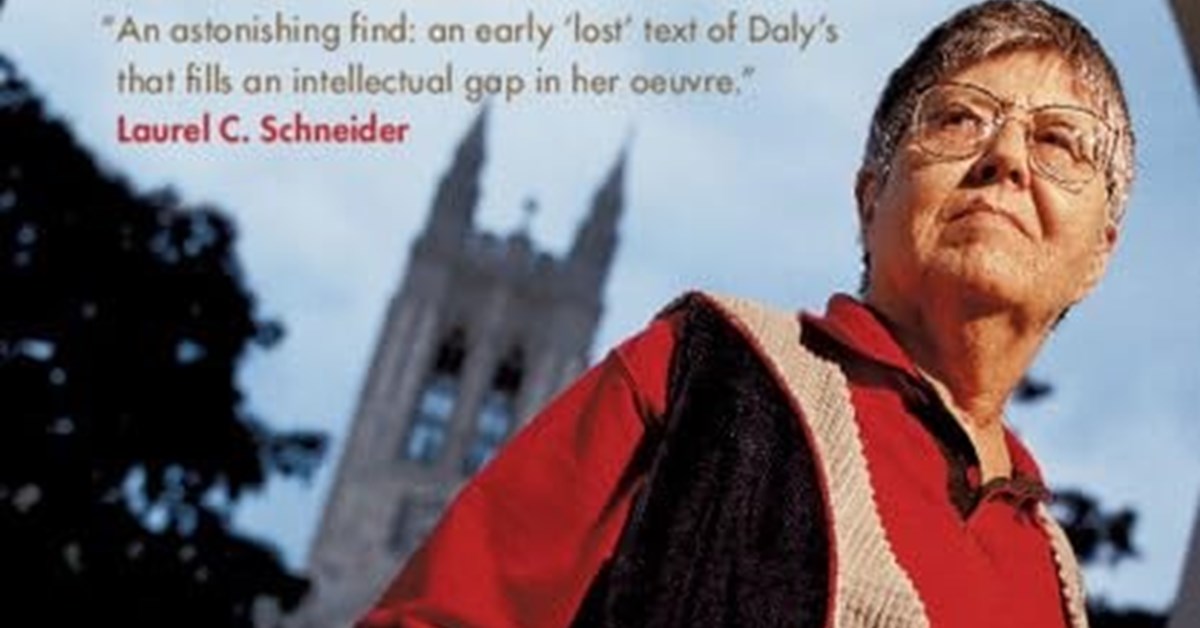
THIS is a many-layered book, and so, as with an archaeological dig, the reader needs to engage both with process and content. At its heart lies an original manuscript, discarded incomplete and abandoned by the celebrated 20th-century North American philosopher and theologian Mary Daly. The editor, Meg Stapleton Smith, teaches theology and ethics at Fordham University. She discovered these four chapters while researching her Ph.D. She has had them published here alongside scholarly articles that examine the author’s work in general and this contribution in particular, helping to locate it at a critical point in Daly’s thinking.
With doctorates in religious studies, theology, and philosophy, Daly was an inspiring lecturer at the Jesuit-run Boston College, in Massachusetts, from 1966. Then came the books: The Church and the Second Sex and Beyond God the Father. With Outercourse and Gyn Ecology, she explored the philosophical and ethical implications of what she had come to understand.
Famously, Mary Daly wrote, “If God is male, then male is God.” Her endorsement of radical feminism was total, and she became the flag-bearer and champion for a whole generation of young women and, indeed, men. She left the Roman Catholic Church, but could never completely shake off the way in which her thought had been configured by her study of theology and by her original mentors, notably St Thomas Aquinas, as evidenced here.
The title of this book promises much. See it in context, understand how her thinking was in flux, and it becomes something of a manifesto: after all, she wrote these chapters in 1969-70. Their backdrop was the Vietnam War, the Civil Rights Movement, and the rise of secular feminism, and Daly was experimenting with the end of her relationship with Catholicism and the beginning of her own journey into secularism.
Did she abandon the manuscript because these writings had become redundant? To her, possibly. To students and interpreters of her thought, evidently not, as the six insightful essays accompanying this publication make clear. They come from six university lecturers: four in the States, one from Dublin, and one — intriguingly — from Iran. Xochitl Alvizo, Lisa Sowle Cahill, Mary E. Hunt, Jennifer Rycenga, Siobhán Garrigan, and Zahra Moballegh share a common love for what have become known as Daly studies.
One quibble: in their commentary, the word “mystic” is used to describe Daly. I would prefer “visionary”, as it better reflects her ability to inspire and the lucidity and the sheer originality of her thought, even at its most extreme.
This not an easy book to read in 2026, as so many of the contradictions that she exposed lie unresolved. In the end, as Daly herself realised, the decision to stay within a named belief system or to go must lie with the individual. Certainly, all our Christian Churches stand judged by her lacerating indictment. Nowadays, she would find much to analyse in how we are perceived by our secular critics — the hypocrisy, the greed, the double standards — but she would have understood these as symptoms of a far deeper malaise: a flawed anthropology because “male is God.”
Lavinia Byrne is a writer and broadcaster. Her latest book is A Place of Belonging: Finding your space in the Bible during Lent and beyond (DLT) (Books, 30 January).
Catholicism: End or beginning?
Mary Daly
Meg Stapleton Smith, editor
Cambridge University Press £29.99
(978-1-009-18063-4)
Church Times Bookshop £26.99