(LifeSiteNews) — On October 21, Cardinal Blase Cupich released a reflection on the liturgy and its relationship to poverty. This letter sparked debate, and the renowned Italian theologian Father Nicola Bux wrote an open letter, published on November 18 on Edward Pentin’s Substack, which drew attention back to the heart of Christian worship: the manifestation of the mystery of God in the glory of the sacred.
According to Cupich, the liturgical reform inaugurated by the Second Vatican Council is in harmony with the “growing sense of the need for a new image of the Church, simpler and more sober […] not defined by the elements of worldly power.”
Moreover, according to Cupich, the reformed Roman Missal would thus have recovered its “ancient sobriety,” which had been lost over the centuries due to a Church made worldly by its own cultural hegemony.
READ: Pope Leo XIV issues joint blessing with Orthodox Patriarch Bartholomew
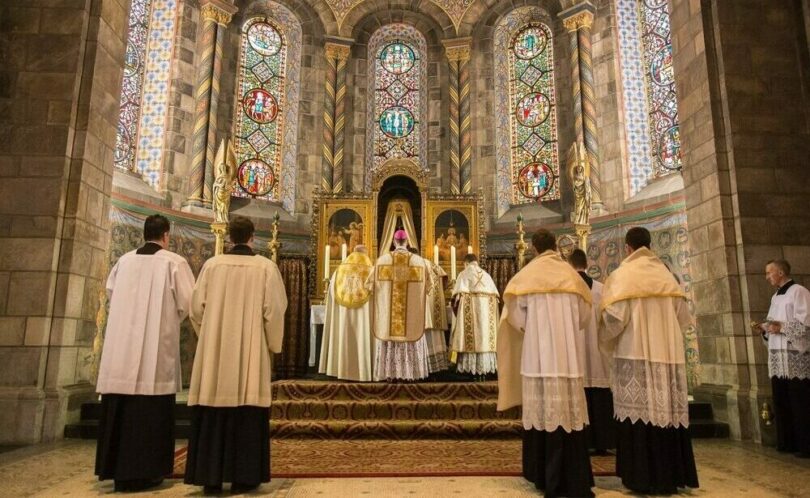
Fr. Bux’s open letter, rooted in a theological and historical reading of the perennial identity of the Roman Rite, challenges the idea that the liturgical Tradition is a form of “spectacle,” remote from the people of God. On the contrary, he argues that it is precisely the solemnity of worship that expresses Christ’s presence and converts the world.
Fr. Bux is a well-known Italian Catholic priest and theologian. He served as a consultor to the Congregation for the Causes of Saints (1998–2019), the Congregation for the Doctrine of the Faith (2002–2013), the Office of the Liturgical Celebrations of the Supreme Pontiff (2008–2013), and the Congregation for Divine Worship (2010–2018); and as assistant to the Special Secretary at the Synod of Bishops on the Eucharist (October 2–23, 2005) and at the Synod on the Middle East (2010).
A jurist and Doctor in Eastern Ecclesiastical Sciences, he has taught Eastern liturgy and sacramental theology at various prestigious universities (Jerusalem, Rome, Bari). A consultant and personal friend of Pope Benedict XVI, and currently of Cardinal Raymond Leo Burke, under whose patronage – together with the assistance of other distinguished theologians – he founded the Ecclesia Mater School. Through this institution, he promotes Catholic doctrine in Italy, in fidelity to apostolic Tradition and, in particular, to devotion to the Traditional Latin Mass.
LifeSiteNews: Father Bux, thank you for this conversation. In response to Cupich’s remark that the Church’s liturgy should free itself from all references to power in order to show closeness to the poor, you instead recall the “regal” nature of Christian worship against every sociological reduction of the liturgy. How do you judge the current tendency to interpret the liturgical reform almost exclusively through categories of material poverty and “social solidarity”? What doctrinal risks do you perceive in this semantic shift?
Bux: The current tendency is the effect of Karl Rahner’s “anthropological turn,” which has also penetrated divine worship: instead of speaking of God, one speaks of man and the world – the profane – a term indicating the reality of the world before and around (pro) the temple (fanum).
This word, temple, from the Greek temno, meaning the “enclosure” obtained by cutting out a portion of the world and consecrating it to God, is meant rather to recall man to set aside earthly cares, the affairs of daily life, and to devote mind and time to the eternal, the divine majesty of the Rex aeternus, from the Latin regere, “to sustain,” which is what makes worship – liturgy – “regal.” God sustains the liturgy!
Therefore, the liturgy is the pivot, the “culmen et fons” of the Church’s life. In this, Christianity connects with the religious sense of the ancients and brings it to fulfillment through the Incarnation of the Son. The term temple did not prevent, in the early Church, calling the place of worship of the assembly domus ecclesiae, the “house of the Church” gathered from every place.
However, the One who gathers is God; He is the builder, and therefore the first inhabitant of the domus, as affirmed by the rite of the dedication of a Church: it is thus the house of God, domus Dei et porta coeli, even though He is the One whom the heavens cannot contain. For the Israelite it was clear that worship took place in His presence, as the Psalms say. Thus, the doctrinal risk is that of evading this presence and treating worship as if God were not there and did not show us how He wishes to be adored.
READ: Catholics demand removal of ‘blasphemous’ Vienna exhibit mocking Jesus, Our Lady
LSN: In your open letter, you observe that the “noble simplicity” of Sacrosanctum Concilium does not mean aesthetic poverty, but the transparency of the mystery. In a time when many faithful perceive a dimming of the sense of the sacred, which concrete criteria can guide a genuine recovery of the ars celebrandi?
Bux: The liturgy makes the Lord present and evangelizes the poor first of all by its richness: the truth of the prayers and rites, the beauty and solemnity – terms that indicate grandeur, majesty, extraordinariness – and it lifts the poor out of the ordinary monotony of daily life.
Christ warned that the poor we always have with us, but we do not always have Him (cf. Mt 26:11). Hence the meaning of vestments, of sacred music and art, which must therefore distance themselves – seen especially in the Eastern liturgies – from popular and serial contemporary fashions. One cannot reduce sacred liturgy to a worldly rite that offers man what he already knows from daily life, but rather to that from which his soul truly longs to escape, so to speak, because it yearns for God. The poor are those marginalized by worldly power, whom Jesus has gathered into His house, the Church, to enrich them with grace, by which the liturgy ennobles them.
LSN: You state that the usus antiquior has resisted the secularization of the sacred. In what way can the traditional form of the liturgy today exercize an apologetic and missionary function, especially among young people who seek a more robust and identity-forming faith?
Bux: After the [Second Vatican] Council, emphasis was often placed on the Lord as the “completely other,” but then He ended up being reduced to one of us. Clearly, these expressions contain a part of truth, since the Son of God descended from Heaven, while at the same time never abandoning it (cf. Jn 3:13). Moreover, man has an immortal soul and carries with him, knowingly or not, the longing for his true homeland – Heaven.
If we carry out, with the Traditional Roman rite – just as with the ancient Eastern and Western liturgies – what in archaeology is called a “core sample,” we can grasp the entire patrimony of 2,000 years and more, if we also consider the Jewish worship from which everything took shape.
For this reason, the liturgy speaks of the truth of the faith in Christ, proclaimed throughout the ages, and it also speaks to us of the fact that it has withstood the test of time, and thus can answer the objections of those who think it outdated.
If it were not so, it would not attract so many young people and men throughout the world, “seekers of truth” like St. John Henry Newman. Instead, the more worship imitates worldly banalities, the less it attracts and the more it loses its missionary capacity.
LSN: Some argue that the distinction between “profane spectacle” and “sacred spectacle” is incomprehensible to contemporary man. How would you respond to those who believe that traditional solemnity risks being perceived as distant from real life and therefore pastorally ineffective?
Bux: If it were incomprehensible, if there were no difference, one could not explain the resistance and unstoppable advance – despite the obstacles of 60 years – of the Usus antiquior of the Roman rite. As I pointed out to Cardinal Cupich, the term “spectacle” is a double-edged sword: what matters is understanding the content being given form, or rather the dogmatic foundation, the fixed point of the liturgical rite.
In reality, there is disagreement within the Church on the nature of sacred liturgy: those who consider it sacred worship owed to God, and those who instead consider it human entertainment, perhaps with a religious veneer, as Ratzinger observed – thus a profane spectacle.
In truth, liturgy is a drama, in the sense that it transforms reality to purify it, and presents it again transformed precisely by divine intervention, and thus it is called “sacred.” It is the making-present of the event of Christ, the saving mystery of His Passion, accomplished once and for all in a bloody manner. It is the sacrament by which “Behold, He is with us always, until the end of the world.”
READ: Catholic priest: Saints, popes affirmed Mary is Co-Redemptrix, Mediatrix of All Graces
LSN: In your final appeal, you call for a “synodal dialogue for the unity of the Church.” What conditions do you consider indispensable for this dialogue – and the unity pursued – to be authentic, and not simply a one-way process that marginalizes the liturgical heritage of two millennia?
Bux: In the book La liturgia non è uno spettacolo (Italy, Fede & Cultura: 2025), published together with well-known Italian journalist Saverio Gaeta, we proposed to the Pope that he encourage the publication of the documents of the post-conciliar liturgical reform, the work carried out by the Consilium that implemented the Constitution on the Sacred Liturgy. Until this is done, it will not be clear what was executed and what was distorted with respect to the intentions of the Council Fathers.
This would provide a more objective view of the liturgical reform that followed, and would be of great help in resuming that “reform of the reform” hoped for by Joseph Ratzinger, who, as pope, judged it fitting to begin with the motu proprio Summorum Pontificum, fostering equal dignity and mutual enrichment between the Vetus and Novus Ordo.
Liturgical reform, like any reform in the Church, cannot be understood or carried out as a revolution, but as a renovatio: Pope Paul VI himself wrote this in the apostolic constitution Missale Romanum, with which he promulgated the new missal in 1970. The underlying principle recalled by Benedict XVI is this: what has been sacred for centuries remains such, and cannot suddenly be judged harmful or entirely forbidden.
Thus, the “rights of God” in the worship owed to Him must be restored and preserved through a Codex liturgicus regulating what the Constitution affirms, especially article 22c of Sacrosanctum Concilium: no one, not even a priest, may add, remove, or change anything in the sacred liturgy.
If the Pope addresses the matter, as he suggested in his interview with journalist Elise Ann Allen (Crux), with a “synodal” style and by seeking consensus, the “reform in continuity of the one subject, the Church,” hoped for by Benedict XVI in his well-known discourse of December 22, 2005, will resume. The renewal of the Church depends largely on the return of the liturgy to its sacred character, that is, directed to God, present and acting.
LSN: Finally, I would like to propose a provocative reflection. It seems to me that Cupich and other well-known ecclesiastical figures who claim to be liberating the Church from worldly influences of power are, in reality, the first to be influenced by them.
Throughout the centuries, the Church’s message has always been perceived as scandalous – a challenge to ideologies and to the ambitions of the powerful. Today, however, the Church is silent on many genuinely burning issues (I am thinking, for example, of the silence of the Holy See regarding the so-called end-of-life laws spreading in the West), or shows embarrassing “openness” on other topics (consider the LGBT issue). Who is it then, I ask myself – and I ask you – who is truly influenced by worldliness power?
Bux: In the recent book written with Vito Palmiotti, Realtà e utopia nella Chiesa (Italy, La Nuova Bussola Quotidiana: 2025), we observed that Pope Francis and Father Tonino Bello (1935-1993) – a very famous progressive bishop in Italy, who is being considered for the honors of the altars – often used the term “worldliness”: they condemned the world with regard to social inequalities, but then caressed it, following the prevailing thought – for example on migration and pacifism.
The Church is worldly when it follows the fashions of thought and action of the world in various areas of human life, rather than orienting the world toward eternal realities. What is worldliness, after all, if not conforming to the mentality of the present age?
The worldly mindset has ended up being favored, while clerics and faithful who hold the Catholic faith have been criticized and accused. Is all this a true reform? That the Church has a fallible and sinful human component we know, because the mystery of iniquity is at work.
READ: ‘War or peace depends on this’: Why the Five Saturdays Devotion is an urgent prayer for our times
But the grace of God is not in vain: it suffices not to set obstacles and not to remove the primacy of Jesus Christ. Grace and truth come to the Church from Him alone. If she no longer believes in Him, indeed if she uses Him as a pretext to speak of poverty and ecology, as though she were founded by Christ to eliminate poverty and save the planet from environmental problems, it is no wonder that hearts are not transformed.
The Church is totally relative to Jesus Christ, who said He came to bring judgment (cf. Jn 9:39). Therefore, pastors must submit to the judgment of Revelation, of His Word, everything that occurs in the world, the systems of thought and behavior, without being influenced, and without teaching an accommodating and flexible gospel.