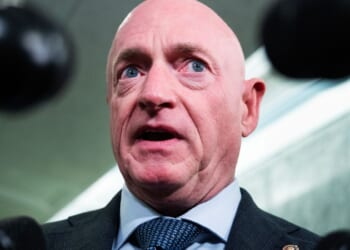
THE need for a public broadcasting network that prioritises “facts over partisanship” has “never been more vital”, the Bishop of Manchester, Dr David Walker, has said.
He was speaking on Thursday in a House of Lords debate on broadcasting.
The motion, “That this House takes note of recent developments in relation to broadcasting in the United Kingdom,” was moved by Lord Fowler (crossbench). The debate was held after the Government’s publication of the Green Paper on the BBC Royal Charter review on 16 December. The charter, which comes up for renewal every ten years, will expire in December 2027 (News, 19 December 2025).
Dr Walker said that broadcasters operated “in an international context of increasing polarisation, against a background where the greatest global political powers are retreating rapidly into levels of imperialist control and expansionism not previously seen in most of our lifetimes”.
In such a context, he said, “truth is subservient to expediency and honesty is sacrificed to personal or political advantage.” Many broadcasters lacked the interest or incentive “to do other than collude with the political masters of the age”, he said.
“In such a world, the place of broadcasters who seek to offer a balanced range of perspectives and prioritise facts over partisanship has never been more vital. Public-service broadcasting — and, in the UK, that does mean particularly the BBC — with a funding mechanism not wholly dependent on courting advertisers or placating the government of the day enables a level of impartiality, and thereby public trust, that exists both here and beyond these shores.
“Moreover, the BBC, uniquely among mainstream broadcasters, continues to afford a place for the religious and ethical input necessary to support our British values.”
As the next stage of the charter renewal process ensued, those involved must ensure that the BBC maintains “transparent operational independence from government”, he concluded.
The part played by radio in the future of broadcasting would be “vital”, he said, since “radio brings a level of immersive intimacy that even 3D movies fail to achieve”.
Lord Hall (crossbench) described the BBC as “the nation’s storyteller”. He said that viewing the BBC as “not only as another media organisation but as a cultural organisation, and part our social infrastructure, is crucial”.
Discussing the licence fee, Lord Hall said: “Let us make sure we have a properly funded BBC that reflects and celebrates who we are in all our rich diversity.”
Baroness Stowell (Conservative) said: “There is much that is great about the BBC and I want it to be part of our future, but as things stand — this is a big ‘but’ — we and BBC bosses are kidding ourselves if we believe the BBC is the solution to a divided society.”
Lord Hannay (crossbench) spoke about for Panorama and the “BBC’s major editorial blunder” in the editing of President Trump’s speech on 6 January 2021 (Comment, 14 November 2025). He also asked whether it “makes sense to impose on the director-general the choice between financing the BBC’s domestic programmes and its overseas ones”.
Viscount Colville (crossbench) spoke about development of artificial intelligence (AI). He said: “Now, we have a chance to develop digital technology imbued with ethical public-service values. . . Public-interest AI could be rolled out across the country to build trust in other services, such as secure age verification.”
Lord Grade (non-affiliated), who chairs Ofcom and described himself as a “veteran” of a previous BBC charter review, said that the charter review “always starts at the wrong point. . . That point is governance and funding.
“I therefore beg that the question about the future of the BBC is focused on what we want from it in this changed world. Parliament and the regulators have to create the conditions to help them to sustain their investment. Part of that will be serving all parts of the nations and regions, and part of that will be to preserve a plurality of trusted news and current affairs throughout the nations and regions.”
In her closing speech, the Parliamentary Under-Secretary of State at the Department for Culture, Media and Sport, Baroness Twycross, said that “the BBC fulfils a vital public service role, telling the story of who we are: our people, our places, and giving cultural definition to our communities.”
She also agreed with Baroness Stowell: “The BBC must own its problems and failings in order to rebuild trust.”