I HAVE five children. My youngest, Mira, is now 12 years old. Currently, her favourite things are — in no particular order — playing Mariokart on the Switch (a games console); spending time with friends; her stuffed elephant, Ella; family; and going to church. Mira is a very enthusiastic churchgoer, but she faces barriers that many others do not. She has quadriplegic cerebral palsy and epilepsy; she cannot eat or drink, and is fed through a PEG (a tube that leads directly into her stomach); she is a full-time wheelchair-user, and cannot walk, stand, or sit on a pew or normal chair; she cannot read; and her eyesight means that she doesn’t see everything.
At an obvious level, Mira (and many others also) would not be able to attend a church if there was no ramp or level access. But being truly inclusive is not simply about allowing people physical access to the building to attend a service: it is also thinking about how they can be fully involved in the life of the church.
RECENTLY, questions have cropped up regarding Mira’s involvement in church life. How can someone be baptised if they are older and can’t stand at the font, but are too big to be lifted in a dignified way? (And what if they scream every time water goes near their face?) How can someone receive communion if they can’t eat or drink? How does someone in a wheelchair engage with a service if they are short and their eyesight isn’t great, but the only area without pews is at the back of the church? These are all questions that we have faced as a family and that I have had to respond to, both as a father and as a vicar.
Mira was not baptised as a baby. Every time we had a baptism during the Sunday service, Mira would shout “Me turn!” There was no doubt whatsoever that she wanted to be baptised, but we had to think through the logistics. There were three options:
1. Say that it’s too difficult, but that there could be some kind of thanksgiving instead.
2. Go ahead and try to do the baptism, as we would for anyone else.
3. Make adaptations so that the baptism could be meaningful for Mira, and so that she could be fully involved in church life.
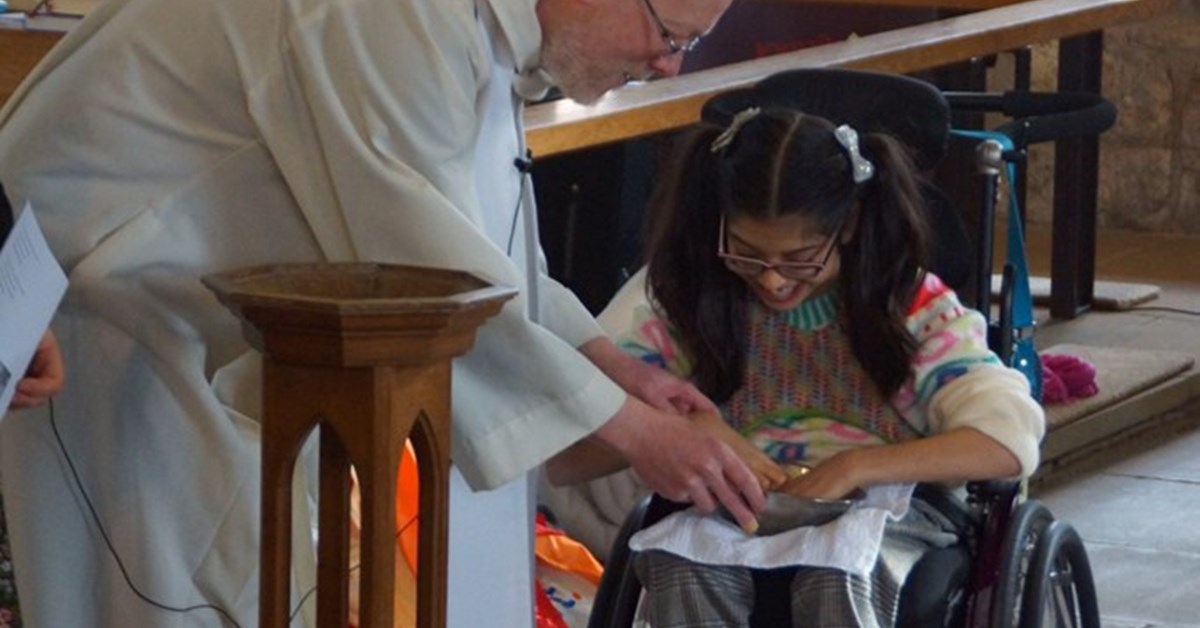
Unsurprisingly, we went for option 3. We borrowed a portable font of the right height from a neighbouring church, and I checked the baptism regulations, which state that water should be poured on the person being baptised, and that the water “must at least flow on the skin of the candidate”. And so, to Mira’s great delight, and to the joy of her parents, godparents, family, friends, and church family, she was baptised on 5 February 2023. Without a flexible approach to baptism, it might never have happened, might have ended up being undignified and upsetting for Mira, or might been a reduced experience, in which water was somehow flicked in her direction.
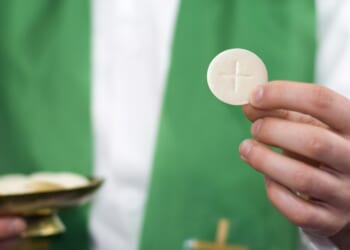
AFTER being baptised, Mira quickly realised that there was another key part of church life which other people did differently from her: receiving consecrated bread and wine at communion. In our churches, children are able to receive communion before confirmation, and some children at Holy Redeemer were preparing to do this.
Having given it some thought, I contacted the Suffragan Bishop of Selby, Dr Flora Winfield, and asked if it would be permissible to syringe non-alcoholic wine through Mira’s tube at communion. Dr Winfield could not have been more supportive, replying: “I am delighted to say that all my colleagues were of one mind in saying that you should go ahead and include Mira in Communion with the other youngsters, and the provision you make for her is quite acceptable. Reception in one kind is equally valid as in two.”
And so, to Mira’s great delight, and to the joy of her parents, godparents, family, friends, and church family, she received communion for the first time on 2 June 2024, alongside some other children. Again, this would not have been possible without an inclusive approach to communion.
LIKE many churches, Holy Redeemer had an area set aside at the back of the church where there were some books and colouring/drawing materials. Families know that they don’t have to sit there, but that they are welcome to if it would be helpful. The problem was that the area was so far away from the front that it was impossible for Mira — and other children, too — to see what was going on, and it was very hard to engage with them.
So, we moved the area from the back to the very front of church, acknowledging the risk that the children at the front, while simply being children, might be too much of a distraction for everyone else. Months later, the conclusion is that this has worked wonderfully well. Children are much more engaged with worship, they can actually see what’s going on, and many adults enjoy seeing the children in church.
Without an inclusive approach to the layout of the church, Mira and many others would continue to struggle fully to engage with church.
LIKE other churches, Holy Redeemer is on a journey. There is still work to be done to make the church inclusive in every sense, but relatively small changes have made a disproportionate difference to the life of one young lady — and plenty of other people, too.
Recently, I was away with Mira on a Sunday morning. As she loves church so much, I wanted to find a church that we could attend — but turning up to a random church is not straightforward. I had to look for churches that had ramps or level access and a layout that might work for a wheelchair-user. While I am sure that the village church would have been very welcoming, attending a service there was impossible, as there were steps up into the churchyard from the road, and a further step without a ramp up into the church.
EVERY time we go to a different church with Mira, we have to ask whether it is possible for her to attend. Imagine if, simply because you were you, you had to ask yourself whether you would be welcome at church. Imagine having to check a website, not to see whether there is a ramp, but to check whether you will be welcome and included.
I am transgender — will I be welcome at church? Will I be included or excluded? We are in a same-sex relationship — will we be welcome? I have a learning disability — will I be included or excluded? We can’t afford to give any money to church — will we still be welcome?
While most of us may never have needed to ask ourselves these kinds of question, many others have to do so regularly. As a church, I hope and pray that we can put ourselves in others’ shoes, and that we can seek God’s will together, always seeking to love our neighbours as ourselves.
The Revd Simon Biddlestone is the Vicar of Holy Redeemer, Acomb, in the diocese of York.