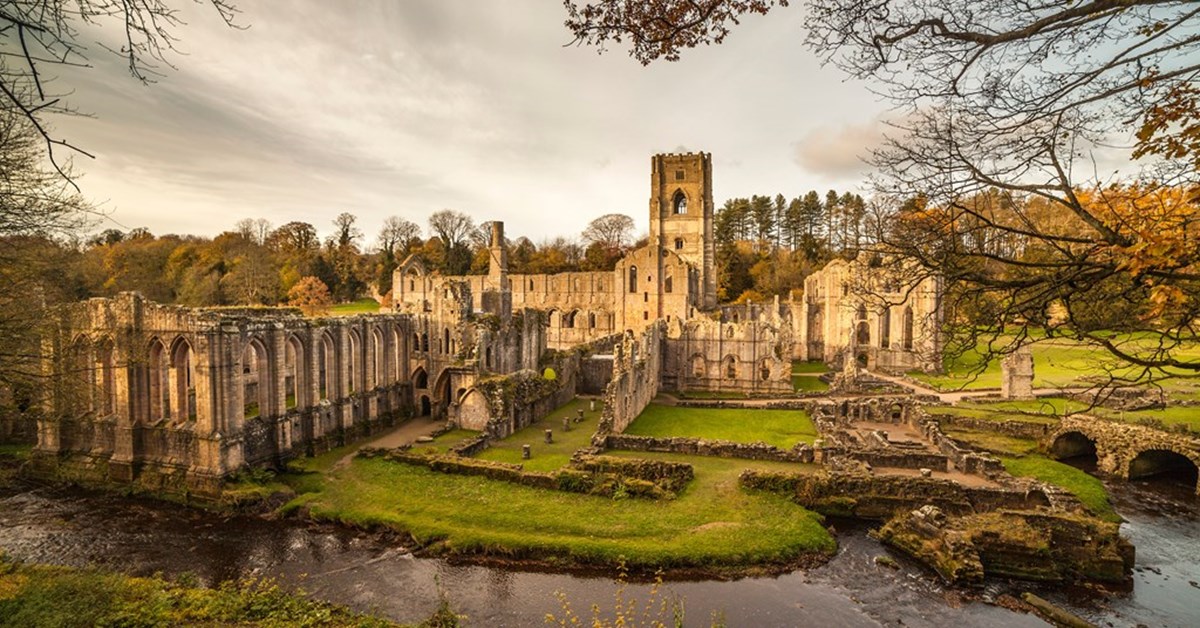
THE great medieval abbeys of Yorkshire are a well-kept secret. As a southerner, I had no inkling of them until, having made a mid-career move to far North Yorkshire and landed in a village midway between Harrogate and Ripon, I began to explore. Our new Ordnance Survey map showed Fountains Abbey just four miles distant, and I recall first approaching the deep valley of the River Skell on foot, much as the 13 founding Benedictine (soon to be Cistercian) monks would have done in 1132.
The plundered remains of the vast abbey are hidden from view: a local secret, too. It is only as you get close to the site that the 14th-century Huby’s tower appears, and the whole range of ruins. The monks chose with care: the river provides fresh water; the valley floor is flat, with one precipitous, river-carved side, providing stone for building; the site is remote, sequestered. A perfect place for prayer and reflection.
Part of a World Heritage site, along with the neighbouring Studley Royal estate, with its 18th-century water gardens, classical temples, and serpentine tunnel, the abbey ruins could now be little more than a Gothic backdrop. Its grounds entertain day-trippers from Leeds and further afield, with their picnic rugs and baskets, balls and frisbees. Somehow, though, holiness remains. Whenever I enter the great nave and approach the site of the high altar, I feel compelled to kneel — to the possible bemusement of others. But it seems right to kneel “where prayer has been valid”; to recall the seven canonical hours of Cistercian practice; and to acknowledge the spiritual and cultural loss of the 1549 Dissolution, the poignancy of the “bare, ruined choirs”.
“HOLINESS” is hard to define. But Keats spoke of “the holiness of the heart’s affections”, and, for me, one aspect of the holiness of Fountains is the recollection of those dear to me with whom I have shared the place. One of my oldest friends — a writer — and I hopped over the barbed wire into the grounds for a memorable walk shortly after the National Trust had been given the site and before its visitor centres and worldwide fame. Another old friend — a bishop’s granddaughter, who had sustained us in the early days of our family life — was among the first to enter with me through the original official entrance in the Skell Valley.
We celebrated one daughter’s birthday at Fountains, during a hard patch in her early teens, complete with our own picnic basket and rugs. And there have been endless family walks, involving the precious gift of conversation. On several occasions, my younger brother—– now, alas, no longer with us — and I took the “seven bridges” walk down the Skell Valley, out of sight of the ruins, emerging from woodland to a glorious, open vista of Ripon Cathedral.
Conversation, exploration, reflection — Fountains is an unparalleled setting for them. So much of our Anglican inheritance — and our English history, too — is somehow embodied here. The ruins themselves speak of change and decay, but also of One who changes not. The wild garlic and celandines of spring evoke renewal, and the confirmation that nothing is ultimately lost. Fountains is truly a holy place: one to “grow wise in”, as Larkin puts it, “if only that so many dead lie round”.
The Revd Dr John Caperon is a former deputy head of St Aidan’s High School, Harrogate, and sometime assistant curate of Knaresborough.