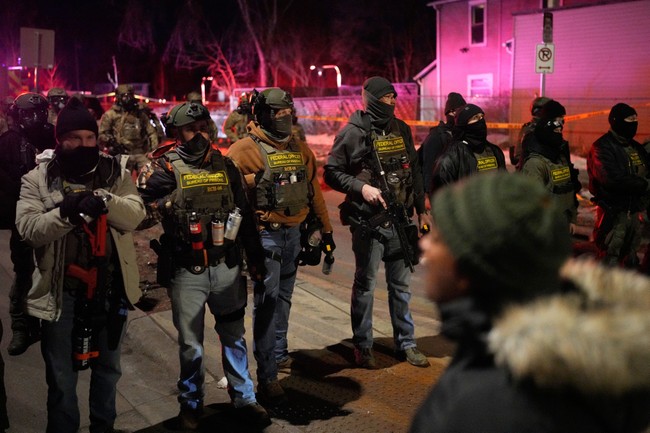
In a bit of a surprise ruling on Saturday, a judge in the United States District Court for the District of Minnesota denied the state’s request for a preliminary injunction regarding the Trump administration’s immigration enforcement operation in the state, dubbed “Operation Metro Surge.”
🚨🚨🚨BREAKING: Trump win in Minnesota where state tried to interfere in Operation Metro Surge. Of course, judge has to hedge her rejection of injunction as limited to that question implying that it is still problematic. pic.twitter.com/67v6n3KW1c
— Margot Cleveland (@ProfMJCleveland) January 31, 2026
The suit was filed on January 12, 2026, by the State of Minnesota, the City of Minneapolis, and the City of St. Paul against the Department of Homeland Security (DHS), DHS Secretary Kristi Noem, and other DHS officials, and asked the court to declare the surge unlawful and enjoin the administration from implementing the surge.
In a 30-page order entered Saturday morning, Judge Katherine Menendez, a Biden appointee, declined to grant the plaintiffs’ motion, explaining at the outset:
The Court pauses to observe what it is not deciding. At this stage, the Court makes no final determination on the merits of any claims asserted by Plaintiffs. Nor does the Court offer any opinion about the wisdom of Operation Metro Surge. And the legality of many of the specific actions taken by federal agents during the operation is not before the Court in this case. Instead, the Court only decides whether to grant the extraordinary remedy of a preliminary injunction halting a federal law enforcement operation based upon the Tenth Amendment. In answering this question, the Court must view Plaintiffs’ claims through the lens of the specific legal framework they invoke, and, having done so, finds that Plaintiffs have not met their burden. For the reasons discussed below, the motion is denied.
Ultimately, Menendez determined that the plaintiffs were not likely to succeed on the merits of their claims. Their Tenth Amendment anticommandeering argument (the idea that the federal government should not infringe on a state’s sovereignty) would require extending existing precedent into a new context — challenging an expansive federal law-enforcement deployment. As Menendez noted, existing anticommandeering caselaw involves clear statutory compulsion on states, which this case did not present. Per Menendez, “None of the cases on which they rely have even come close. While the novelty of Plaintiffs’ claims does not necessarily preclude their ultimate success on the merits, it weighs against the propriety of preliminary injunctive relief.”
And though she found some merit to the plaintiffs’ argument that Operation Metro Surge was an attempt by the federal government to coerce plaintiffs into modifying or repealing their “sanctuary city” policies, she also found plausible the federal government’s argument that plaintiffs’ refusal to cooperate with its immigration enforcement efforts has been a hindrance necessitating the introduction of additional federal resources:
Based on the record before the Court, a factfinder could reasonably credit that Plaintiffs’ sanctuary policies require a greater presence of federal agents to achieve the federal government’s immigration enforcement objectives than in a jurisdiction that actively assists ICE.
Further, although Menendez acknowledged serious impacts on Minnesota communities and resources from the operation, she emphasized that an injunction barring enforcement of federal law would itself cause significant harm by impeding federal immigration law enforcement.
In other words, Menendez appears to have applied the law to the facts properly before the court in fairly straightforward fashion and, in this instance, found the plaintiffs have not met their burden, and an injunction is not warranted.
It’s worth noting that Menendez is the same judge who limited some ICE tactics in relation to the anti-ICE protests in a ruling earlier in January. It’s also worth noting that the 8th Circuit then stayed her injunction in that case.
READ MORE: Biden-Appointed Judge Neuters ICE — You Can’t Use Non-Lethal Weapons or Arrest ‘Peaceful’ Agitators
Of course, as with so many of these rulings, this is not the end of the line. The plaintiffs may well opt to appeal, though they’ll be mindful of the fact that the 8th Circuit isn’t likely to be inclined to rein in what was, in this case, a fairly restrained, well-reasoned decision — nor will the Supreme Court. So…this could be one they let go. For now.
We’ll keep an eye out and report on any further developments that warrant it.
Editor’s Note: Do you enjoy RedState’s conservative reporting that takes on the radical left and woke media? Support our work so that we can continue to bring you the truth.
Join RedState VIP and use the promo code FIGHT to get 60% off your VIP membership!