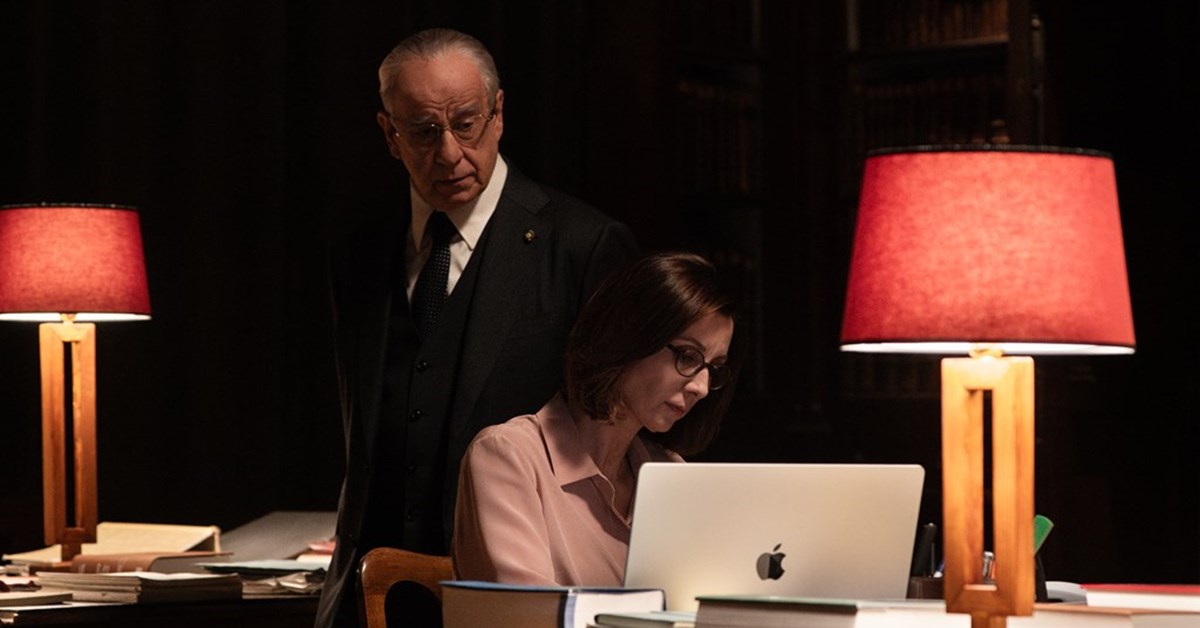
“WHO owns our days?” is a question that the film La Grazia (Cert. 12A) poses. It is the latest attempt by the writer-director Paolo Sorrentino, through his protagonist, President Mariano De Santis of Italy (Toni Servillo), to scale what he calls the impossible, i.e. the truth. Devoutly Roman Catholic and a renowned lawyer, Mariano deliberates during his rapidly receding tenure whether to sign a euthanasia Bill. He is also being petitioned to pardon two different murderers.
Meanwhile, his horse, Elvis, remains in agony — possibly an indication of the President’s likely attitude towards impending legislation. Dorotea (Anna Ferzetti), his daughter and judicial adviser, urges him to enact the Bill. Mariano is friends with the Pope — the Ivory Coast actor Rufin Doh Zeyenouin, refreshingly unconventional and sporting a long pony tail. He opposes euthanasia while qualifying his stance. God suggests questions and carefully avoids giving answers. “He keeps us alive with mystery.”
It is a statement congruent with much of Sorrentino’s work, which has repeatedly sought connections between faith and life. Witness Parthenope (Arts, 16 May 2025). Like Mariano, we may well desire some satisfactory reasons for our existence. And while, as a politician, he wrestles with humanity’s monumental issues, beneath it all lies an excruciating 40-year-old hurt: with whom was his late wife unfaithful? We may question, like him, why, in the light of eternity, it matters so much. Symbolising this are references to an Italian astronaut currently in space. Mariano watches him, in the absence of gravity, free-floating on-screen. In a gesture replicating Michelangelo’s The Creation of Adam, he extends a finger on to the image: his desperate attempt, perhaps, to transcend humanity’s earthbound existence?
Dorotea represents a more secular outlook. It is clear she considers that we, as people, own our days. Yet, when she visits Isa Rocca (Linda Messerklinger) in jail to consider grounds for pardoning Rocca’s murder of her husband, Dorotea is emotionally disturbed. Unlike her own life, governed by rules and life-long habits, this prisoner knows freedom. Mariano subsequently counsels Dorotea that the law looks at life only from a distance. One must see the truth close up, even if it takes our breath away.
But this doesn’t feel easier for him. To the Pope, he reels off a string of dilemmas. The Pontiff’s response is to recognise that Mariano has la grazia (grace). The man whose nickname, based on a career of solid judgement, is Reinforced Concrete finds that he can no longer live by the law. His Christian faith needs re-examination.
Being interviewed for Vogue, he admits that people feign certainties every day. “It’s called courage,” he says. The arena where his dying horse lies has the motto Virtus in periculis firmior (Courage becomes stronger in danger) emblazoned on its wall. The more we’re threatened the more we proclaim a certainty that doesn’t exist. “Grace”, says Mariano, “is the beauty of doubt.” A whole lifetime is insufficient to answer our questions. Sorrentino scatters beautiful touches of surrealism throughout La Grazia in a reminder of how much richness there is yet to discover if only we have the grace to trust.