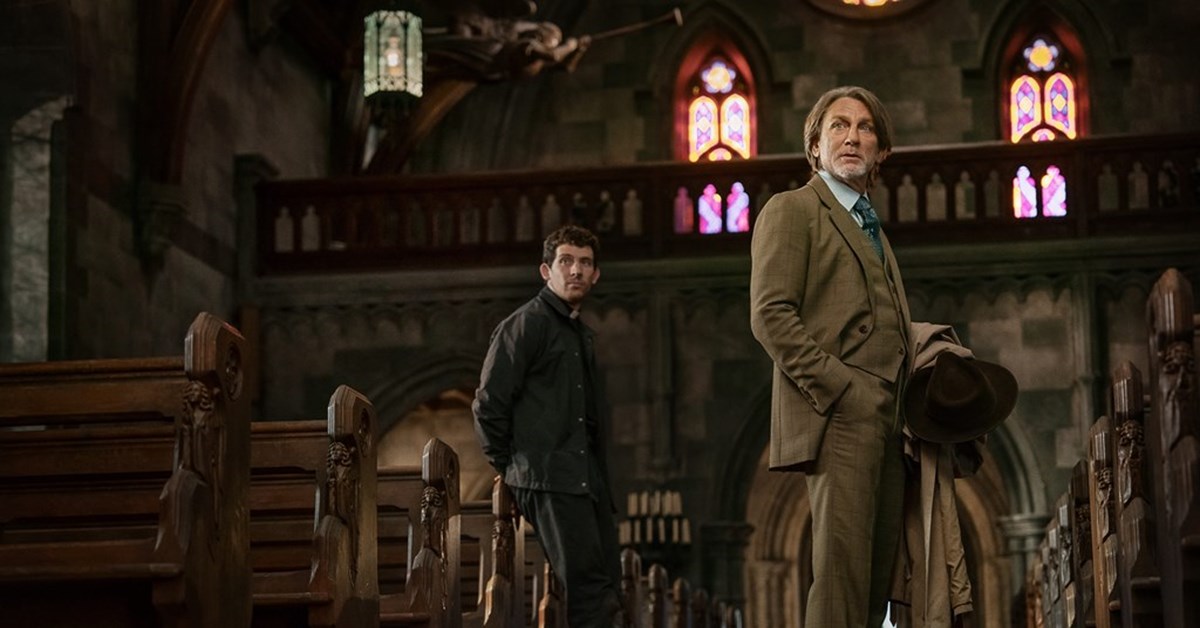
THE film Wake Up Dead Man (Cert. 12A) is the latest in the Knives Out series of crime mysteries. Remarkably, its star, Daniel Craig, as the private detective Benoit Blanc doesn’t enter the movie for about 40 minutes. Meanwhile, Josh O’Connor’s Fr Jud Duplenticy mostly carries the story, also acting as narrator. He is appointed assistant to Mgr Jefferson Wicks (Josh Brolin), a controversial priest in New York State.
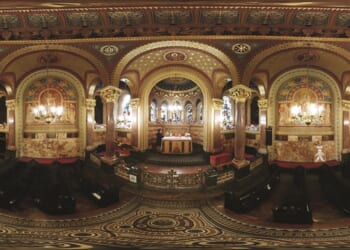
The film is made in the UK, where Holy Innocents’, High Beach, in Epping Forest, Essex, serves as the film’s Church of Our Lady of Perpetual Fortitude. Wicks’s bullying tactics instil fear into the remnant still worshipping there. One of them is reading John Dickson Carr’s crime novel The Hollow Man, possibly a variation on T. S. Eliot’s similarly titled The Hollow Men, which is a consideration of guilt-ridden broken lost souls. It aptly describes all Wicks’s followers. Angrily bellowing at them them, he preaches that the world’s a wolf and, if church members don’t take back control, there’ll be no church. Jud rejects this. Fighting like that, they will become wolves themselves.
Grace (Glenn Close) is general factotum in a church built by her grandfather, whose vast wealth mysteriously disappeared when he died. Several pointed references to Eve’s apple possibly offers some sort of clue. It set me wondering whether the writer-director Rian Johnson was taking up W. H. Auden’s tantalising suggestion that enjoying detective stories indulges a desire to be restored to the Garden of Eden, to a state of innocence; the relief that someone else is guilty, not us.
This film reinforces such notions while also confounding them. The circumstances under which the hateful Wicks is murdered appear to let all of the congregation off the hook. Everyone had a motive in what is known as a “locked-room murder”, a venerable form of narrative dating back at least to Edgar Alan Poe’s writings. This is when a killing occurs in circumstances seemingly unachievable for the culprit to access the location in order to commit the crime, and afterwards remain unspotted on departure. Those recurring shots of the John Dickson Carr paperback are the film’s acknowledgement that the author devoted a whole chapter to outlining various ways whereby murder can be committed in an impossible situation. It is a scenario hinting at divine intervention being the only explanation — which is exactly how some parishioners conceive it.
This is the precise moment for a deus ex machina. It comes in the flamboyant form of Benoit Blanc. His conversation with Jud makes it clear that faith has no part to play in his analysis of what has happened. “I kneel at the altar of rationality,” he says. We are subsequently given cause to doubt this statement; for the denouement, after many twists and turns, comes not through forensic detection, but something strongly allied to Christian faith.
Viewers may by then find themselves losing the will to livem as Johnson does take his time telling the story. And why some of its characters hang on in a church desperately in need of special measures may stretch credibility. It will prove difficult, none the less, to resist being swept off our feet by O’Connor’s stand-out portrait of holy endeavour.