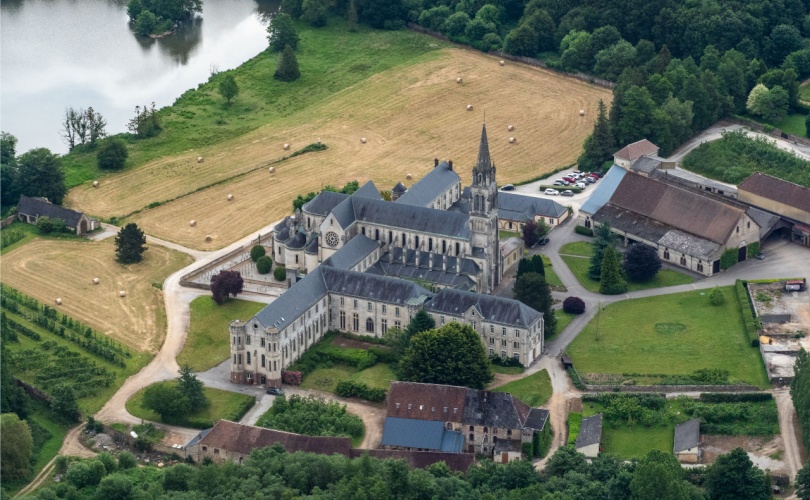
(LifeSiteNews) — The Cistercian monks of La Trappe Abbey in the village of Soligny-la-Trappe in Normandy, France, famous for brewing Trappist beer, announced last week that they are considering leaving their 12th-century abbey by 2028 due to a lack of vocations and financial hardship.
In a March 5 statement, the Trappists (officially known as the Order of Cistercians of the Strict Observance) announced that, due to a shortage of vocations and rising expenses, they may be forced to leave the nearly 900-year-old abbey by 2028. The monks of La Trappe are best known for brewing Trappist beer, which dates to the 17th century and has quickly become popular worldwide.
While some reports have claimed that the brothers had already moved or that the decision to move was final, the Trappists emphasized in their statement that moving is only under consideration at this time.
“It is true that, after much deliberation and given the scarcity of vocations and the increasingly heavy burden of property ownership, the brothers are considering leaving by 2028,” the statement read.
“Discussions are underway with other communities to find more suitable solutions that are more economically and spiritually relevant. The context has been difficult for several decades now, and many other abbeys have already changed hands,” the statement continued.
The Trappists further stressed that should the monks ultimately leave the abbey, it would impact not only their monastic community and the diocese but also the village of Soligny-la-Trappe, which the brothers have called home for centuries.
“While this is not a catastrophe, it is clearly the end of an era. Present for nearly nine centuries on an iconic site in the Perche region, the community has forged close ties with its surroundings: neighbors, the village, and the diocese,” the order said. “The departure of the brothers, which is very difficult and painful for them, will inevitably upset all those who have been attached to the community, sometimes for generations.”
The La Trappe abbey dates to 1140, when it was added onto an oratory founded by Rotrou III, Count of Perche, which he had dedicated to Our Lady. Seven years later, the monks stationed at the abbey, part of the monastic Congregation of Savigny, joined the Cistercians, an order dedicated to simplicity, poverty, manual labor, and fervent liturgical prayer.
This order underwent a major reform in 1664, led by Abbot Armand Jean le Bouthillier de Rancé, adopting stricter rules in response to spiritual laxity, including the addition of periods of silence, and became known as the Cistercians of the Strict Observance, or the Trappists. The monks, who had already been brewing beer at the abbey, began brewing their now-famous Trappist beer, which has since expanded to 10 breweries and become a popular beer worldwide.
Bishop Robert Barron of Winona-Rochester, Minnesota, expressed his sadness at the news that the Trappist monks are considering leaving their historic monastery and highlighted how the news showcases the spiritual disaster that has plagued Europe over the last century.
EXCLUSIVE: Brazil’s Catholic crown prince says the West must restore Christendom to survive
“That this venerable monastery cannot find enough vocations to keep it alive is, in my judgment, a sign of the spiritual disaster that has befallen Europe in the last hundred years: an ideological secularism that is rotting the soul of the West,” Barron wrote. “Let’s redouble our prayers that the monks of La Trappe might find a way to preserve their great Abbey. It is needed especially now.”
It was with real sadness that I learned that the monks of the Abbey of La Trappe in Normandy are considering closing down their operation. As the name suggests, this monastery is the mother house of the Trappist Order, a reform of the Cistercian movement and a particularly… https://t.co/GmAbqpFXth
— Bishop Robert Barron (@BishopBarron) March 10, 2026
Several historic monasteries across the globe have faced the prospect of closure in recent years for various reasons. In 2022, the historic Carmel in Philadelphia, which was the cradle of devotion to St. Therese of Lisieux in the United States, was suppressed by the Congregation for Religious Institutes under Cardinal João Braz de Aviz, purportedly due to the nuns’ stricter and traditional charism.
More recently, the City of Oradea, Romania, has attempted to force the eviction of the abbot of the 900-year-old Norbertine abbey of Oradea who had refused to hand over his property to the government.
READ: This Catholic abbot is standing strong against Freemasonic forces trying to confiscate his monastery