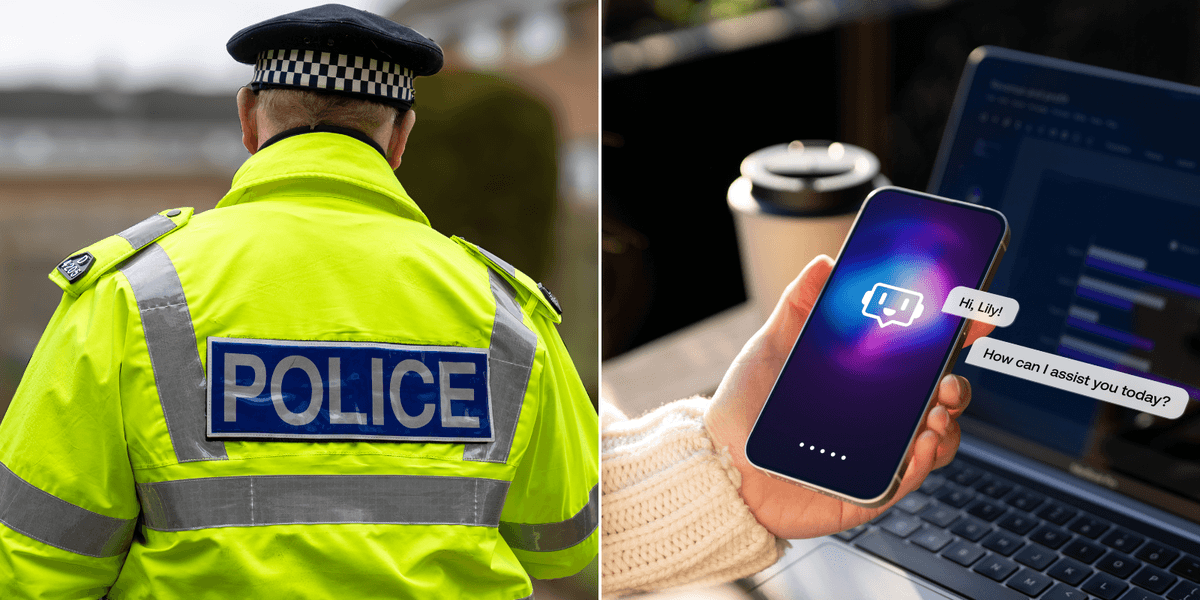
Police forces across Britain are set to deploy AI chatbots to handle non-emergency calls under Home Secretary Shabana Mahmood’s sweeping policing overhaul.
Under reforms announced in the Commons, AI software will assess the level of risk in public calls and determine whether police involvement is necessary.
The shake-up also includes a major expansion of live facial recognition, with the number of police vans equipped with the technology set to rise from 10 to 50.
The move will allow all 43 police forces in England and Wales to deploy facial recognition, up from just 15 currently using it.
Ms Mahmood said: “Criminals are operating in increasingly sophisticated ways. But some police forces are still fighting crime with analogue methods.”
At the heart of the reforms is a new Police.AI centre, tasked with overseeing the use of artificial intelligence across law enforcement.
The hub will assess AI systems for accuracy and reliability, support forces rolling out new technology and maintain a public register detailing how the tools are being used.
It will also introduce AI robots to replace administrative staff carrying out data entry, while algorithms will dramatically speed up the analysis of CCTV and doorbell camera footage.

AI software will assess the level of risk in public calls and determine whether police involvement is necessary (file photo)
|
GETTY
Other capabilities include identifying AI-generated deepfakes and reviewing detective casework in hours rather than days.
Home Office estimates suggest automating tasks such as redacting court documents, filing crime reports, translating material and analysing video footage will free up around six million hours of officer time each year.
Ministers say this is equivalent to 3,000 additional police officers, with £140 million committed to the technological transformation.
The Government’s white paper also sets out plans to merge England and Wales’s 43 police forces into as few as 12, although only one merger is expected to take place before the end of the current Parliament in 2029.
POLICE – READ THE LATEST:

Ms Mahmood claimed that ‘some police forces are still fighting crime with analogue methods’
|
PAA British equivalent of the FBI – dubbed the National Police Service – will also be created to tackle terrorism, serious organised crime and fraud.
The new body will absorb the National Crime Agency, Counter Terrorism Policing and regional organised crime units under a single commissioner, who would become the country’s most senior police chief.
However, the white paper concedes that neither the National Police Service nor the restructured force model will be fully operational until 2034 – leaving the reforms vulnerable to reversal by a future Conservative or Reform government.
The Conservatives have already signalled their opposition to the proposed force mergers.

Home Office estimates suggest the shift to AI could save police officers across Britain up to six million hours of frontline time
|
GETTYSir Andy Marsh, head of the College of Policing, rejected claims the changes would spell the end of neighbourhood policing, insisting the traditional community bobby “is reincarnated into 2025 policing”.
Met Police Deputy Commissioner Matt Jukes said officers would be better equipped, using facial recognition and AI tools to prioritise their work more effectively.
He claimed facial recognition was three times more effective than traditional methods for locating wanted suspects, revealing the Met scanned 4.2 million faces last year and arrested more than 1,700 people as a result.
Shadow Home Secretary Chris Philp dismissed the merger plans as counterproductive, warning that “mega-forces covering whole regions will be very remote from the communities they serve”.