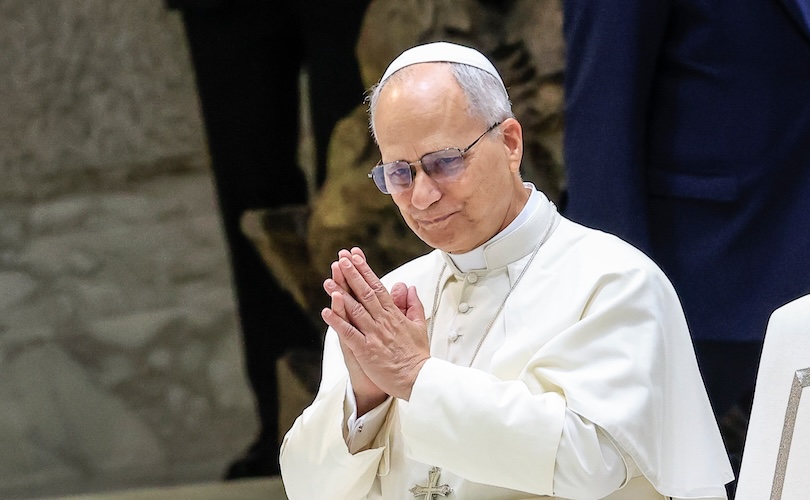
(LifeSiteNews) — German former bishop Reinaldo Nann has come to the defense of Pope Leo XIV in light of his participation in a 1995 Pachamama-related ceremony, arguing his presence was only an “interreligious” cultural gesture to honor the “soul of the Earth.”
On March 22, Spanish language news outlet Religión Digital published a defense of Pope Leo XIV by Nann defending Leo XIV against accusations that he participated in an act of idolatry during a 1995 ecological and theological congress in Brazil, where then-missionary Father Robert Prevost was photographed kneeling in the context of a ceremony associated with Pachamama, a pagan goddess linked to Andean religious traditions.
UNEARTHED: 1995 photo shows Pope Leo XIV participating in Pachamama ritual
“We see an interreligious act, where a representative of the Andean culture makes a payment to the Earth, an offering and a dialogue with the Earth. The gesture of prayer is not automatically adoration and the gesture of kneeling neither,” Nann wrote.
Nann was ordained a priest in 1987 in the Archdiocese of Freiburg, Germany. He worked as a missionary in Peru starting in 1991, therefore within the same cultural context and during a historical period similar to that of the events in question.
In 2017, he was appointed Bishop of Caravelí by Pope Francis. However, he resigned from episcopal office in 2024, and in the following year he married. According to the description provided by Religión Digital, he currently lives “in retirement and he lives out his prophetic vocation with a loving, critical, and constructive attitude toward the Church.”
“To put it bluntly: the young missionary Robert Prevost did in fact take part in this 1995 congress on ecology and theology, and during a ceremony dedicated to Mother Earth he did kneel,” Nann admitted. “But I don’t see any Pachamama statue in the photo – only men kneeling, and one of them raising his right hand.”
For this reason, he adds, “My interpretation of the photo, as a missionary who has studied Andean culture, is very different.” “What we see is an interreligious act, in which a representative of Andean culture performs a payment to the Earth – an offering and a dialogue with the Earth. Other people, including Augustinian priests, take part in this ceremony, which is part of Andean tradition. Andean culture preserves certain pagan beliefs, such as the idea that Earth has a soul similar to that of a person (just like water, a hill, or a tree).”
The article explicitly responds to interpretations advanced by outlets such as LifeSiteNews, Novus Ordo Watch, and InfoVaticana, which have described the act as idolatrous and suggested theological consequences for the legitimacy of Pope Leo XIV. Nann rejects this conclusion, stating that such readings “misunderstand” both the nature of the act and the intention behind it.
Justifying Prevost’s actions, Nann continues: “In pre‑Christian times Pachamama was a goddess, but today she is seen more as a creature of God with a certain personality. This is not in line with Western Christian philosophy; however, it does fit within Franciscan spirituality.” Nann’s reference points to Saint Francis of Assisi’s Canticle of the Creatures. “This is not syncretism; it is inculturation.”
“In the case of Pachamama, there are forms of ceremonies that do not contradict the Christian faith,” he continues. “We can kneel before her just as we kneel before the Saints. What matters is the intention. A gesture of prayer is not automatically an act of adoration, nor is the act of kneeling. This is exactly what the evangelical sects in Latin America always throw in our faces: they claim that Catholics worship the saints because we kneel before them. Now some Catholics themselves are using this argument against Pope Leo – it is the most absurd thing I have heard in years.”
Attributing a soul to the Earth implies an animistic worldview incompatible with Catholic doctrine, which holds that only living beings possess a soul and that only the human soul is immortal.
This perspective inevitably leads to pantheism, blurring the distinction between Creator and creature. Unsurprisingly, similar ideas have been revived by various neo‑Modernist theologians, such as the Jesuit Pierre Teilhard de Chardin.
Equally misplaced is the attempt to present the ceremony as a form of “veneration” of the Earth, comparable to the veneration of the saints. The Earth is not a spiritual subject with whom one can enter into dialogue: only the human being was created “in the image and likeness of God” (Gen 1:26–27). The saints are real persons, endowed with intellect and will, sharing in divine glory and capable of intercession. They belong to the communion of saints as living members of the Church.
Furthermore, in the canticle of St. Francis, creatures are called “brother” and “sister” in a poetic and analogical sense, as signs pointing to the Creator. There is no religious dialogue with them, nor any worship gesture directed toward nature. The intention was, in fact, to counter the Albigensian heresy, which denied the goodness of matter.
READ: UK Catholic bishops decry House of Lords vote to decriminalize abortion up until birth
Finally, regarding the argument about “intention” and the reference to evangelical polemics, it must be said that in Christian worship the object of veneration is theologically defined. In the case of Pachamama, however, the object of kneeling remains ambiguous and tied to a religious system both foreign to and incompatible with the Gospel.
“This worship has adapted itself to Christianity, and is now being horribly adapted to Western capitalism. Informal miners – and there are millions of them in Latin America – generally come from Andean culture,” Nann continues. “They know their work is extremely dangerous. Those who are very Catholic hire a priest to give a blessing before entering the mine for the first time. Others, who are not as Catholic, hire a shaman to perform a payment‑to‑the‑Earth ceremony. There are no human sacrifices there: only products of the Earth are offered. However, I have heard that in a very small number of cases animals or even people may have been offered in this context. It is not something normal,” the former bishop downplays.
Nevertheless, as shown by several independent sources, cases of ritual killings are more than mere exceptions. The wilancha rite is no exception either. The only reason such practices are not more widespread is the prevailing legal and cultural context, which condemns human sacrifice as abhorrent. In pre‑Columbian mythology, human sacrifice was, as is well known, the norm. Only Christianity put an end to that barbarity.