THERE are two approaches to thinking about the meaning of Jesus’s death. One focuses on the effect of his death on the individual believer. The other asks what has been achieved by that death, even apart from its impact on believers.
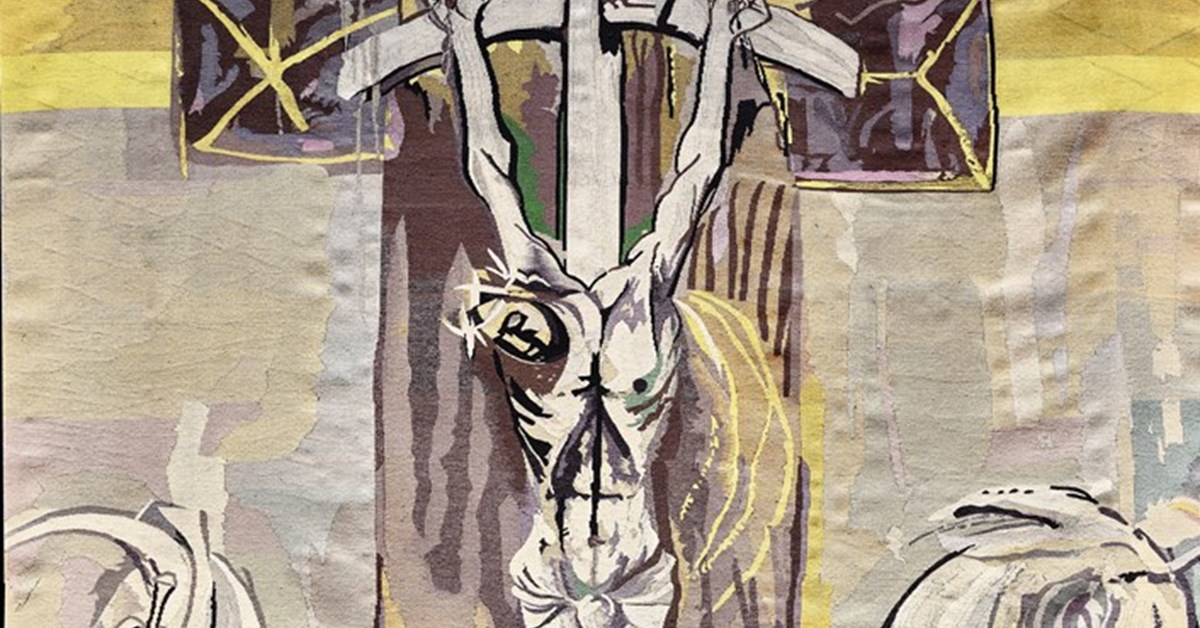
The first approach is easier to understand. When we stand or kneel before the cross, we confront the Son of God who has come among us to draw us into his Kingdom, and who, as a result, has suffered rejection and death. This both exposes the horror of human sinfulness and the extent of God’s love in his willingness to go through torture to take us to himself. The cross is the price he paid for reaching out to us, as the death of a soldier in battle is the price he paid for love of his country.
AUSTIN FARRER believed that, whatever images we might use to bring out some aspect of the meaning of Christ’s death, we had to say clearly what he had done. He put it like this: “In the saving action of the incarnation, God came all lengths to meet us, and dealt humanly with human creatures. . . He came among them bringing his kingdom, and he let events take their human course. He set the divine life in human neighbourhood. Men discovered it in struggling with it and were captured by it in crucifying it. What could be simpler? And what more divine?”
The incarnation was key to his thinking about our redemption: the setting of divine life in human neighbourhood. This was an actual event, with historical consequences: something objective. It led to the cross, and this had the effect of raising a large question mark against the values of every society and every individual. This in turn led to the breaking down of all barriers for the first followers of Jesus, which had the further effect of bringing into being a community of believers.
This was something achieved in history. But Farrer did not believe that the effects of the incarnation were limited to time and space. Whether in time or out of time, all would have the opportunity to recognise Christ in his people. His work of redemption, breaking down all barriers and reconciling them to the fount of their being, had universal significance. But he saw this universal significance not in mythical terms but in the actual working out of the incarnation, within time and beyond time, as it changes hearts and minds
THE other approach looks at what Christ’s death has objectively done, irrespective of its effect in converting hearts and minds. Down the ages there have been a variety of different images and myths used for this purpose, from ransoming us from the devil, to paying the price for offending the majesty of God. None has ever been made the official doctrine of the Church.
One, often put forward by conservative Evangelicals, is that sin has so alienated us from God that we deserve eternal death; however, on the cross, Christ has suffered that punishment in our place. For many people, this view of God is morally intolerable. For them, like Julian of Norwich, God is a God who pities us rather than blames us.
But, if God is committed to saving us rather than punishing us, is there not still some kind of metaphysical justice that demands to be satisfied? About the cluster of ideas which make up a penal substitutionary view of the atonement (as described above), Farrer wrote that, if this is taken as a piece of solid theology, “It is monstrous enough. The theologian will be bound to ask what he is to make of a debt to a Supernatural Bank of Justice. The idea is utterly meaningless; and if we try to give it substance by personifying the Bank as God himself, we merely exchange nonsense for blasphemy.”
FARRER strongly rejected the view that Paul taught that Christ propitiated God. He offered expiation, the spiritual cure for our sins. He equally strongly rejected the idea that Paul taught that God poured his wrath on Christ, or cut him off from grace as a substitute sinner on the cross. “Nothing of this sort is to be found in the Bible,” he wrote.
Nevertheless, all that having been said and accepted, there is in human life a strong sense that wrongdoing ought to be punished, and those who do wrong ought to suffer for it. This is not part of the outlook of God, and there is no metaphysical basis for it, but it remains a very powerful driver in human life and conduct.
MATTHEW PARRIS has argued that no doctrine of the atonement can be found in the teaching of Jesus, and that Christian thinking on the subject is a terrible muddle. He suggested it was invented by St Paul because it has deep cultural and psychological roots. Leaving aside his first points, he is surely right in the last assertion: that the Christian message about Christ dying to do away with human sin does resonate deeply. This is because — even apart from any guilt we may personally feel — there is that in us which is looking for someone to blame, and too often this takes the form of scapegoating some innocent person or group.
Against that background we know that, when things go wrong, the painful consequences of that wrongdoing are often borne by the innocent. A man goes to prison for some terrible crime. His mother visits him regularly, does not give up on him. She bears the pain of continuing in a supportive relationship. So with Christ. As Simone Weil put it, “All the criminal violence of the Roman empire ran up against Christ and in him became pure suffering. . . The false god changes suffering into violence. . . the true god changes violence into suffering.”
WHEN people are casting around for someone to blame, the acceptance of responsibility by someone can, as it were, make possible a fresh start. If an institution has failed people, and the chairman — though not personally culpable —resigns, there is a clearing of the air, with lessons to be learned and a different future.
The chairman, in such circumstances, can be said to have borne the sins of the whole institution. A price has been paid, and people can move on from looking for someone to blame. I do not believe that Justin Welby was personally culpable for the failures over John Smyth, but in resigning he has taken responsibility for the successive failures of the Church over this and other abuses. He has had to bear the cost.
Extending that analogy, Jesus, as it were, represents the Chair of the universe, taking responsibility for what the Book of Common Prayer’s Eucharistic Prayer describes as “the sins of the whole world”. This is not because God needs such a sacrifice, but because we humans do. The effect of the sacrifice is to do away with this whole quest to blame someone.
AS JAMES ALISON, one of those influenced by the thought of René Girard, argues in his recent extensive exploration of the language and imagery associated with sacrifice in the Bible (You Can If You Want To, Bloomsbury Continuum, 2026), such language is not there to assuage a punishing God, but to do away with this whole way of thinking.
We should “treat sacrifice as a largely tragic human ‘necessity’ since we don’t know how to live together without it, and what God was doing was not filling in something necessary in God but exploding from within something ‘necessary’ for humans, making it permanently and forever unnecessary”.
Freed from the drive to blame others and ourselves, our eyes are open to see the steady, undeviating love of God for us.
The Rt Revd Lord Harries of Pentregarth is a former Bishop of Oxford. He is the editor, with Stephen Platten, of Austin Farrer for Today: A prophetic agenda (SCM Press; 2020). richardharries.com