AUGSBURG, Germany (LifeSiteNews) — A German bishop has stressed that priests can never be replaced by laypeople.
Bishop Bertram Meier of Augsburg said on Wednesday during the Chrism Mass in the Augsburg Cathedral that priests are indispensable for the Catholic Church.
“No matter how many active men and women there are, they cannot take the place of a priest,” he said. “The priest’s ministry cannot be replaced by anyone, because what Christ does through him cannot be replaced by anything. And this ministry is, first and foremost, the ministry of the Eucharist.”
“God takes my life into His hands and leads me down a path that serves my salvation and the salvation of those entrusted to me,” he stated. “I must and am allowed to let something happen to me without being able to ‘do’ it myself.”
Bishop Meier noted that this sole power of Jesus Christ is expressed in the celebration of the Mass in such a way that the words and gestures of the priest are prescribed down to the last detail.
This is an admission, the bishop said: “We can only see ourselves as instruments of grace and as recipients.”
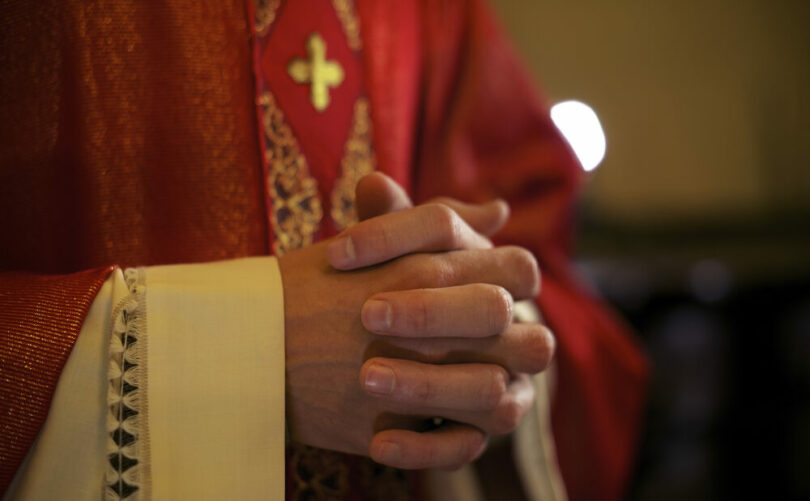
According to Bishop Meier, this also becomes clear in the drama of the Eucharistic Prayer. The celebrant surrenders the power of his hands to the Holy Spirit. This signifies neither arrogance nor presumption, but rather self-emptying and humility, for the priest does not obtain the authority to celebrate the Eucharist through the study of theology, but through the reception of the Sacrament of Ordination.
“Even as a priest standing before the congregation, I am first and foremost myself a recipient of the Body of Christ,” Bishop Meier emphasized.
The timing of the prelate’s defense of the sacramental priesthood is significant, as the German bishops have just handed over the statutes of a proposed “Synodal Conference,” a body that would purport to enable Catholic laity to share in the bishops’ authority, to the Vatican for approval.
The Synodal Conference was conceived as a continuation of the heretical Synodal Way that seeks to change Church doctrine. In the conference, bishops, other clergy, and laity will discuss and decide on ecclesiastical matters together. According to the statutes, the Synodal Conference will consist of the 27 diocesan bishops of Germany, 27 lay members of the Central Committee of German Catholics (ZdK), and 27 other Catholics (potentially clergy or laity) voted for by the Synodal Assembly.
Critics warn that this structure, which grants the laity authority in ecclesiastical matters, clearly violates the hierarchical and sacramental nature of the Catholic Church. Some conservative German bishops, like Cardinal Rainer Maria Woelki, Bishop Rudolf Voderholzer, and Bishop Stefan Oster, have therefore decided not to participate in the Synodal Assemblies anymore.
Cardinal Woelki also recently warned that Sunday Masses are being replaced by the Liturgy of the Word in many parishes, in what he sees as an attempt to become “independent of the priest.”
While Bishop Meier himself has not announced his retreat from the Syndal Way, he is seen as a moderate within the German episcopate and has criticized some of the project’s heretical aspects, such as attempts to change the Church’s doctrine on sexuality and not heeding to the Vatican’s corrections.