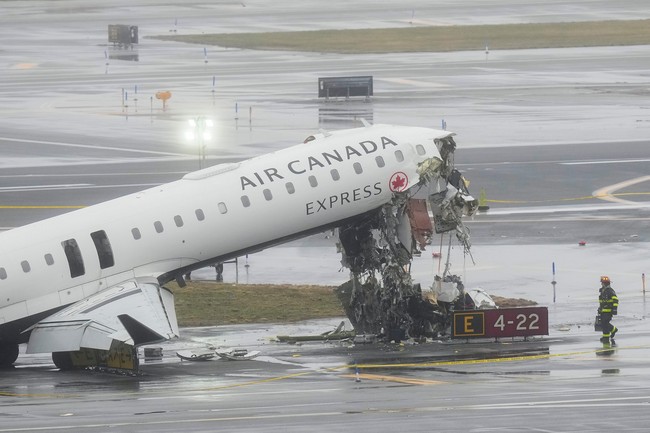
On Tuesday, the National Transportation Safety Board (NTSB) hosted an afternoon press conference and provided an update on the investigation into the tragic Sunday night collision between an Air Canada plane and a Port Authority fire truck at LaGuardia Airport (LGA) in New York.
NTSB Chairwoman Jennifer Homendy hosted the press conference, beginning with the current status of the investigation. Homendy noted that this was their first full day on scene. They started the morning with a two-hour meeting to organize their investigative groups. The entire NTSB team has now arrived. (Yesterday, they had significant delays with investigators getting there due to backups of Transportation Security Administration (TSA) lines. In fact, as Homendy noted, today’s press conference had to move because the security lines were wrapping around the building.)
As noted in Monday’s press conference, they were able to take possession of the cockpit voice recorder (CVR) and flight data recorder (FDR). Those were taken down to NTSB headquarters in Washington, D.C., and to their labs for downloading and analysis. They do have some information to share from the final three minutes of the CVR, though she cautioned that it is preliminary and still subject to change.
ALSO SEE: Nightmare at NYC’s LaGuardia Airport As Air Canada Plane Hits Vehicle, Multiple Casualties Feared
Homendy introduced Doug Brazy, the Investigator in Charge (IIC), a senior aviation accident investigator, who’s been with the NTSB for 34 years.
Brazy began by noting that the CVR contained over 25 hours of good-quality audio across four separate channels, and the FDR contained approximately 80 hours of data and recorded more than 400 parameters. He stated that the NTSB will convene a CVR Group tomorrow at their headquarters in D.C. to review the accident flight recording and produce a transcript.
He then provided a summary of the events captured on CVR during the final three minutes of the recording (all times are referenced from the end of the CVR recording):
- 3:07 – Approach controller instructed plane to contact LGA tower
- 2:45 – Flight crew lowered landing gear
- 2:22 – Flight crew checked in with LGA tower
- 2:17 – LGA tower cleared the plane to land on Runway 4 (R4) and advised that they were No. 2 for landing
- 1:52 – Flight crew set flaps to 30 degrees
- 1:33 – Flight crew set flaps to 45 degrees
- 1:26 – Electronic 1,000 callout occurred from the Enhanced Ground Proximity Warning System (EGPWS), indicating that the plane was 1,000 feet above the ground
- 1:12 – Flight crew confirmed landing checklist complete
- 1:03 – An airport vehicle made a radio transmission to the tower, but that transmission was stepped on by another radio transmission, source unknown.
- :54 – Flight crew acknowledged that the plane was 500 feet above the ground and on a stable approach
- :40 – LGA tower asked which vehicle needed to cross a runway
- :28 – Truck 1 made a radio transmission to the tower
- :26 – Tower acknowledged transmission
- :25 – Truck 1 requested to cross R4 at Taxiway Delta (TD)
- :20 – Tower cleared Truck 1 and company to cross R4 at TD
- :19 – Electronic 100 EGPWS callout occurred
- :17 – Truck 1 read back runway crossing clearance
- :14 – Electronic 50 callout
- :12 – Electronic 30 callout
- :12 – (same time) Tower instructed a Frontier flight to hold position
- :11 – Electronic 20 callout
- :10 – Electronic 10 callout
- :9 – Tower instructed Truck 1 to stop
- :8 – Sound consistent with landing gear touching down on runway
- :6 – Pilot transfer of controls (from one pilot to another)
- :4 – Tower again instructed Truck 1 to stop
- :0 – Recording ended
Following the summary provided by Brazy, Homendy returned to the podium and provided some additional context. First, she clarified that regarding the transfer of controls, they do know that the first officer was flying and transferred control to the captain.
She noted that the Aircraft Rescue and Firefighting (AARF) vehicles were responding to United Airlines Flight 2384, which was at the gate following two aborted takeoffs. ARFF was advised that there were fumes or smoke or some sort of smell in the cabin, so they were en route to address that. There were other vehicles behind Truck 1 that did not begin to cross the runway. They are still verifying how many. She also noted that Truck 1 did not have a transponder.
With regard to Air Traffic Controllers (ATC), they have conflicting information as to how many certified controllers were in the facility at the time, and the interviews with the ATC are beginning this afternoon. They have logs, but there’s conflicting information regarding dates and times, so they need to pin that down. They can confirm there were two people in the tower cab at the time of the collision: the local controller (LC), who signed in at 10:45 PM that night, and the controller in charge (CIC), who signed in at 10:30 PM that night.
Homendy also explained that the ATC positions were combined into two positions, which is standard operating procedure for the midnight shift at LGA, and also common practice across the national airspace. She did acknowledge that the NTSB has raised concerns in the past about midnight shifts and the issue of fatigue, but added that there is presently no indication that it was a factor here — just something they have focused on in past investigations
LGA has ASDE-X [Airport Surface Detection Equipment], a runway safety system that allows ATC to track surface movement of aircraft and vehicles. The NTSB requested the ASDE replay of the display of information that would have been available in the tower cab. Tech Center analysis shows the ASDE-X system did not alert, explaining: “ASDE-X did not generate an alert due to the close proximity of vehicles merging and unmerging near the runway, resulting in the inability to create a track of high confidence.” Homendy saw the replay and noted that, while there were two targets with radar returns on Taxiway Delta, on replay, it looks like two blobs, adding, “We don’t see any of them go in front of the plane on the runway.”
She cautioned against pointing fingers at controllers at this point or assuming that there was some distraction involved. This is a heavy workload environment, and there was the United Airlines flight issue they were addressing. They have to determine what happened at shift change and also determine who else was in the facility and available at the time of the collision. They do know that the controller was still on duty for several minutes afterwards, when normally, they would be relieved. So that raises the question as to whether there was anyone on duty to relieve him. They don’t know yet, and they still need to confirm what else was occurring at the time and what other traffic they were dealing with at the time.
Homendy also observed that the NTSB rarely, if ever, investigates a major accident where it was just one failure, adding that the aviation system is incredibly safe because there are multiple layers of defense built in to prevent accidents, so when something goes wrong, there are usually many things, a combination of factors.
Following her remarks, Homendy answered several questions from the press. The two key takeaways from that are that the lack of transponders on the trucks (none of those at LGA have them, though there are other airports whose trucks have them) makes it difficult for the ASDE-X system to adequately pick them up, and that, given the fact that LGA fields 900 flights per day, the practice of just having two controllers in the tower cab for the midnight shift may warrant a closer look, even if it is SOP across the national airspace.
The full presser may be viewed here:
NTSB will hold a media briefing today at 1:30 p.m. ET on the March 22 collision involving Air Canada Express Flight 8646 (Jazz Aviation, CRJ-900) and a firefighting vehicle on Runway 4 at LaGuardia Airport. 📍 LaGuardia Airport Terminal B upper-level corridor connecting Terminal…
— NTSB Newsroom (@NTSB_Newsroom) March 24, 2026
Editor’s Note: Do you enjoy RedState’s conservative reporting that takes on the radical left and woke media? Support our work so that we can continue to bring you the truth.
Join RedState VIP and use the promo code FIGHT to get 60% off your VIP membership!