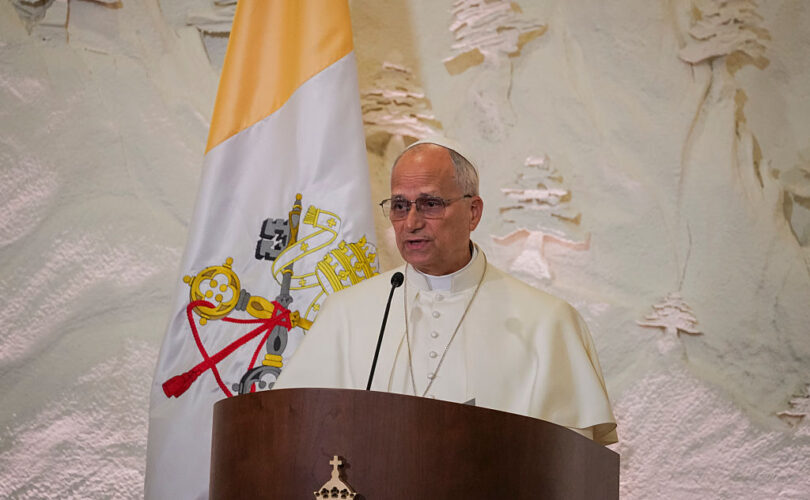
(LifeSiteNews) — Pope Leo XIV’s Catholic perspective on international relations, communicated via the Holy Father’s Jan. 9 “State of the World” address to foreign ambassadors accredited to the Holy See, has been taken to be an implicit criticism of the “Donroe Doctrine.”
In pursuit of hemispheric dominance, the Pope seemed to be saying, the U.S. should not abandon its longstanding efforts to promote democratic principles and uphold human rights around the world. Such higher values, drawing upon the spiritual insights that St. Augustine communicated 1,600 years ago in his famous Christian treatise City of God, can never be discarded in the international arena.
Three American cardinals, Cupich, McElroy, and Tobin, also recently criticized Trump’s foreign policy, although not as eloquently, for its retreat from multilateralism and globalism. They suggested that this was undermining America’s “moral role in confronting evil around the world.”
You would think that the first American Pope and the three American cardinals would know better. Those who read history understand that America has been upholding democratic principles, religious liberty, and human rights from the earliest days of the Republic.
Simply put, the Constitution devised by our Christian Founders is the greatest governing document ever struck off the mind of men, and its appended Bill of Rights forms the basis for the human rights that all Americans enjoy.
This year, as we celebrate 250 years of freedom, it is important to remember that our powerful example of ordered liberty has spread far beyond our shores. Our values and system of government has been, and continues to be, an inspiration for people seeking freedom everywhere in the globe.
Our Constitution is one of the most influential documents ever written. About 160 out of 170 existing national constitutions are based at least partially on the U.S. model. The Bill of Rights pioneered the idea of enshrining freedoms of speech, religion, press, assembly, and protections against unreasonable searches in a supreme legal document, and the majority of countries on the planet have followed our lead.
All this is to say that the United States — which is, by God’s grace, the largest, most powerful and most generous nation ever to exist on the planet — promotes its democratic values and upholds human rights by its very existence.
America has long been a beacon of freedom for liberty-loving people everywhere. This means that we can best promote democracy abroad by practicing it at home — by ensuring free and fair elections and a peaceful transition of power once the winner is determined. We can best uphold human rights by protecting the fundamental rights of all of our citizens, including the unborn, and by ensuring that our borders are protected, our streets are safe, and that every American has the opportunity to succeed.
READ: Cardinals’ letter against Trump’s foreign policy is a blatant political attack
The more successful we are in putting our God-given principles into action at home, the more attractive our model becomes to others and the more they seek to emulate us. The best example of this came in 1989 with the fall of the Berlin Wall and the collapse, two years later, of the Soviet Union.
President Reagan may have called for the Berlin Wall to be torn down, but it was the peoples of Eastern Europe and the Soviet Union who, encouraged in their fight for freedom by the Gipper, brought it down. And it is the U.S. that today is inspiring the cries of the people of Venezuela and Iran for liberty.
We cannot impose our democratic principles and human rights values on others by force, as our costly failures in Iraq and Afghanistan once again proved. The American model can only be “imported” by a like-minded population, not “exported” by us to one totally alien to its basic beliefs.
The Holy Father drew attention to the decline of international multilateralism, lamenting that the framework “established after the Second World War, which prohibited nations from using force to violate the borders of others, has been completely undermined.”
But that “framework,” as Pope Leo surely knows, did not arise from nothing.
Rather, it was the creation of the United Nations — an idealistic effort to encourage the nations of the world to join with us to prevent a Third World War and to ensure that the human rights of all peoples are respected by their governments.
Sadly, this effort has failed. The United Nations is powerless to prevent conflict, and no longer effectively promotes human rights. In fact, the UN’s Human Rights Council has, perversely enough, has long been under the control of some of the most lawless states in the world.
The Trump administration’s new “National Security Strategy,” released in November, recognizes this. It is precisely the failure of international multilateralism that has led Trump to act unilaterally. To date, without firing a single shot, he has ended eight wars, several of which could easily have erupted into regional or even global conflagrations.
Trump is not an aspiring hegemon, and the goal of the “Donroe Doctrine” is not American hegemony over the globe, or even the hemisphere. Rather, his goal is to protect the U.S. — and the hemisphere — from the country that does want global hegemony: China.
In this, President Donald Trump is very much in alignment with President James Monroe. The Monroe Doctrine did not assert U.S. primacy over the entire Western Hemisphere. Rather, it told the Europeans that the newly liberated Latin American countries were no longer open to future European colonization or attempts to reimpose control, and that any European attempt to extend its political system, oppress independent governments, or meddle in the affairs of the Americas would be viewed as a hostile act toward the United States.
We were not then, and we are not now, seeking to control the Western Hemisphere, but rather seeking to prevent other nations from controlling it. And, in Venezuela, we had a regime under Maduro which had fallen under China’s influence, was brutalizing its own people, and was killing Americans.
Does anyone doubt that removing Maduro at least opens the opportunity for the advancement of democracy, human rights and religious freedom in Venezuela? Does anyone doubt that the ultimate aim of the U.S. will precisely be, as Pope Leo suggested, “to respect the will of the Venezuelan people and to safeguard the human and civil rights of all, ensuring a future of stability and concord”?
I, for one, do not.
The Trump administration is not discarding the Christian virtues that St. Augustine communicated 1,600 years ago in his famous treatise City of God, in the international arena or anywhere else. It is putting them into practice, for that is the American way.