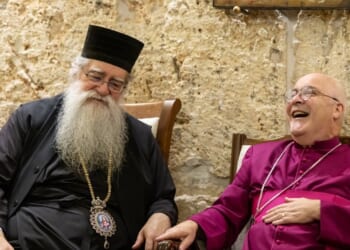
THE resolution this week of a dispute between the Latin Patriarch of Jerusalem, Cardinal Pizzaballa, and the Custos of the Holy Land, Fr Francesco Ielpo OFM, on the one hand, and the Israeli authorities, on the other, is to be welcomed. The Cardinal and the official custodian of the Church of the Holy Sepulchre had been barred from entering the church to celebrate mass privately on Palm Sunday. The ban, by Israeli police, caused understandable outrage among church leaders around the world.
The plight of Christians in the Holy Land, the vast majority of whom — some 79 per cent — are Arab or Palestinian, is, in fact, far from being a new issue that has arisen only since the war of the Israeli–US alliance against Iran. The latest annual study by an Israeli group, the Rossing Center for Education and Dialogue, Attacks on Christians in Israel and East Jerusalem, underlines the problem. The report identifies a “continued and expanding pattern of intimidation [of] and aggression” against Christian clergy and church property in 2025: it says that there were 155 documented incidents last year. The report demonstrates that most of these were physical attacks, commonly spitting, directed at easily identifiable Christian clergy.
Although 72 per cent of the respondents said that their freedom to worship was largely intact, the survey found that, in 2025, churches perceived a threat to the status quo in the pattern of increasing restrictions of access to religious celebrations. Since the 2021 Mount Meron tragedy, in which 45 men and boys lost their lives in a crush during a Jewish religious gathering, “authorities have significantly reduced the number of attendees at highly important liturgies.” At Nazareth, in December 2025, police imposed restrictions on the Christmas tree-lighting ceremony, ordered shopkeepers to close their stores, and limited attendance to 1000 people — significantly fewer than were in the crowds that the event drew regularly before the war in Gaza.
The report says: “While these measures cannot be defined as outright violations, they are perceived by the Christian community as. . . the slow increase of systemic pressure on the life of Christians.” And while “freedom of religion is ostensibly guaranteed, [Christians] have experienced a gradual, subtle erosion of both their symbolic and physical spaces”.
Christians are in many ways the quietest voices of the three monotheistic religions in the Holy City, drowned out by louder Muslim and Jewish groups. Church leaders face a balancing act, and need to keep the Israeli authorities onside, as the row over Palm Sunday illustrates. Holy Week and Easter are the time when Jerusalem is most in the hearts and minds of Christians — but it is becoming increasingly difficult for them to witness to their faith in the land where Christ himself lived and died.