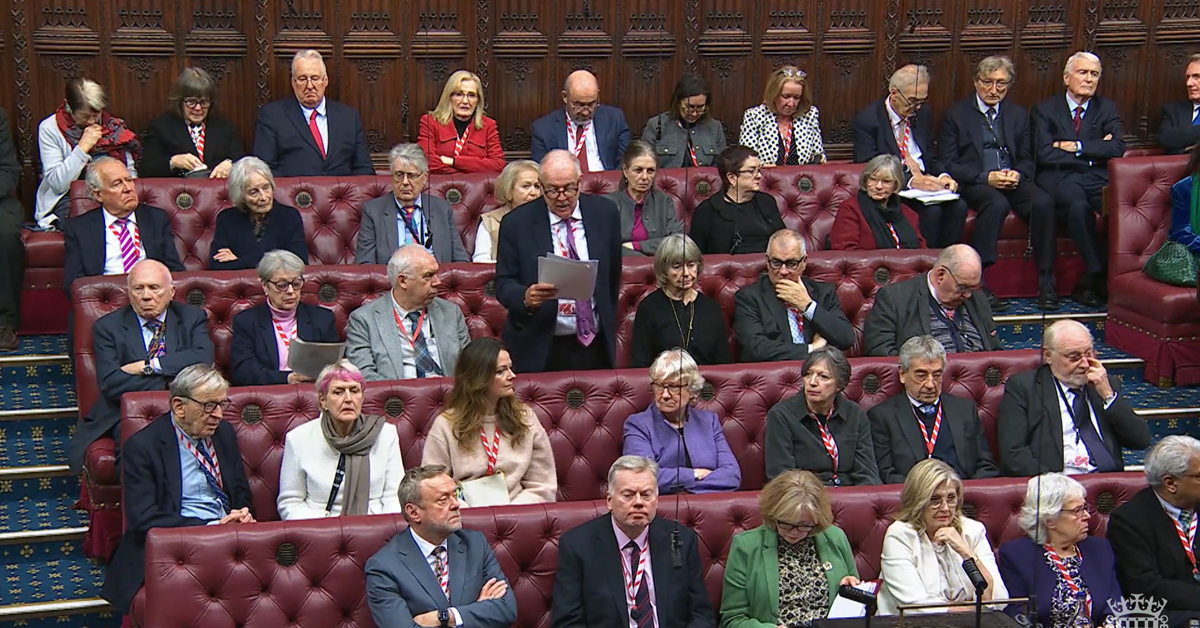
LEGISLATION on assisted dying will receive further time for scrutiny in the House of Lords, it was agreed on Thursday.
The Terminally Ill Adults (End of Life) Bill was already due to be debated into the spring, after the addition of ten extra days of debate (News, 27 November 2025).
The details of the further extension are yet to be announced, but were agreed in principle in a debate on Thursday evening.
The proponent of the Bill in the House of Lords, Lord Falconer (Labour), proposed the extension, saying that without extra time, it would be impossible to “complete the process of scrutiny”.
Over one thousand amendments to the Bill have been tabled, and only a fraction have been debated so far, and there is only around 50 hours of allocated parliamentary time left.
Members from both sides of the debate had expressed the view that it would be “wrong, and would significantly damage the reputation of this House, if we failed to reach conclusions on the Bill”, Lord Falconer said.
In the debate that followed, Lord Shinkwin (Conservative), who opposes the Bill, suggested that the fact that so many amendments had been proposed might reflect “the quality, or lack thereof, of the Bill that was sent to us”.
He said: “If any Bill is so poorly drafted and so unsafe, surely the question is not so much whether the Bill deserves more time, but whether yet more time could transform it.
“You can’t make a silk purse out of a sow’s ear.”
There was broad agreement across the House that more time was needed to scrutinise the Bill, but nonetheless the debate lasted almost an hour.
Baroness Butler-Sloss, who chairs the Ecclesiastical Committee, suggested that peers should “speak more briefly” in the debates on assisted dying. “At the end of the day, we have to get it through,” she said.
The President of the Catholic Union of Great Britain, Baroness Hollins, also supported the proposal for more time, but she said that she did not think it would be sufficient. “The kindest thing for the Government to do would be to seek to establish a royal commission to give this weighty issue the attention that it deserves. We cannot do it justice through the Private Members’ Bill process,” she said.
The next day, the debate on the Bill itself continued with discussion of an amendment seeking to require a judge to approve applications for an assisted death.
Also debated was an amendment which would see a panel of palliative-care experts assess applicants, and to offer care “to the extent necessary to enable them to decide whether such care would affect their wish to end their life”.