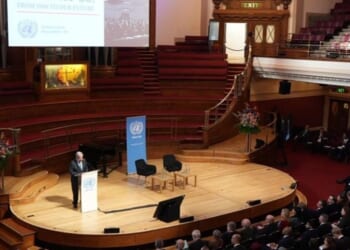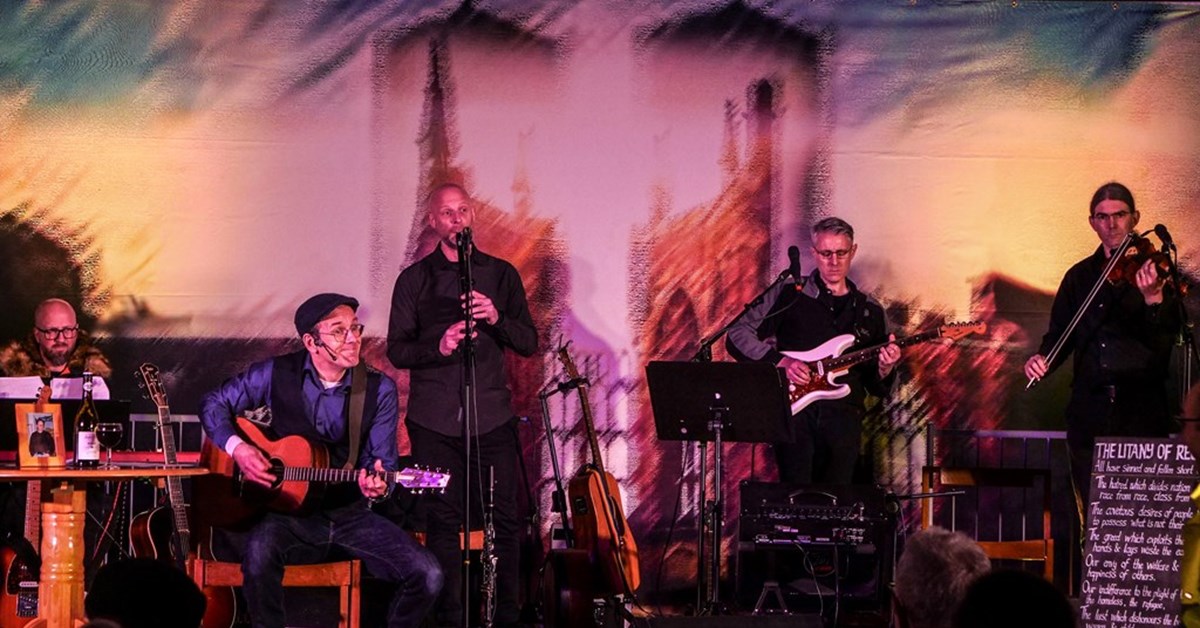
THE singer-songwriter Rob Halligan describes himself as a troubadour and a maverick, and his show, How Did We Get Here? as an itinerant’s musical. It swept us along on a reckless, dust-raising road trip, as he recounted the story of his life and the faith-challenging enigmas thrown up by his father’s death in the Twin Towers in New York, in 2001, and Coventry Cathedral’s ministry of reconciliation.
Coventry is his home town now, and the cathedral is his place of worship: a big leap for someone who was with the Jesus Army. His songs are as gritty as Springsteen; his four-man band, Homeward Hie, can fill a corner of this vast, beautiful, and brutal space as if it were a stadium, or add bodhran, low whistles, and fiddle to take us into other realms. Sometimes, it’s like one big, glorious jam session.
He starts in the wilderness of Ground Zero, ten days after the terrorist attacks. A child of the 1970s and 1980s in Sussex, he had a chaotic home life. His father married four times, his life went “spinning out of control”, and, by 15, he was sleeping on the streets and getting arrested. His songs “Streets of This Town” and “Dancing with Seagulls” come from this part of his life and carry enormous power.
And then comes the Jesus bit: “a guy with a sandwich board”, “Jesus Saves”, Christians offering free board and lodging; absorption into the Jesus Army; a faith embraced. Halligan’s laconic, anarchic telling of it obviates the cringe factor that can come with dramatic testimony.
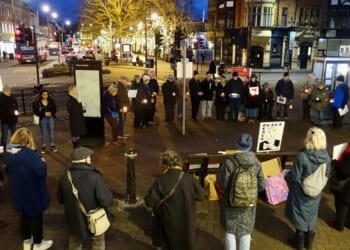
New York, where his father settled, becomes his second home. Anger at Ground Zero is compounded by the audacity of “Father, Forgive” inscribed in the ruins of the old Cathedral. The songs of the second half resonate with that — “This life is beating us up. All of us are walking with a bit of a limp” — but move beyond it. People place white roses on the stage to endorse Coventry’s Litany of Reconciliation.
The message is strong and simple: love is stronger than hatred. It is not about persecuting or annihilating the “other” but acknowledging “The ‘other’ is one of us.”