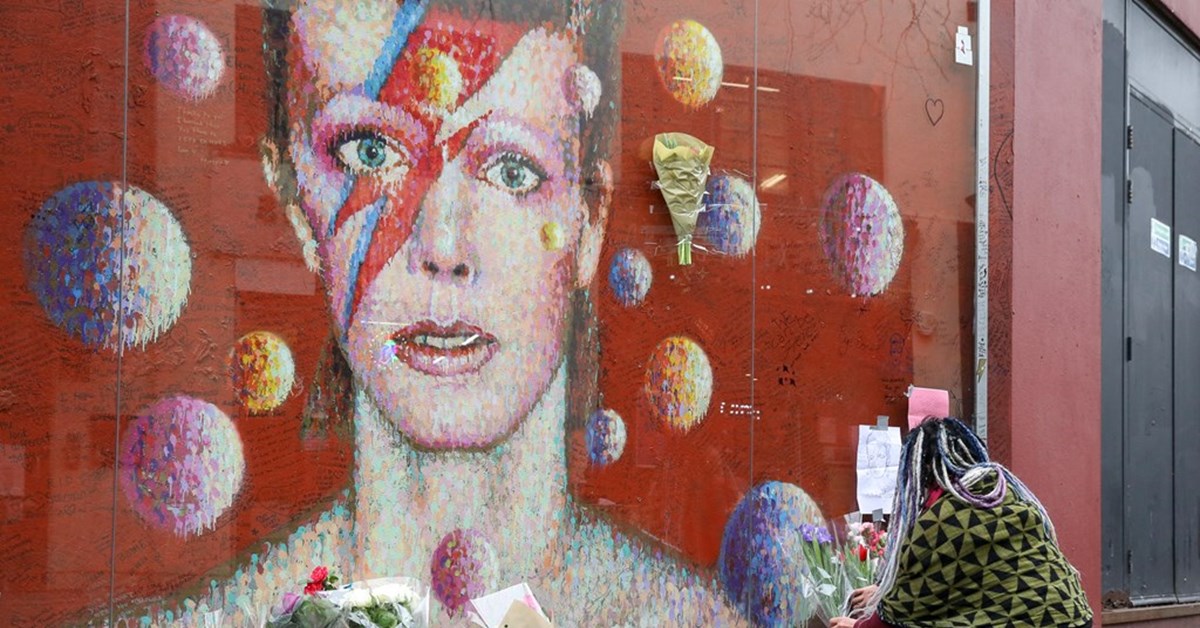
TOMORROW, it will be ten years since David Bowie died. He is remembered as a man whose music and style left an indelible mark on our culture: one whose influence spread far and wide and deep, and whose restless creativity lit up the world.
But one dimension of Bowie tends not to be thought about so much. He called it his “search for a spiritual foundation”. This was no mere rock-star hobby: it was to him a matter of the most profound importance, fundamental to his work. And what may be more surprising still is that this search involved not only exotic beliefs and esoteric practices, but also a lifelong fascination with Christianity. At first, it is a story of foundation, inspiration, and salvation; later, there is torment and transcendence.
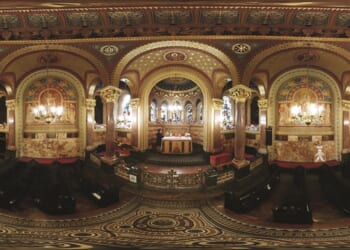
The boy David, then Jones, joined the choir of his local church in 1956. He was about nine years old, and the church was St Mary’s, Bromley, just south of London. Led by the Revd John Rahe Hughes, it was the very picture of the suburban Church of England, then at its post-war zenith.
Looking down on the choirboys in their robes and ruffs was an arresting stained-glass window. Still there today, it shows Christ enthroned in glory, encircled by adoring cherubs. Angels play in an orchestra fit for paradise, with harps, horns, and cymbals. The saints of all the ages gaze on, rapt, as do the prophets of ancient days: here is Noah; there are Elijah and Moses.
Overhead, in the highest heights, is a burst of flame, and out of it flies a dove. A few years later, as he exploded into stardom, Bowie sang of a flaming dove, while stained-glass windows remained a fascination for him, as did rich Christian imagery and various Bible stories.
It is simple to infer that St Mary’s gave him a valuable foundation in the faith. But this is not to say that he was an especially pious choirboy. “Joining the church choir had nothing to do with religion in my house, or David’s, for that matter,” recalls his fellow chorister George Underwood, who saw it more as a chance to socialise.
David stayed in the choir for only a year or so, and religion generally seemed a contentious issue for his parents. Speaking many years later, David said of his father: “He didn’t particularly care for the English religion — Henry’s religion”: a telling insult, that, associating the supposedly sacred institution with power and vanity in the form of Henry VIII.
David was being led away from the C of E by other forces, too. Through his beloved older half-brother Terry, David grew infatuated with the Beat generation: Jack Kerouac’s novel On the Road was a strong early influence. The Beats were keen on Buddhism, and this was to be what the young David had recourse to. An interest in the plight of Tibet had been instilled in him by reading Seven Years in Tibet by Heinrich Harrer.
DAVID adopted the name Bowie in 1965. By now a musician, he became ever more enthused by Buddhism, going so far as to spend time at a Buddhist monastery in Scotland in 1967 and wanting to become a monk himself. Buddhism infused some of the songs that he wrote before he was famous, such as “Silly Boy Blue” and “Karma Man”. But it became apparent to him that he would be more effective as a musician than as a monk, and his fervour waned.
The appeal of the counterculture endured, however, and a darling of the counterculture at that time was Aleister Crowley. Born in 1875, Crowley was known during his lifetime as “the wickedest man in the world”. He promoted what he called “sex magick”, the ritualistic use of sex for allegedly spiritual purposes.
Crowley became a notorious figure, and he embraced moralistic opprobrium, calling himself “the Beast 666”. He did not, in fact, consider himself a satanist, but he did profess a hatred of Christianity. For Bowie, Crowley was another source of intrigue: the latter’s ideas crop up in songs such as “After All” and “Holy Holy”, both from 1970, and Bowie sings of being “immersed in Crowley’s uniform of imagery” in the 1971 song “Quicksand”.
Then, in 1972, Bowie went stratospheric. He devised and assumed a character named Ziggy Stardust, an alien, a rock star, and, crucially, some kind of god. Here, Christianity brought inspiration. Bowie described Ziggy in biblical terms as being “like a leper Messiah”, and in more hip terms as “The Nazz”, the name given to Jesus of Nazareth in a work of performance poetry by “Lord” Richard Buckley, who had been an influence on the Beat generation.
“Soul Love”, one song on the album ostensibly telling Ziggy’s story, abounds with Christian imagery: there are a priest, the Word, God, and a baby and a cross, bookending the life of Christ. Then, once the song has ascended to its chorus, there is a dove, ablaze: doves and fire are commonly used together to depict the Holy Spirit, as in that stained-glass window. In the end, Ziggy Stardust is slain by those he came to save.
Bowie found immense popularity as Ziggy Stardust, to the point at which he was becoming overwhelmed. By late 1973, he had killed off the character, but had become hooked on cocaine. Over the next couple of years, he fell deeper into a spiritual netherworld of Crowley, the Jewish mystical system of Kabbalah, and occultism generally. He believed that witches and warlocks were out to get him, and he said that he saw Satan rise from his swimming pool. There was soon an exorcism, the ritual reportedly making the water thrash about violently, with a demonic mark on the bottom of the pool.
This was a terrifying time for Bowie. He felt that his soul was at stake. So, he cried out for salvation — and cried out to Jesus. In 1975, Bowie wrote a song, “Word on a Wing”, which is essentially a hymn, telling of gratitude, devotion, and belief. “Just as long as I can walk I’ll walk beside you,” he sang, “I’m alive in you”. The following year, he started to emerge from the depths.
THE spiritual adventure continued for decades, often expressed in song and performance. Christianity and associated beliefs were rarely far away. He was particularly keen on aspects of Gnosticism, and protested against institutional religion, which he saw as a corrupting intermediary force between humanity and the divine. In his upbeat pop song “Modern Love”, from 1983, he sang of putting his trust in “God and Man”, with “no confession” and “no religion”.
The following year, he railed against religious violence and what he apparently viewed as the naïvety of prayer in the song “Loving the Alien”. In 1992, having found the love of his life, the Somalian supermodel Iman Abdulmajid, he seemed especially devout: during a concert at Wembley Stadium in honour of the late Freddie Mercury, the frontman of the band Queen, Bowie knelt on stage and said the Lord’s Prayer.
He told Rolling Stone magazine: “I have an unshakeable belief in God. I put my life into his hands every single day. I pray every morning.” He married Iman at St James Episcopal Church, Florence, in Italy. The ceremony included Psalm 121, which begins: “I will lift up mine eyes unto the hills: from whence cometh my help? My help cometh even from the Lord.”
Christian themes are apparent in the artwork and lyrics of his 1999 album Hours, whose title gestures towards the Books of Hours used in the Middle Ages to mark and hallowing the passage of time with prayer.
But the relationship between Bowie and God could still be troubled. In dismay about the state of the world, Bowie addressed the divine directly and with hostility on his 2002 album Heathen. In one song, “I Would Be Your Slave”, he questioned God’s silence, and suspected or feared God’s mockery.
In another, he sang: “I demand a better future Or I might just stop loving you”. Bowie called it “a bald-faced idiot statement” but one reflecting “the frustrations of day-to-day life”. The album’s artwork shows classical works of art slashed, defaced, desecrated; each has a biblical theme. There is bitter torment on this record.
And, finally, there was Blackstar, Bowie’s last album. Its lyrics, artwork, and videos collected together so much of the spiritual adventurism that had gone before — Christianity included. One of its songs was Bowie’s last single: “Lazarus”. The lyrics speak of transcendence — “Look up here, I’m in heaven” — but it is the music that truly expresses it. The album was released on 8 January, 2016. Two days later, Bowie died.
It is not possible to know if Bowie found what he was searching for. But it is clear that his search was essential to his creativity. And we know that Bowie’s spirituality was not some vague, feelgood affectation, but grounded, informed, and of the utmost significance. It encompassed poetry, history, philosophy, mysticism, and more, and it led to expressions of belief which defy conventional theism and yet have a deep affinity with it.
“Searching for music is like searching for God,” he said. “There’s an effort to reclaim the unmentionable, the unsayable, the unseeable, the unspeakable.” When you think of David Bowie, maybe this is the best place to start.
David Bowie and the Search for Life, Death and God by Peter Ormerod is published by Bloomsbury Continuum at £20 (Church Times Bookshop £18); 978-1-3994-2282-6.