ON THE first weekday after the American kidnapping of the President of Venezuela, the front page of the Daily Express warned readers of a looming crisis: “Fears Starmer is plotting ‘a full-blown Brexit betrayal’”. In other front-page news, the readers learned that the Queen was looking regal.
Newspapers have two functions that must sometimes clash. One is to bring the readers news that might disturb their lives and require action; the other is to reassure them that nothing really changes, and that quotidian life and thought is all there is. So, as the naked rule of gangsters once again replaces the dream of international law, the readers urgently need to know that the Queen is looking regal and to be reminded more than ever that traitors threaten the immeasurable gains of Brexit. I wonder how the paper will treat President Trump’s invasion of Greenland when it comes.
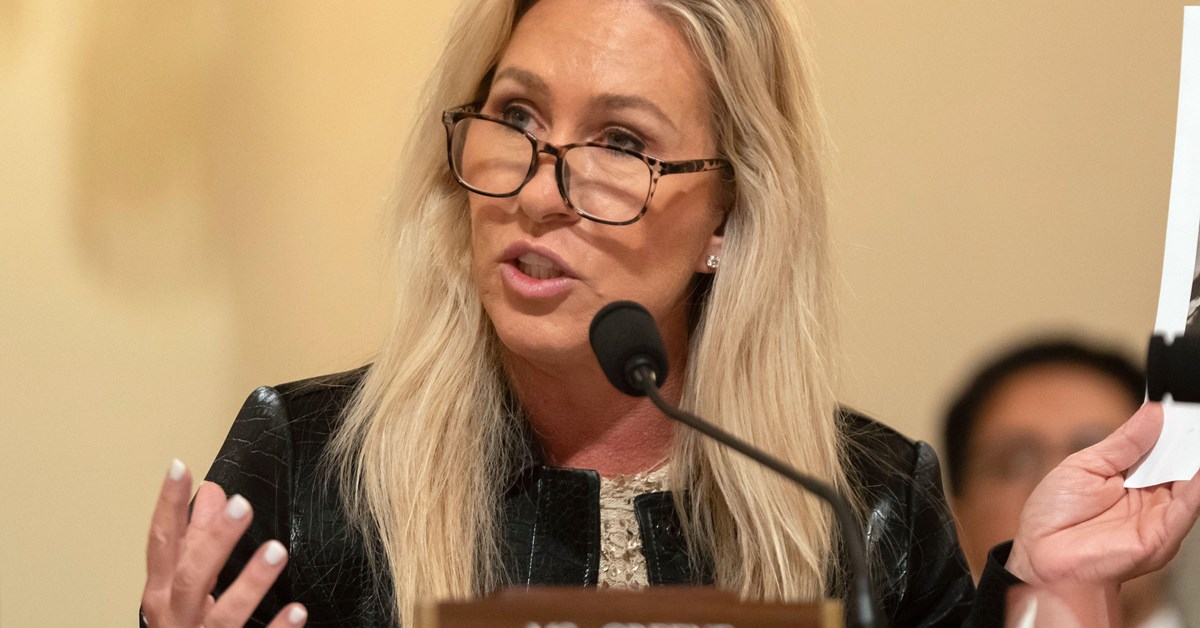
All this made me think of a most illuminating interview in The New York Times before Christmas with Marjorie Taylor Greene, an American politician who became a byword for slavish, lunatic obedience to Donald Trump and the fantasies of QAnon. She claimed, for instance, that wildfires in California had nothing to do with global warming, but might be the effects of “Rothschild space lasers”. She described Mr Trump’s first presidency as “a once-in-a-lifetime opportunity to take this Global Cabal of Satan worshiping pedophiles out”.
It appears that she really believes some of that stuff. She agitated for the release of the Epstein files, which will clearly be damaging for President Trump, and she told The New York Times that she had supposed that he was a Christian until this autumn, when she watched Charlie Kirk’s funeral on television.
“What stayed with Greene long afterward were the last two speakers who took the stage. First there was Kirk’s widow, Erika, who stood in white before the crowd filling the Arizona stadium, lifted her tear-filled eyes and said that she forgave her husband’s killer. And then there was President Trump. ‘He was a missionary with a noble spirit and a great, great purpose,’ he said of Kirk. ‘He did not hate his opponents. He wanted the best for them. That’s where I disagreed with Charlie. I hate my opponent, and I don’t want the best for them.’
“‘That was absolutely the worst statement,’ Greene wrote to me in a text message months after the memorial service. And the contrast between Erika Kirk and the president was clarifying, she added. ‘It just shows where his heart is. And that’s the difference, with her having a sincere Christian faith, and proves that he does not have any faith.’”
It took her till now to notice?
But it seems that she is more or less sincere in her renunciation of President Trump, her sincerity perhaps strengthened by the death threat to her son as well as herself sent to her personal Gmail account after the break became public. Mr Trump, of course, refused to condemn it. An underreported aspect of his power over the Republican Party is that politicians who defy him have credible reasons to fear for their lives and those of their families.
Let’s be charitable and assume that she lived in a bubble, like the readers of the Daily Express, except that hers was made not by print, but by video and social media. Video is simultaneously more gripping and more distancing than anything that print can manage. Reality is safely confined in your phone, but, at the same time, so much more compelling than anything your unaided senses seem able to offer. Deepfakes accelerate the process, but there is something intrinsically fake even about stuff that might seem absolutely realistic, such as video feeds of Russian soldiers dying, or an assassination in the US.
It’s all a sort of porn, offering emotion without connection. So, where does the connection come from in today’s world? The cognitive scientist Tom Stafford has an interesting take on this. He argues that trust is essentially personal and based on what you know of the trusted person, and also that it falls off sharply with distance: we all know that third- or fifth-hand information is unreliable. Impersonal institutions, or an expert consensus, can, while they work, extend reliable chains of trust, but when the chain breaks, it’s gone for good. In this context, organised religions have a huge power, because doctrine passes through a chain of personal trust. The believers you know are a warrant for the truth of what they believe.
That’s the theory, at any rate. If anyone finds it works to convince a PCC, do get in touch.