I WAS catching up with a clergy colleague who, like me, was looking back on many years of parish ministry. We had both been ordained when our children were still in primary school, and I had added one more (first incumbent in the diocese to be pregnant in post). We were discussing our experiences, and, more particularly, those of our children.
Of my four, one was blithely indifferent to their status as “vicarage child” and all that this involved. Two accepted the benefits and the disadvantages with a shrug in their early years, and a period of teenage rebellion as they fought against the label and its attached assumptions, striving to show that they were just as “normal” as the next young person. One of them was, I am afraid, permanently scarred.
There are benefits to vicarage life, of course — my children learned to mix with a wide range of people, to treat death as part of life, and to make mulled wine in large quantities — but the jury is still out on whether the advantages outweigh the challenges.
“So,” my colleague commented, “Church, Family, God. Which order did you put them in? And was it the right order?” These three words took me in an instant straight back to ordination training, and some very earnest discussions about what came where, as we looked innocently ahead to our imagined lives as parish priests.
At the time, the prevailing feeling seemed to be that God, obviously, was at the top of the pile. Church came next, and, at the bottom, Family. It was felt among many that this last should be dealt with by the clergy spouse: the natural order of things according to male ordinands — rather daring and maybe not quite possible for the females.
ORDINATIONS happened, posts were applied for and accepted, and the comfortable cushioning of curacies misled me and many of my cohort into thinking that, yes, it was perfectly possible to be all things to all people; no sacrifice needed; everything fitting very comfortably into the space and time allotted.
I eased in gently to incumbency, in a rare and precious half-time post that, I reasoned, would leave me plenty of time for looking after three, then four, children under 11. Even with a wonderful pair of churchwardens, an enthusiastic and committed congregation, and a generally supportive wider community, the pressure began to increase. “I’m only part-time,” I said at a meeting with my churchwardens, “and I can’t do it all. What would you like me to drop?”
After a few days of thinking about this, they came back to me with the response that they didn’t really see how I could drop anything.
AS THE children grew, so did resentments over the constraints of vicarage life. Rural ministry offers fewer opportunities for the anonymity that one of my children craved; and the use of the family home as a meeting place was intrusive and disruptive, especially when the meeting was strife-ridden, as happened frequently in one of my parishes. In any group of young people, the vicar’s child will always be the recognisable one and, in times of trouble, the first one identified, even if — as was often the case — they weren’t actually there at the time.
I struggled during this time, trying to maintain family life, run several churches, and honour my faith commitments. The hierarchy I had absorbed of God, Church, Family, led to the family making sacrifices which, in hindsight, they should not have had to do.
Even then, the occasional, and extremely mild, misbehaviour of a family member would lead to emails quoting 1 Timothy 3.4,5: “He must manage his own family well and see that his children obey him, and he must do so in a manner worthy of full[ respect. (If anyone does not know how to manage his own family, how can he take care of God’s church?).” If ever there were a Bible passage to beat someone over the head with, surely this is it! Perhaps most dangerously of all, Church threatened to overwhelm both God and Family, becoming a stern, unbending taskmaster demanding endless work and personal sacrifice.
AT A clergy conference, one woman put forward the daring idea that it should be God, Family, Church. But how do you structure family time, when its demands surge and recede like the tide on a beach? What do you do about “pinch points”, when Church and Family both have their needs?
Christmas is especially challenging, as we juggle the nativity plays of our children and grandchildren with those of the local school, or rush through Christmas-morning stocking-opening in order to fit in both peeling the potatoes and taking the eight-o’clock. Mothering Sunday has always rankled, particularly in the early years, as I celebrated the day by cramming in extra services and trying to include mothers/non-mothers/those with unsatisfactory mothers/those with no mothers/those who weren’t mothers, while at the same time being around for my own young family.
Whose idea was a hierarchy anyway? Where did God, Church, Family, or God, Family, Church, come from? Are they not a throwback to times past, when life was more leisured, wives and servants were plentifully available, and boarding school was the best solution? Are we not committing a serious sin, boxing in our all-powerful, creative, imaginative, and ever-loving God, by simply making him the top building block of an unstable, humanly created tower?
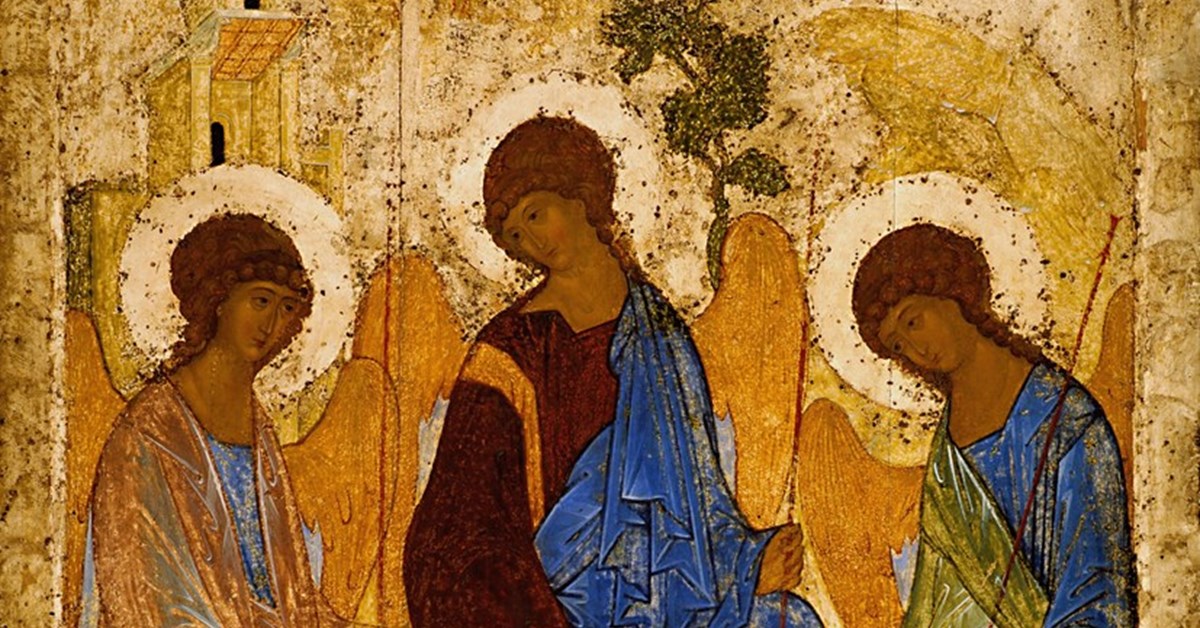
I DON’T know when I threw out the terrible trio. I suspect it was when I stopped pretending I could ever be Superpriest and settled for being Goodenoughpriest. Instead of worshipping the idol of Doing It All, I found a different model, based on Rublev’s Trinity icon. The three calm figures in tranquil shades of green and blue sit in an open circle, inviting the observer to stop a while and join the holy group, becoming part of the unity and sharing in the peace that they offer.
Our lives are not to be sliced into chunks, brutally dividing us into separate identities. Just as we are loved wholly and completely, so we offer our whole selves in love and service as a response to the One who gave us life. Times and seasons ask different things of us, but those we have been given to love and to cherish are just as much a part of our lives as Christians and priests as those in the wider Church and community, and are just as important. We are not asked to crucify ourselves and our loved ones, but to model holistic, Christ-centred living as an example and invitation to others to live a fuller, richer life, which in turn enriches others.
“Come now, little person, fly for a moment from your affairs, escape for a little while from the tumult of your thoughts. Put aside now your weighty cares and leave your wearisome toils. Abandon yourself for a little to God and rest for a little in him. . . Speak now, my whole heart, speak now to God: ‘I seek your countenance, O Lord, your countenance I seek.’
“Come then, Lord my God, teach my heart where and how to seek you, where and how to find you” (St Anselm, the opening lines of Proslogion, 1077).
The Revd Dr Sally Welch is Vicar of the Kington Group, in the diocese of Hereford.