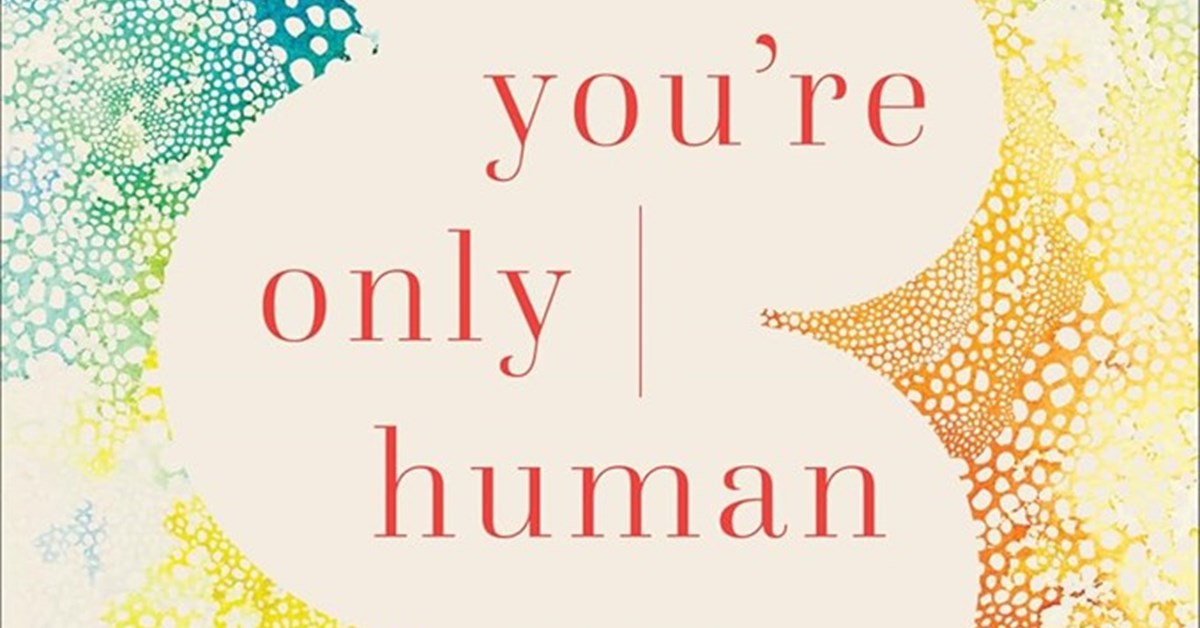
FINITUDE is a significant theme, but the number of good theological books on the topic is surprisingly limited. I found in Kelly Kapic’s wise new book a good deal to agree with, and much to be grateful for. On this topic, it deserves to be put alongside Stephan Kampowski’s impressive Embracing Our Finitude (2018), which is somewhat more philosophical and a little less popular in style.
You’re Only Human explores theological anthropology, with finitude at its heart. It is a plea for Christians to accept and value the inherently limited character of human life. It encourages us to receive our finitude as part of God’s good intention, not seeing it as a flaw or failure.
One significant strand considers the boundedness of our bodies. There are also meditations on humility and dependence (addressed first in terms of identity and later in terms of our place in the Church). Two chapters consider finitude and time: one on stress and busyness, the other on the inescapably gradual nature of Christian progress.
Each chapter is pastoral in tone, but that is particularly true of the final chapter, which takes what has been said hitherto and works it through in terms of practices and disciplines. This confirms the book’s place in a school of Protestant thinking influenced by figures such as Richard Foster and Stanley Hauerwas.
One of Kapic’s obvious intentions is to broaden the repertoire of theological themes which he thinks his readers are likely to encounter, expanding beyond redemption, as he puts it, to take in creation and ecclesiology. He does that in the company of well-chosen voices from the theological tradition, notably Tertullian, St Augustine, John Owen, and Dietrich Bonhoeffer.
In places, the writing struck me as resembling a little too much a tapestry of quotation and homages to recent writers (which is a besetting problem for writing of this sort). Occasionally — again thinking about style — I found myself wanting the author to get on with it. Perhaps I am too hardened a reader of technical theology to judge what best serves a general audience. I can only say, speaking personally, that I would have welcomed a five-per-cent trim to remove the homely examples (many involving Kapic’s no doubt delightful family).
Theological discussion of finitude can gravitate towards a fixation with death and mortality, at the expense of thinking about the finitude that is inherent to all creaturely life. Kapic avoids that: indeed, the near complete absence of death as a theme may come as a surprise. The reader might therefore supplement this book with something like J. Todd Billings’s The End of the Christian Life: How embracing our mortality frees us to truly live.
This is not a perfect book — especially if you share my curmudgeonly “Get on with it” impulse — but it is broad and wise, humane and insightful: stretching from its insistence at the beginning that “finitude is not sin” to its attention to the importance of sleep at the end. God made each thing “according to its kind”: that is, according to the distinctive finitude proper to it. That should be integral to the Christian message that God delights in each thing according to what it is and what it can be, not what it is not and cannot be. Kapic makes that point very well.
The Revd Dr Andrew Davison is Regius Professor of Divinity in the University of Oxford and a Canon Residentiary of Christ Church, Oxford.
You’re Only Human: How your limits reflect God’s design and why that’s good news
Kelly M. Kapic
Brazos Press £16.99
(978-1-58743-703-8)
Church Times Bookshop £15.29