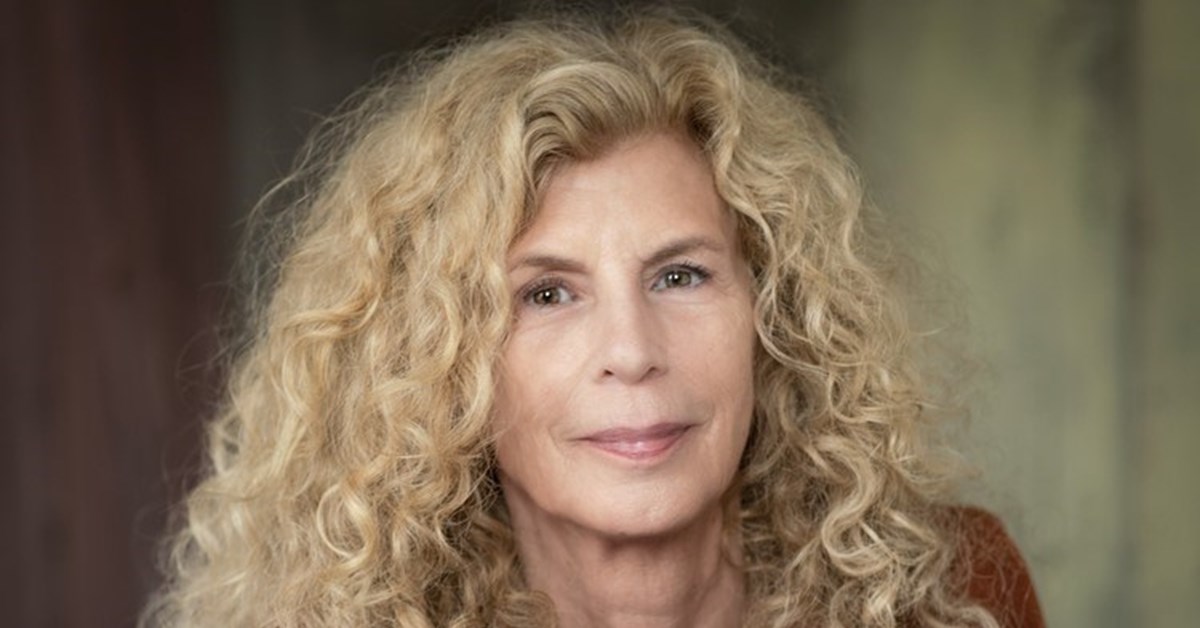
MARIE HOWE is writing poetry again. Short, four-line pieces, she tells me over a video call from Los Angeles, where she’s just out of teaching a class. The winner of this year’s Pulitzer Prize for poetry, for her New and Selected Poems, dives deep into her phone to find an example. It takes some time, but there’s no rush; her collections arrive slowly but surely every ten years or so — four, since her debut The Good Thief, in 1988.
It has been a year and a half since New and Selected Poems — published in the UK as What the Earth Seemed to Say — and her latest miniatures are “just to keep my hand in”.
“I’m coming back. I’m coming home. Sometimes that happens. You think, oh, it’s happening again. You feel an interior quickening. . .”
While she is diving deeper into her phone, the morning sunlight bounces off the ocean outside her office window, illuminating the poet in a blinding halo. There is definitely something beatific about Marie Howe. Located in the ordinary, her poetry is perforated with the not-so-ordinary. Now 75, the opening entry in What the Earth Seemed to Say finds her in the middle of her life (“OK, just past the late middle”) and falling into a litany of names of those she has lost. “I came to the edge, and I did not know the way.”
In all this loss, she explains, she came to a place where she had lost the way herself. “I didn’t know how to write any more. I didn’t know how to proceed. I never know, really, how to find my way. And then I remember, oh, the way is the next step, and the next step, and the next step. You don’t have to know it beforehand.”
The trouble is, she says, “sometimes, one can’t even step. The losses pile up, the trouble is too deep, the concern — for example, about my country right now — is paralysing.”
A line from Theodore Roethke is her guide — “I learn by going where I have to go” — and now she finds that poem that features a conversation with the owner of a restaurant, who is showing her photos of his daughter. In the last line, he says: “I followed all the rules of man and God and still I was punished.”
I am left wanting to know more of this everyday story, reminded that Howe is a poet who pays attention to the “glinting miracles” of ordinary life, and that this is how she finds her way.
BORN in Rochester, New York, the eldest of nine in an Irish Catholic family, she attended convent school and the University of Windsor, and became a high-school teacher and journalist. Not until her thirties did poetry seriously present itself, and, in time, she was studying under Stanley Kunitz (“my true teacher”) at Columbia University. Of the poems in The Good Thief, Kunitz said that they “address the mysteries of flesh and spirit in terms accessible only to a woman who is very much of our time and yet still in touch with the sacred”.
That he also described her as a “religious poet” initially horrified Howe, until she came to see what he was getting at. “I’m obsessed with the metaphysical, the spiritual dimensions of life as they present themselves in this world; so I understand what he means,” she says.
What The Living Do, ten years later, was poetic witness to the loss of her brother John, at 28, to an AIDS-related illness, while questions of the self and the soul or the secular and the sacred run through The Kingdom of Ordinary Time (2008). Another decade brought Magdalene, in which, as one reviewer put it, Howe makes “the iconic biblical character . . . mystical and relatable, mythological and contemporary.”
Of the 20 new poems in What the Earth Seemed to Say, many converse with our living earth, but, whatever earth has been saying, suggests the poem “Postscript”, most of us have not been listening. Not even when our children tried to tell us to listen, until, finally, the earth has had enough and turned on us.
What we did to the earth we did to our daughters
one after the other,
What we did to the trees, we did to our elders
stacked in their wheelchairs by the lunchroom door.
What we did to our daughters we did to our sons
calling out for their mothers.
Howe describes an “intersectionality” between how we treat children or women or the old and how we treat the earth: “Women have known this for centuries, because we’ve been treated so terribly, and the misogyny of most patriarchal cultures is still there, but is also directed towards the mother of us, toward the sea, the earth, the trees.”
These recent poems invite us to notice our earthiness, our being part of the everything rather than locked in our selves. “You were once a citizen of the country called I Don’t Know,” the title poem ends. “Remember the boat that brought you there? It was your body: Climb in.”
HOWE increasingly travels the country of “I Don’t Know”. In “The Maples” she asks the trees behind her house how she should live her life, and they suggest that she keep quiet. She tells herself to stand still, to “see how long I can bear that”. This longing for stillness is a recurring theme. “Prayer”, from The Kingdom of Ordinary Time, will resonate with anyone drawn to the idea of being more devout but not quite drawn enough to get around to it.
Every day I want to speak with you. And every day something more important calls for my attention. . .
Even as the writer tells herself to be still, she is planning to leave the still place. Howe remains on the quest. “Be still and know that I am God, right? Or T. S. Eliot, ‘Teach us to care and not to care. Teach us to sit still.’ To be still is very hard for me.”
She is about to head off to a four-day silent retreat, unsure of how she said yes to this, or how she’ll get through it. It must be done. “It is so difficult to sit, but to bear poetry coming through you, that’s a great practice, because it gives us something.”
She refers to a book by a Buddhist friend, Bring Me the Rhinoceros, in which one koan (a paradoxical anecdote) asks, “Why am I afraid of this happiness?”
However unsettling or even troublesome, silence also offers some kind of richness, an “indwelling”: “Why would I be afraid of this happiness?”
But Howe is a poet who bumps into the divine in the noisy as well as the quiet, in the chaos as much as the calm. Out shopping in “The Star Market”, she becomes aware of being in the company of “the people Jesus loved”, people many of us might instinctively rush past, those “who would have been lowered in to rooms by ropes” or “crept out of caves”.
She concludes that “Jesus must have been a saint”. Saints have intrigued her since her youth — not least, she says, because so many were “strong women with their own agency. I believed some of the old stories, that life is short and eternity is long, and so why mess around? Let’s just go right to prayer and to eternity. . .”
If she doesn’t hold those ideas now, she recognises the truth that they carry: that maybe they awakened her to what Paul Éluard was reaching for when he said, “There is another world, but it is in this one.”
When she was a high-school teacher in her late twenties, a scholarship took her to a summer school at Dartmouth College. In a poetry-writing workshop, the teacher, Karen Pelz, explained that she was a poet because “I’m writing my spiritual autobiography.”
Howe recalls the scene.
I blurted out, “Who are you to do that?”
And she said, “I’m a lyric poet.”
And I said, “I want to do that.”
And she said, “Then stay.”
And I did. My whole life.
Looking back now, she understands poetry as a kind of spiritual autobiography, and I mention that the former UK Poet Laureate Carol Ann Duffy has said that poetry is her prayer. Howe hosts workshops on poetry and prayer, but is less drawn to the Psalms: “A lot of complaining and smiting my enemies, kind of a guy thing.”
She can’t be doing with church. “I don’t want to hear a dogma. I don’t want to hear the creed. I don’t want to hear any of that. I struggle in church.” She prefers another company, as she put it recently, a silently connected community of readers and writers, including John Donne and Emily Dickinson and Lucille Clifton and Gwendolyn Brooks. I suggest that that’s what the Church might call the “communion of saints”.
“Of course, you’re right. You need to be a bit quiet to hear them and to enjoy their company . . . but they’re present with us. We carry them with us. . . The communion of saints.”
What the Earth Seemed to Say: New and selected poems by Marie Howe is published by Bloodaxe Books at £14.99 (Church Times Bookshop price £13.49); 978-1-78037-724-7.