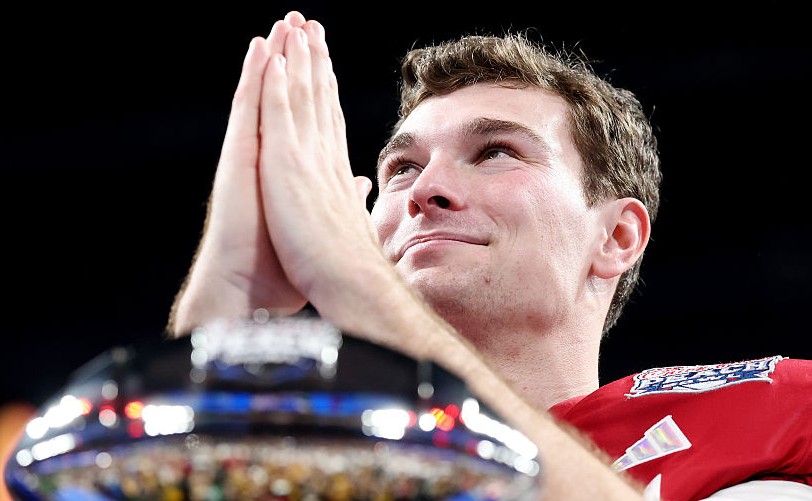
(LifeSiteNews) — After dominating the Oregon Ducks 56-22 in a College Football Playoffs semifinal last week, Heisman Award-winning quarterback Fernando Mendoza said something during the postgame press conference that shocked the sports world.
“Delayed gratification is a concept that was brought up by stoicism and by the stoics and I think it’s one of the greatest attributes,” he said. “If you are able to have delayed gratification, disciple in yourself, discipline in your process and preparation, you’re able to execute every single week.”
Mendoza, who is Catholic, continued, “A lot of players and a lot of coaches and just everybody in Bloomington has done a great job of upholding that concept of delayed gratification and discipline throughout all aspects of our lives.”
“Delayed gratification was taught to us by the stoics. It is one of the greatest attributes.”
Another all-time line from Fernando Mendoza—this one on Stoicism 🤣👏 pic.twitter.com/i65w1uNhHy
— FOX College Football (@CFBONFOX) January 10, 2026
Mendoza has taken not just the sports world but American pop culture by storm over the last several months. He has repeatedly given glory to God after every win his team has had this season. Next Monday, they will play in the national championship game against Miami. Mendoza’s unique mix of on-the field success paired with his deep and abiding faith — and obvious maturity — stands in sharp contrast to what collegiate sports has become in recent years.
In 2012, I wrote an article for Renew America titled “Freedom and college athletics.” In it, I complained that the starting five of the University of Kentucky men’s basketball team declared for the NBA draft at the end of the season. My argument was not that they weren’t qualified to play in “The League” but that college sports was becoming an industry that uses young men for profit while leaving them ill-preparing them for life after athletics.
Rich Lowry, then-editor of National Review, agreed with my outlook. In an article on the subject, Lowry complained that Kentucky coach John Calipari’s “one-and-done” attitude neglects the importance of a formal education. Lowry also said there is an “appalling breach of the amateur spirit of the NCAA” taking place.
During a press conference after the title game that year, Calipari defended his approach. He said that if his players “go to the NBA and become millionaires and change the cycle of their family’s lives, their cycle has now been broken. Can I really be looking back and say ‘I had no success?’ I won’t do that because the success is how they’re performing.”
Today, college sports has shed its “amateur spirit” completely. Players can now get paid, sometimes millions of dollars, for what are called Name, Image, and Likeness (NIL) deals. These “contracts” essentially allow student-athletes — at least that’s what they used to be called — to make boatloads of cash before turning pro, if they choose to even do so.
Many observers maintain that this is a positive development given that college athletes for decades generated millions of dollars for the schools they attended. It’s only fair that they receive some sort of compensation. While not taking a side on that, it’s fair to say that the infusion of money and the adoption of the “transfer portal” has irrevocably changed the way college sports operates.
For the time being, college athletes can change schools after a single season in order to sign a new NIL deal with another one for the ensuring season. At present, there are no rules governing how many times this can take place.
Ironically enough, Calipari has noticed the harmful impact this is having. Now 66 and in the fourth quarter of his coaching career at the University of Arkansas, Calipari has voiced concern with current transfer portal rules.
During a recent press conference, Calipari said the following: “If a kid transfers four times, is he going to graduate from that school? There’s no way! You can’t graduate. So now you’re going to be done playing without a college degree. You have no ties to the last school you went to.”
Calipari also explained that the reason players transfer is because they want more money and that in order to negotiate more cash they simply “extort” coaches with an ultimatum or they leave. Calipari further argued that when players are no longer eligible to play, they will be in for a rude awakening in the real world when they get a job that pays them far less than what they were making in college. “I’m worried about mental health,” he said.
John Calipari is right on this — allow one player transfer, after that, you have to sit out a year to transfer. We have guys playing for four different teams in four years. It’s beyond ridiculous and bad for the sport: pic.twitter.com/Tt7W4f8enj
— Clay Travis (@ClayTravis) December 29, 2025
College athletics needs changing. NIL contracts and transfer portal rules need to be amended so the true well-being of the athletes is upheld. If Fernando Mendoza and the Indiana Hoosiers can beat Miami next week, you can be sure he will praise Our Lord and Savior Jesus Christ in his postgame interviews. If and when that happens, the money-obsessed marketplace that college sports has become will at least momentarily be reminded that Christ and his teachings is what truly matters and that going forward He needs to be put at the center of this un-Christ-like industry.