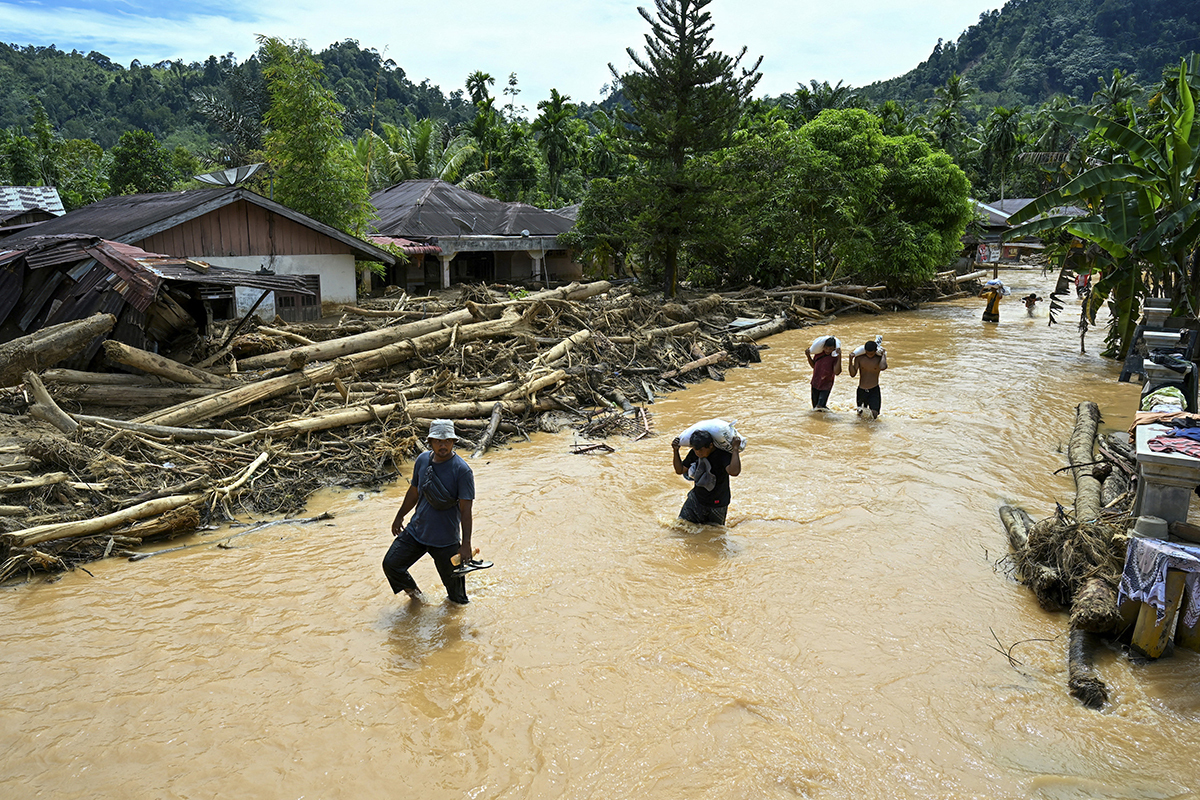
The death toll from widespread flooding and landslides on the Indonesian island of Sumatra has risen to at least 604, according to the country’s National Disaster Management Agency. Thousands remain missing or displaced as emergency teams struggle to reach isolated communities.
The agency said Monday that 464 people were still unaccounted for and 2,600 had been injured in what is now one of the country’s deadliest natural disasters in recent years, The Star reported.
The agency estimated that more than 1.5 million people have been affected and roughly 570,000 forced from their homes, with many sheltering in public buildings that lack clean water and electricity.
Officials recorded the highest number of deaths in North Sumatra Province, where at least 283 bodies had been recovered as of Monday. In West Sumatra, the death toll stood at 165, while Aceh Province in the north reported 156 fatalities.
All three provinces continue to report collapsed bridges, washed-out roads and damaged power infrastructure, complicating rescue and relief efforts.
In Central Tapanuli, one of the worst-hit districts in North Sumatra, residents described scenes of chaos and hunger. Maysanti, a resident, said relief trucks had not reached her village and people were now fighting over instant noodles.
“Everything is gone; our food supplies are running out,” she said. “Even instant noodles are being fought over now. Our food is gone; we need food and rice. Access to us is completely cut off,” the BBC reported.
In the Aceh region’s Pidie Jaya Regency, floodwaters reached rooftop levels. A woman named Arini Amalia described the water as “like a tsunami,” adding that her grandmother, a lifelong resident, had never seen such devastation.
In Central Aceh, thousands queued outside a government office on Sunday night to charge their phones or contact loved ones, after local authorities installed Starlink internet devices to help reconnect communities.
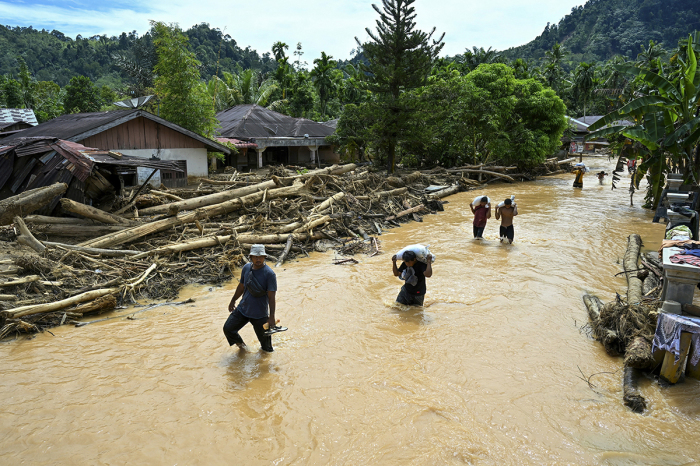
Frustration with the government’s disaster response has grown, with critics pointing to delays in food distribution and logistical failures. Aid workers report difficulty navigating debris-filled roads and washed-out highways, while bureaucratic hurdles have slowed deliveries. Photos from affected areas show entire neighborhoods buried in mud, with logs piled against buildings and vehicles stranded on collapsed roads.
At the Twin Bridges landmark in West Sumatra, heavy machinery has been brought in to clear mud and search for missing persons. Mariana, who lost several family members, stood by the roadside watching excavators dig through debris.
The floods were triggered by torrential rains last week that overwhelmed riverbanks and loosened hillsides, submerging villages and cutting off entire districts. The destruction is most severe in mountainous and coastal areas where landslides blocked access for heavy vehicles.
Emergency workers from the central government, military and local disaster agencies have been deployed, but helicopters and motorcycles are often the only way to reach survivors.
Experts say the flooding was driven in part by a rare tropical storm that formed over the narrow Strait of Malacca. The cyclone, named Senyar, brought high-speed winds and heavy rains to Sumatra and several provinces in southern Thailand, Al Jazeera reported.
Power outages remain widespread in Aceh and North Sumatra, though electricity has been partially restored in West Sumatra.
Across Southeast Asia, the larger storm system has killed more than 1,140 people in Indonesia, Sri Lanka, Thailand and Malaysia.
Meteorologists have linked the extreme rainfall to prolonged La Niña conditions, which are strengthening monsoons and raising the frequency of rain-heavy storms. Senyar, which hit Indonesia directly, also brushed neighboring Malaysia, killing at least two people.
President Prabowo Subianto visited flood-hit areas in North Sumatra on Monday. He acknowledged that some roads remained inaccessible but said emergency crews were doing their best to address the crisis.