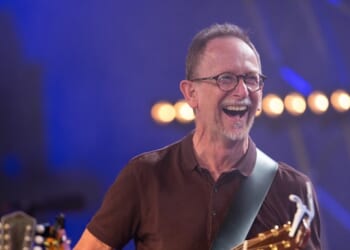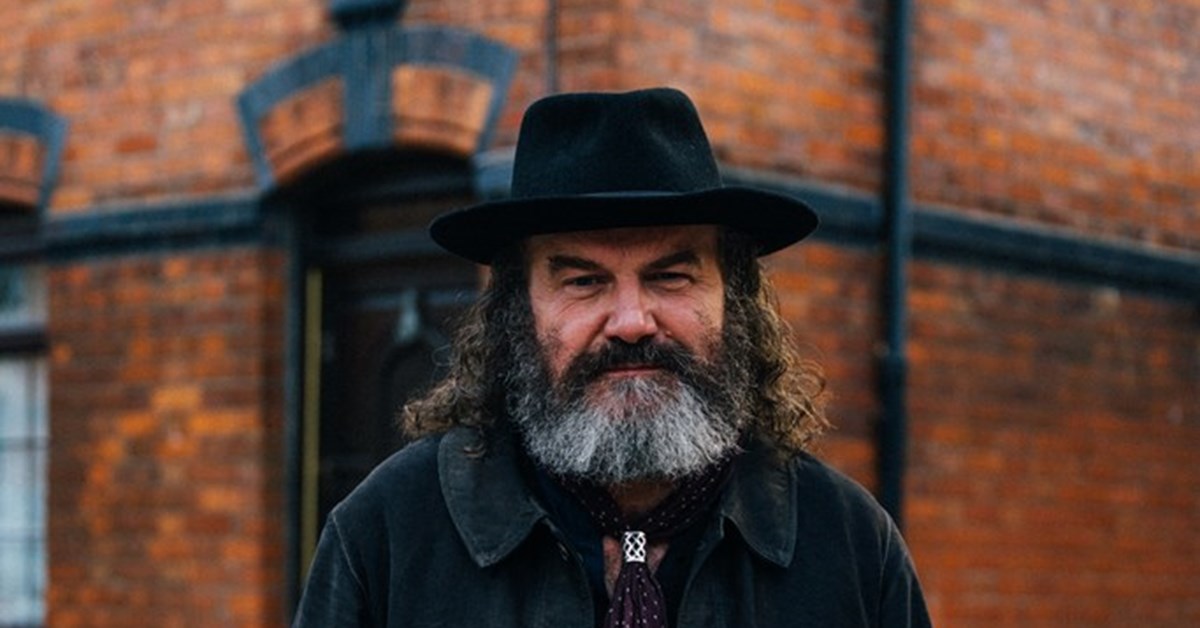
THE book-lined room filling the background of my video call with the writer and storyteller Dr Martin Shaw comes as a surprise. It seems more likely that the author will appear inside one of the tepees described in Liturgies of the Wild, his memoir blending mythology and spirituality.
He now lives in Dartmoor, eight miles away from where he grew up, in Torbay. “My father was and is a preacher; so I grew up in the early ’70s in Upton Vale Baptist Church, being exposed to robust and wonderful sermons, and lots of hymns, but I had no real sense of the contemplative dimensions of the Christian life, other than praying that you do with other people. I had no sense of saints or hermits or monastic traditions.
“By the time I reached adolescence, in the early ’80s, there was a great sweep of the Charismatic movement. So, suddenly, church got very lively, and it was rather like the Acts of the Apostles all over again. And that was riveting: people were speaking in tongues and being healed from various physical ailments. The Holy Spirit seemed very much out and about. It was disarming, after years in a more controlled Christian environment. But, like all good teenagers, by the time I got to 17, I needed some hiatus from the religion of my youth.”
The three-decade interval between parting ways with the Baptist Church and then returning to faith felt like a long time. “I didn’t anticipate that that was going to take 30 years,” he says. “In the interim, between my distancing from Christian faith and being received into the Russian Orthodox Church, I have been receiving my psychological and spiritual nourishment from the great myths and stories from all parts of the world.”
Liturgies of the Wild opens with the deep spiritual experience that Dr Shaw had, spending 101 nights on an “extended vigil” in the forest on Dartmoor, as he approached the age of 50.
“I decided to go on an extended vigil in a Dartmoor forest. Vigil doesn’t mean I sat there without food and water for 101 days. But I visited a forest for 101 days, because I felt an odd compulsion to pray, be quiet, and to listen to the forest. I’m sure many early Irish monastics would have understood. What I didn’t expect to encounter was a profound religious experience on the 101st night. I had an extraordinary encounter in the middle of the night, which is well documented, and the introduction to Liturgies of the Wild.
“From that point onwards, I was left with a growing sensation that what I had encountered was an invitation to go back, in a much deeper and more profound way, to the faith of my childhood. Three or four days before my 50th birthday, through that encounter in the forest, through a succession of dreams, I came to the rather reluctant but inevitable conclusion that, as C. S. Lewis says, God was God, and he was nearer to me than my own breath.
“So, I rang my parents and said, ‘After I’m sure you have been thinking about this daily for 30 years, I’ve got some good news. This is what is happening to me, and it’s incredibly disarming and very powerful.’
“I realised it would be a good idea if I took a deep breath and considered trying a church out. People like myself are terrific in forests and mountaintops, walking by rivers. But a real spiritual test is how you bump along in the scuffs and ordinariness of a real human community. I knew it would be good for my health. So I went to a Baptist church, and I thoroughly enjoyed it. They were lovely people. I went to a Catholic mass, and that was nourishing. But, still, I was not really being moved to my core, until I wandered into an Eastern Orthodox church in Exeter.”
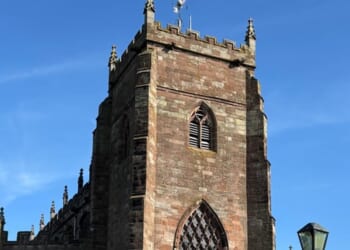
LOCATED in a shopping centre, St Pancras is one of five churches forming the parish of Central Exeter. The tiny church, 46 feet long by 15 feet wide, follows a Saxon footprint and is first recorded in 1191, but has probably been a site of Christian worship for far longer. The church is shared with the Russian Orthodox community.
Dr Shaw’s description of the shops surrounding the church, selling vapes and magic mushrooms, as “head shops”, recalls his twenties, when he was performing in grunge-era bands. As a musician, he had a three-album deal, played at London venues, including the Astoria and the Town and Country Club, and supported the band Prodigy on tour.
Performing as a musician transformed him into an oral storyteller. “I’m an endangered species, because I’m one of the very last mythologists that are left. I am a professor of things like Irish and Arthurian stories. I can tell The Odyssey for five days, or I could tell the Epic of the Grail for five days. Not as a PowerPoint presentation, not as a lecture, but as an event in the old bardic sense of the word.” Creating storytelling events allowed Dr Shaw to “motor along fairly happily for about three decades”.
Orthodoxy’s great appeal was the lack of hard sell. When he first attended the divine liturgy, in Exeter, the priest simply invited him to return if he liked it. And participating in Orthodoxy is very different from observing the faith from the outside. “Orthodoxy, from a distance, is rather different to Orthodoxy in proximity, inside the belly of the whale. From a distance, it always looked like men with long beards, and a lot of rules and probably little mercy.
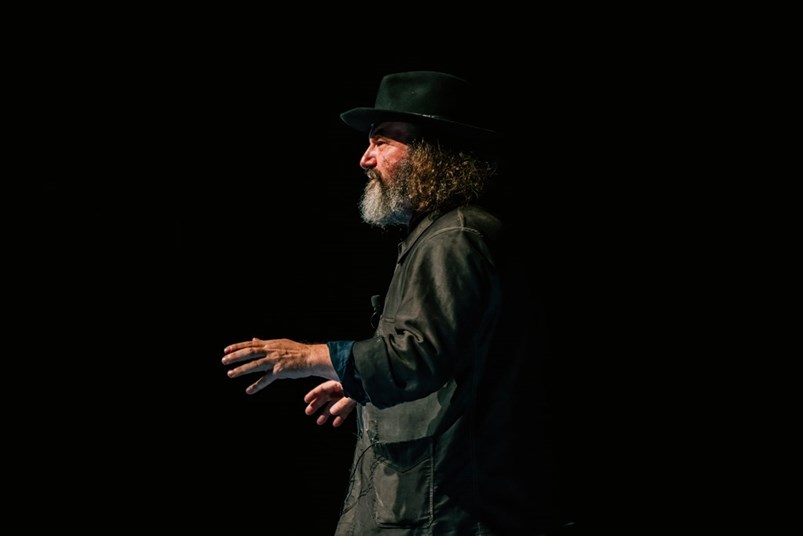 Ruth Medjber at Ruthless ImageryDr Martin Shaw
“Then you find an Orthodox church is a composite mix of profound, deeply ingrained rituals and total anarchy. And the two of them are working very well, side by side. Other than the choir, there’s not a lot of rehearsing in the Orthodox world. It just tends to happen. And we’re very pro-children; so you’ll get often loads of children running around in services that last up to two-and-a-half hours.”
Dr Shaw does not challenge the aura of social conservatism associated with Orthodoxy. “It’s conservative with a small ‘c’, in the sense that there are certain fundamental values that it feels are essential to the Christian experience, and it cleaves to them. But there’s an emphasis on the unknowable within Orthodoxy that I don’t find in so many of the Western traditions.
“The sides of the Orthodox tent are by no means as emphatically nailed down as you might expect. There’s a great place for mystery: I’d recommend it to artists and poets. There’s a robustness, a confidence to the Orthodox faith, but, at the same time, there is a sense that, whilst God is also intimate and listening to us, he is absolutely vast and unknowable. In some strange way, I find that deeply refreshing, because that chimes with my experience of living.”
AT THE top of Dr Shaw’s list of theological influences is the actor and storyteller David Kossoff, famous for his roles in The Larkins, A Kid for Two Farthings, and The Mouse That Roared, as well as his retelling of stories from the Old Testament and Apocrypha in Bible Stories (1968).
“David Kossoff was a stunning Jewish storyteller, and he put into little books a lot of the stories of the Old Testament, and a book about the life of the people that were around Jesus, The Book of Witnesses.
“I loved those books when I was a child, because there was a storytelling kind of looseness to them that you don’t necessarily locate when you’re halfway through chapter-and-verse Old Testament. And there was a great breadth of enthusiasm in what he was doing. So, that’s what I’ve been doing over the last few years: saying ‘How did these stories feel being told in a room?’.”
Stories of saints in the Celtic tradition, such as St Brigid, with their affinity with nature and animals, offer a response to the climate crisis. “In a time of climate emergency, we do have an enormous resource of stories that really speak beautifully about how a Christian can be in this world, especially in the natural world.”
He also draws on the Scottish academic and broadcaster William Barclay, who dedicated his life to “making the best biblical scholarship available to the average reader”. “Barclay’s got a robust and hugely imaginative way of looking at the gospel. I would read William Barclay as I would read Rowan Williams.”
Mid-20th-century Russian theologians who were exiled in Paris, including Sergei Bulgakov, are also influential. “A lot of very interesting writing happens in Orthodoxy, post the Russian Revolution. I often feel that Christians are at their best when their backs are a little against the wall. It all gets fresher and more vivid.”
In Liturgies of the Wild, Dr Shaw draws on stories from mythological traditions, including the Celtic and the Sami, to help his readers through life’s rites of passage, together with psychological and spiritual challenges. I ask him for traditional wisdom on dealing with envy. “Childhood stories often have ‘There were three brothers, or there were three sisters. . . ’ And, usually, the two older siblings betray, in some terrible way, the youngest child. The youngest child has little expected of them, but in the end is going to have the adventure that the older siblings ignore.
“Betrayal is a staple in the fairy-tale tradition and biblical tradition: that extraordinary moment at the end of the story of Joseph, ending up in Egypt years and years later, and meeting his brothers who had initially tried to chuck him in a pit and have him exiled to Egypt, and, rather than him enacting wrath on them, he says: ‘Although you expected evil, God intended good.’
“By showing, even in the most difficult of circumstances, called an underworld episode in a fairy tale, a time of duress, these stories work with an essential premise: no pressure, no diamond. The things in your life that are really uncomfortable and difficult to get your head around are actually calling something forth in you. God’s presence can be there in the duress as well as the celebration.”
Liturgies of the Wild: Myths that make us by Martin Shaw is published by Rider at £22 (Church Times Bookshop £19.80); 978-1-84604-891-3.