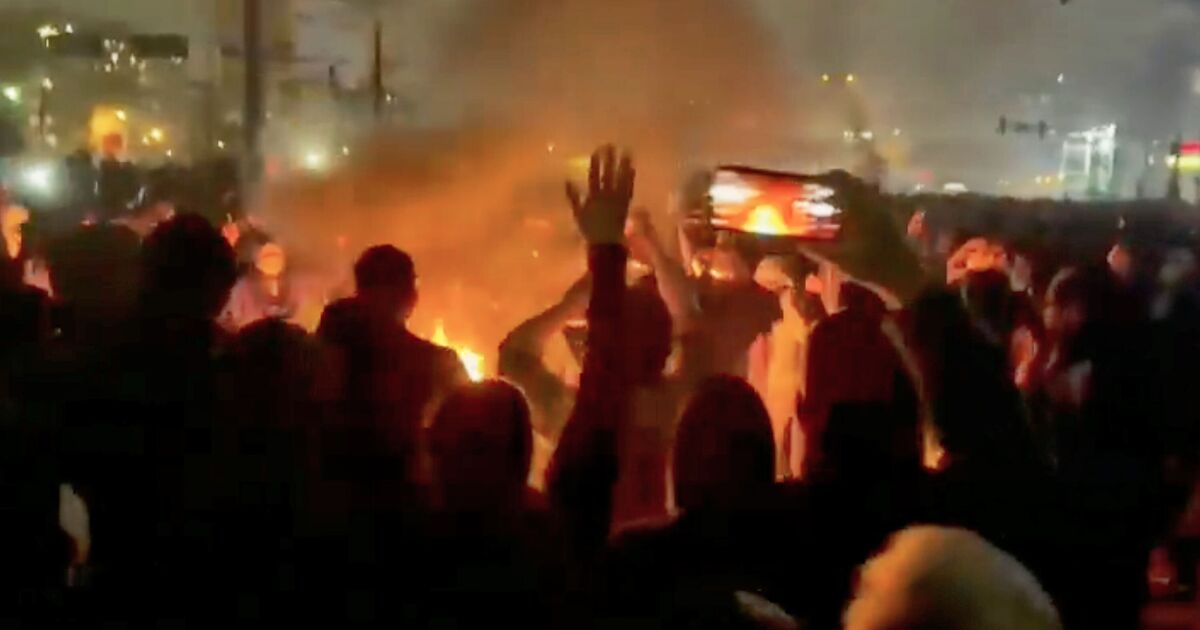
Widespread protests have erupted across Iran (Image: AP)
Iranian security forces have deployed military-grade weaponry against protesters, escalating a crackdown that has resulted in hundreds of deaths amid nationwide unrest driven by economic instability. Human rights organisations report at least 648 civilian fatalities, with some unconfirmed estimates reaching 7,000, as demonstrations continue across all 31 provinces despite a near-total communications blackout.
The protests, which began in late December 2025 following sharp inflation and currency devaluation, have transitioned into a fundamental challenge to the Islamic Republic’s governance. Eyewitness reports and verified footage show security forces utilising anti-aircraft machine guns, AK-47 rifles, and grenade launchers against crowds calling for political change.
Read more: Horror as body bags pile up in Iran as sick regime kills at least 500 protesters
Read more: Moment Donald Trump explodes at CNN reporter with four-word put down
??????BREAKING:
We have confirmation the regime is using military-grade weapons against unarmed civilians in Iran
Unconfirmed reports now indicate death toll could be as high as 7000. The very few people we’ve been able to speak with inside Iran are echoing this number.@SaeidGolkar
— Kasra Aarabi (کسری اعرابی) (@KasraAarabi) January 12, 2026
In cities such as Marvdasht and Qom, IRGC units have reportedly fired DShK heavy machine guns and 40mm grenades from elevated positions and roundabouts, resulting in high casualty rates that activists have categorised as indiscriminate massacres.
An anonymous activist from inside Iran, speaking via smuggled satellite links, said: “The regime is treating its own people as enemies in a war zone. They’re using weapons meant for battlefields on families protesting bread prices.”
Medical facilities in Tehran and Ilam reported removing 7.62mm bullets and buckshot pellets from victims, with surgeons noting severe tissue destruction from military-grade rounds.
At Towhid Roundabout, Basij militia members allegedly lobbed grenades into throngs of protesters, killing dozens and injuring hundreds.
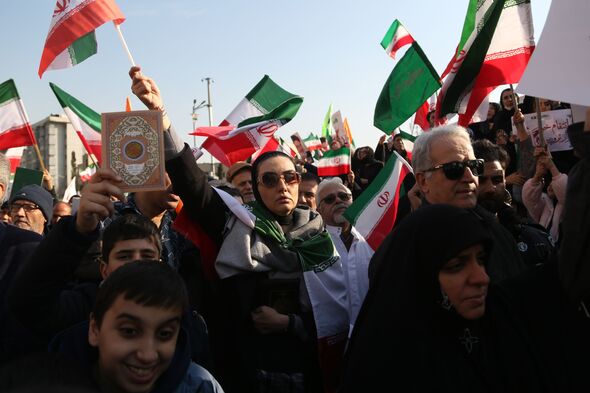
People gather at Enghelab Square after a government call to rally in support (Image: Anadolu via Getty Images)
Supreme Leader Ayatollah Ali Khamenei branded the demonstrators “rioters” who “must be put in their place,” while state media frames the violence as responses to “foreign-backed terrorism.”
The government’s refusal to release casualty figures, coupled with the shutdown of internet and telephone networks since early January 2026, has hindered verification.
The Human Rights Activists News Agency (HRANA), relying on underground networks, tallied over 600 protests by January 11, with more than 10,600 arrests. Amnesty International has condemned the “cycle of bloodshed,” documenting close-range shotgun blasts and live ammunition use as potential war crimes.
The underlying economic triggers are stark: Iran’s rial has plummeted to over 1.4 million per U.S. dollar, battered by UN snapback sanctions reimposed in September 2025 over Tehran’s nuclear ambitions.
Rally supporting protests in Iran held outside Downing Street
Annual inflation hovers at 42%, with staples like meat and rice unaffordable for millions. A new tiered pricing for subsidised gasoline, introduced in December, hiked costs for the world’s cheapest fuel, while the Central Bank’s scrapping of preferential exchange rates for imports—except medicine and wheat—promises further food price spikes.
Merchants in Tehran’s bazaars ignited the spark, but chants soon echoed support for exiled Crown Prince Reza Pahlavi and demands to end theocratic rule, echoing the 2022 Mahsa Amini uprising.
Iran’s woes compound regionally. Its “Axis of Resistance”—a network of proxies including Hamas, Hezbollah, and Yemen’s Houthis—lies in tatters after Israel‘s crushing campaigns since the 2023 Gaza war.
Syrian President Bashar Assad, a key ally, fell in a December 2024 offensive, while U.S. and Israeli airstrikes have pummelled Houthi positions. China and Russia, Tehran’s economic lifelines, offer oil purchases and drones but no overt military backing.
Internationally, tensions boil. US President Donald Trump, fresh from the January 3 capture of Venezuelan leader Nicolás Maduro—an Iranian ally—has vowed intervention if Tehran “violently kills peaceful protesters.”
Mr Trump warned on Saturday: “We’re watching closely. If they start killing like before, they’ll get hit very hard.”
His administration, which bombed Iranian nuclear sites in a 12-day June 2025 war alongside Israel, eyes Tehran’s atomic programme warily. Despite Iran’s recent halt to uranium enrichment, the IAEA warns it could assemble 10 bombs if weaponised. U.S. intelligence notes no active programme but heightened readiness.
As protests persist into their third week, experts predict long-term erosion of the regime’s grip, even if it survives.
Middle East analyst Karim Sadjadpour said: “This isn’t 2019 or 2022. The economy’s free fall and weakened alliances make suppression riskier.”
Activists urge global action: expelling Iranian diplomats, bolstering satellite internet for protesters, and probing atrocities. With gunfire echoing in blacked-out streets, Iran’s theocracy faces its gravest test since the 1979 Revolution.