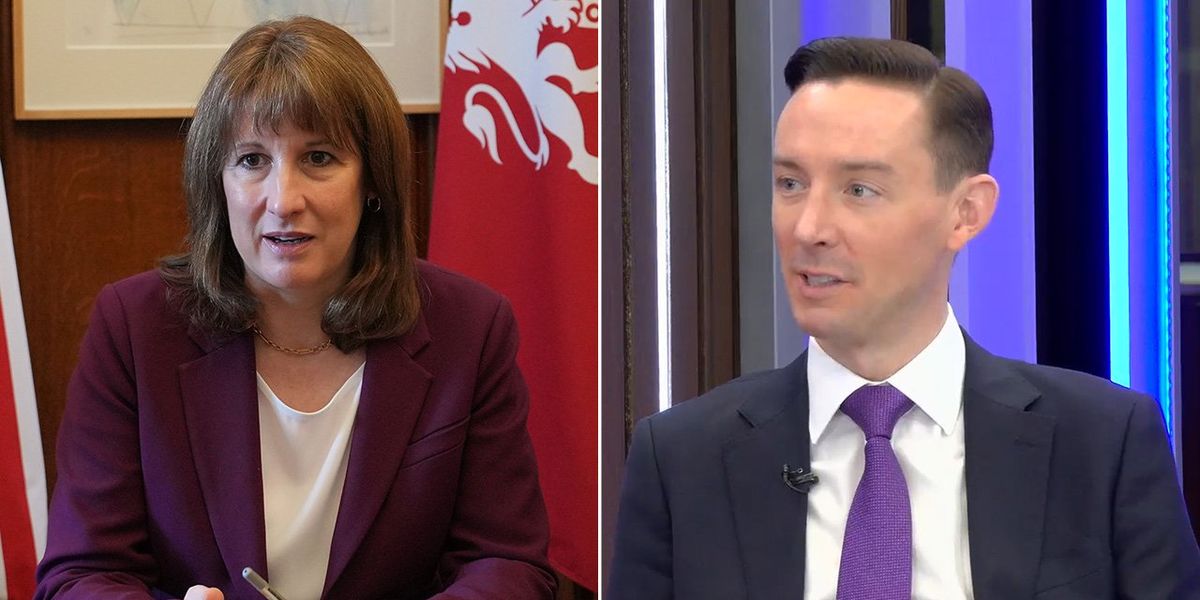
Economist Tyler Goodspeed has issued a stark warning that the ongoing energy supply crisis in the Persian Gulf could plunge both Britain and America into recession, potentially surpassing the severity of the 1973 oil embargo.
Speaking to GB News, Mr Goodspeed expressed surprise at how calmly financial markets responded to the situation last week, given that roughly a fifth of the world’s oil and gas passes through the narrow Straits of Hormuz.
“And here we’re living through what could be the biggest oil supply shock and gas supply shock since at least the 1973 Arab oil embargo,” he said. “And if indeed this does persist, it would actually be even bigger than the 1973 to 1975 oil crisis.”
Mr Goodspeed drew on four centuries of economic data to make his case, describing energy supply disruptions as “serial killers of economic expansion” throughout transatlantic history.
He invoked former Federal Reserve Chairman Ben Bernanke’s observation that “economic expansions don’t die of old age, they’re murdered,” positioning energy shocks as the primary culprits or accomplices in these economic deaths.
The economist challenged conventional narratives about downturns, arguing that recessions are fundamentally driven by sudden shocks rather than corrections to previous excesses or poor investments.
“We tell ourselves stories about recessions, that there was some boom, there was some excess, there was some malinvestment to which the subsequent bust is in some sense a remedy, but the reality is recessions are about shocks,” he told GB News.
Mr Goodspeed argued that Britain faces greater exposure to this crisis than both the United States and continental Europe, a reversal of historical patterns.

Economist Tyler Goodspeed has offered a bleak assessment of Britain’s economy under Rachel Reeves
|
PA / GB NEWS
He noted that the UK was once relatively insulated from oil shocks in 1948, 1957 and 1970 because the economy depended primarily on plentiful domestic coal supplies.
“The United Kingdom is considerably more vulnerable than the United States and also more vulnerable than Europe,” he explained, calling the situation “ironic” given Britain’s previous resilience.
Over recent decades, however, the country has shifted heavily towards gas consumption without fostering conditions that encourage North Sea exploration and production.
This means Britain’s benchmark gas prices are increasingly determined by liquefied natural gas imports, which carry higher costs than domestically sourced alternatives.
 G7 finance ministers including Rachel Reeves are set to hold emergency talks today | TREASURY
Mr Goodspeed was sharply critical of Chancellor Rachel Reeves’s approach to economic policy, noting that despite her frequent emphasis on growth over recent years, he has “yet to see sufficient evidence of serious policy making in support of that objective.”
He warned that increased government spending under Reeves leaves her particularly exposed should energy prices remain elevated, drawing a pointed comparison to Liz Truss’s downfall.
“Remember, it was not the well-signalled tax cuts announced by Liz Truss that was her undoing, it was the massive unfunded and potentially unlimited energy price guarantees,” he said.
The economist advised that if he were in Reeves’s position, he would demonstrate genuine commitment to growth by establishing a regulatory and tax framework that encourages both workforce participation and capital investment.

Me Goodspeed told GB News that the UK is ‘more vulnerable’ than the US to the oil crisis
|
GB NEWS
Mr Goodspeed suggested the conflict could resolve swiftly, but indicated that scenarios involving a prolonged crisis are becoming increasingly likely.
He pointed to Tehran as a complicating factor, noting that even if President Trump considers American objectives achieved, Iranian leadership may not share that assessment.
“The conflict could be over quickly, but I think there are more and more probable scenarios in which it drags on,” he told GB News.
The economist also highlighted a crucial lesson from the 1970s: once energy supplies face disruption, the consequences extend well beyond the immediate crisis.
“A lesson of the 1970s was that once this supply has been disrupted, then risk premia on a barrel of oil go up dramatically,” he warned.