VENTIMIGLIA, Italy (LifeSiteNews) — The Diocese of Ventimiglia–San Remo has installed a bell dedicated to unborn children at its episcopal headquarters, prompting criticism from leftist political figures.
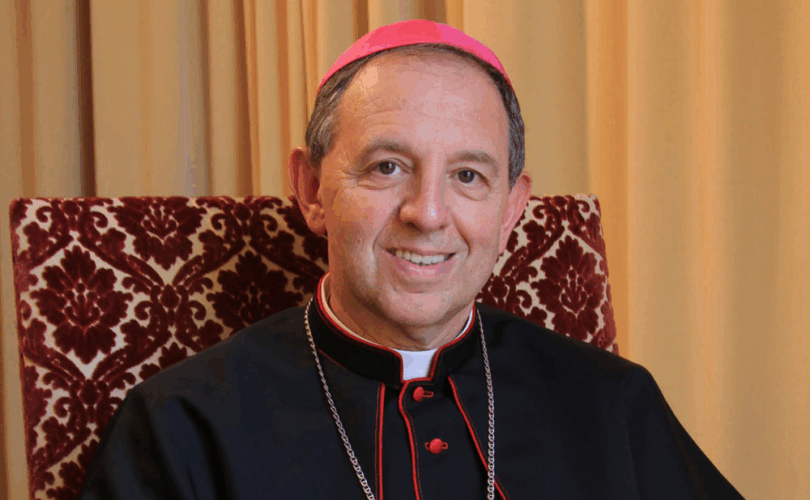
On December 28, 2025, the Diocese of Ventimiglia–San Remo inaugurated the “Bell for Unborn Children” at the tower of the diocesan curia building in Ventimiglia, north-western Italy, as an initiative promoted by Bishop Antonio Suetta to raise awareness about unborn life, encourage reflection on abortion laws, and convey a message of hope and prayer. This action has since attracted strong objections from representatives of the centre-left in the region of Liguria.
READ: Democrat Senate candidate falsely claims Bible is silent on abortion, homosexual ‘marriage’
“Contrary to prejudices expressed in various quarters regarding this initiative, the sound of this bell is in support of life and is not intended as an invective against women who have had an abortion,” Suetta said in an interview with La Nuova Bussola Quotidiana.
The bell, which bears the inscription “To all unborn children,” is designed to ring once a day at 8 p.m. According to the diocese, the daily toll is meant to serve as a reminder of children who were never born and as a call to prayer for the protection of human life. The inauguration took place on the liturgical feast of the Holy Innocents, a date traditionally associated in the Catholic calendar with the commemoration of children killed at the time of King Herod, as narrated in the Gospel of St. Matthew.
The initiative immediately sparked controversy in Italy’s political arena. Edoardo Verda, a Democratic Party councillor in the city of Imperia, described the bell as “moral propaganda” and as “an unbearable intrusion into a sphere that does not concern religion, but women’s self-determination.” Similar criticism came from Enrico Ioculano, a regional councillor for Liguria, who publicly stated that “the diocese should question its priorities.”
Suetta, responding to accusations that the bell represented a judgement against women, stressed that the Catholic Church’s position distinguishes between the moral condemnation of abortion and pastoral care for women involved. Citing the Second Vatican Council’s document Gaudium et Spes, he reiterated that the Church defines abortion as an “abominable crime,” while also considering women who have undergone abortions as victims of a broader moral and social harm. “In the fact of abortion,” Suetta said, “a child dies and, at the same time, a mother also suffers. Abortion leaves a heavy burden of pain, and the bell invites prayer and closeness for all women who suffer for this reason.”
The bishop also framed the initiative as addressing what he called a widespread “assuefaction” (or habituation) to abortion in countries where it is legal. In his interview, he argued that legal abortion, now permitted in most countries worldwide, has led many people to underestimate its biological and medical reality and to cease considering it either a crime or a sin.
He added that, in his view, abortion is often presented by progressive and feminist movements as an absolute right, subordinating scientific evidence, natural law, and moral judgement to individual choice. For this reason, he described the bell as an attempt to “sensitize consciences” on an issue that he defined as “not confessional, but anthropological and scientific.”
READ: Federal court confirms Trump can defund Planned Parenthood, overriding pro-abortion judge again
The controversy expanded further after Laura Amoretti, the Equal Opportunities Councillor of the Liguria Region, wrote a formal letter to Pope Leo XIV asking the Pontiff to take a position against the initiative.
In her letter, Amoretti stated that the decision to install the bell, because of its strong symbolic value, had caused “concern and pain in many women and families” and had generated “a climate of judgement and stigmatization” regarding personal decisions often made in complex and distressing circumstances.
Amoretti argued that, in a pluralistic society and a secular state, such initiatives risk becoming a form of public judgement on women’s bodies and choices, potentially increasing gender inequalities rather than reducing them. While acknowledging the Catholic Church’s religious freedom and social role, she maintained that “both religious and civil institutions should aim to accompany and support individuals rather than divide communities or expose legally recognized personal decisions to public scrutiny.”
The origins of the bell predate its installation on February 5, 2022, during the diocesan initiative “40 Days for Life,” when the bell was cast as a permanent and visible sign of prayer, remembrance, and entrustment. “40 Days for Life” is a period of 40 days dedicated to prayer, public witness, and educational meetings focused on pro-life issues, an initiative in which the Diocese of Ventimiglia–San Remo has previously taken part.
According to diocesan sources, its purpose has remained consistent since its casting: to give symbolic “voice” to unborn children and to keep the issue of abortion present in public consciousness through a daily, audible sign. Since its inauguration, however, the bell has become a focal point of a broader public debate in Liguria, highlighting ongoing tensions in Italy between religious expression, political authority, and differing views on abortion and women’s rights.