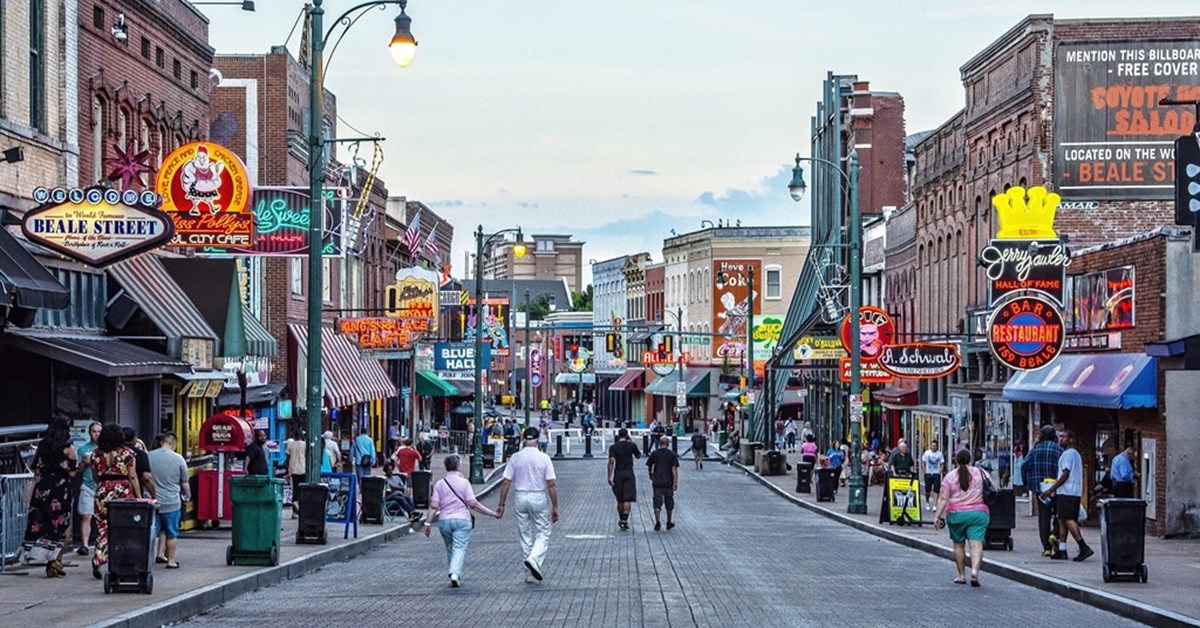
TRILLS of northern mockingbirds serenade my steps as I trudge from Dockery Plantation, perspiring and dusty, towards the cypress-fringed, rust-coloured crossroads, where legend has it that Robert Johnson sold his soul to the devil for guitar skills. Mercifully, the intense heat is the only satanic element today.
Living and working on the nearby Dockery Plantation in the 1930s, Johnson, father of modern blues, brought the spiritually inspired music of African-American sharecroppers from the plantation to urban audiences. Dockery, once a vast cotton plantation and sawmill, dating from 1895, with its own railway station and company currency, is now weathered-timber farm-buildings, only hinting at the era of the “juke joints” (informal drinking clubs) that nurtured blues musicians.
I am on the penultimate day of a six-night group tour of the Mississippi Delta region, Memphis, in bordering Tennessee. Our tour marks the centenary of B. B. King’s birth, in September 1925, and highlights the religious roots of the Mississippi Delta’s music and civil-rights movement. Our road-trip route traces a triangle, 140 miles south from Memphis to Greenwood, and then north-west (via Clarksdale) on our return to Memphis.
The plantation is 40 minutes’ drive from Greenwood, an old cotton town where Johnson spent his final year before his unexplained death in 1938. Cotton merchants used to strike deals at the substantial Irving Hotel, built in 1917 and now called the Alluvian, where we stay. After the daytime heat, luxuriating in the Alluvian’s Southern charm, antique furnishings, and cooling rooftop terrace is bliss.
Along Howard Street from the hotel, a Mississippi Blues Trail marker (one of more than 200 on the trail, developed in 2006) denotes the building that housed the former WGRM Station, which hosted B. B. King’s first live performance as part of the St John’s Gospel Singers. Singing both at church on Sunday morning and at juke joints in the evening was common for blues musicians. Blues also accompanies my evening stroll in Greenwood, coming from lamppost speakers.
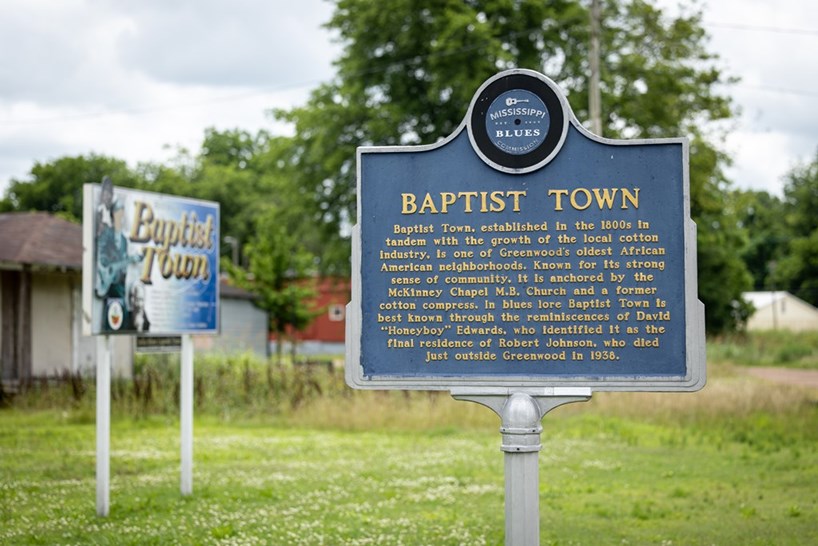 Maris, West & Baker/Greenwood Convention and Visitors BureauBaptist Town, the historic African American neighbourhood that was the location for much of the film The Help
Fans of the film and book The Help (2011), set in the 1960s, will recognise Baptist Town, an African-American neighbourhood of small wooden houses, built in the 1880s, where the homes of characters Aibileen and Minny were located. The house of the aspiring journalist Skeeter is on the other side of the Tallahatchie river.
Reminders of segregation from the era of The Help, and previous decades, are ever present. In central Greenwood, a bronze statue of Emmett Till, the 14-year-old lynched in 1955 for allegedly wolf-whistling, memorialises the town’s darker past.
At Ruleville, 30 miles out of Greenwood en route to Clarksdale, our group stops at the memorial garden and grave of Fannie Lou Hamer. Hamer tried to register to vote in 1962, aged 44, and was sacked from her job. She energised civil-rights meetings, declaring: “I’m sick and tired of being sick and tired.”
Our last night is in Clarksdale, home to the clapboard rectory where the American playwright Tennessee Williams stayed with his grandfather, Walter E. Dakin, Rector of St George’s Episcopal Church.
The derelict Riverside Hotel, by the Lower Mississippi River, was once a jewel in the Chitlin’ Circuit — the venues accepting touring Black musicians during segregation. Now, musicians flock to the Ground Zero Blues Club, owned by the actor Morgan Freeman and housed in an unrefurbished 1905 warehouse.
As the band plays blues standards, interspersed with an audience harmonica solo, I chat to the next table. They are from Sheil Catholic Center, in Chicago, and are giving up vacation time to volunteer for Habitat for Humanity, improving housing for the poor of Clarksdale.
IN MEMPHIS, where our trip begins and ends, the city’s museums and churches illuminate how faith was a historic agent for change. As well as the Mississippi Blues Trail, many city sites also feature on the US Civil Rights Trail, celebrating the legacy of the civil-rights movement.
At the National Civil Rights Museum, at the Lorraine Motel, where the Revd Dr Martin Luther King, Jr, was assassinated in 1968, images of religious leaders supporting the struggle for equality include the Roman Catholic Fr Maurice Oulett, and the Unitarian minister the Revd James Reeb, beaten so badly at one of the Selma to Montgomery protest marches, in March 1965, he died two days later.
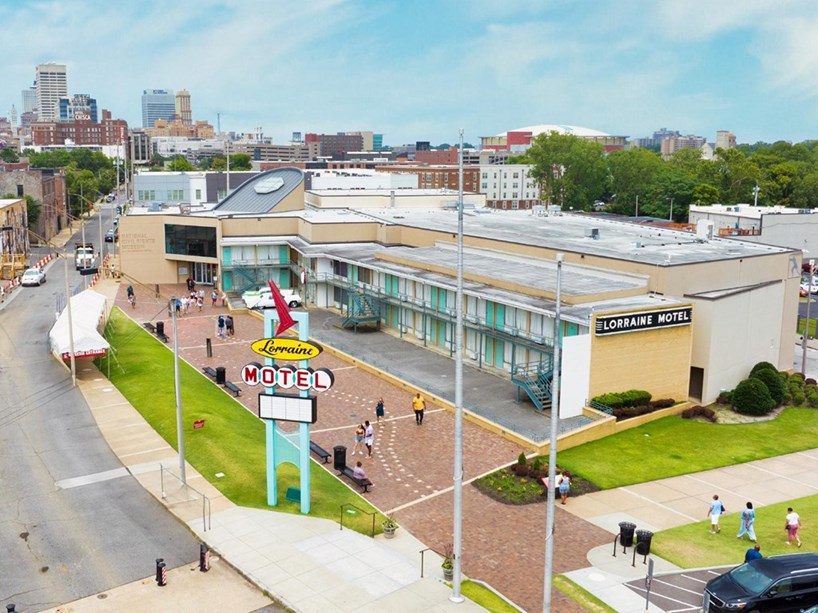 Julian Harper The National Civil Rights Museum at the Lorraine Motel, in Memphis, where Dr King was assassinated
Visitors approach Room 306, with its fateful balcony, in silence, learning that Dr King’s last request was to the orchestra leader, Ben Branch, to play “Precious Lord, take my hand” at the evening rally for the striking sanitation workers, which he was never to attend.
Sadly, Clayburn Temple, the central staging point for the strikers’ marches, was damaged by arsonists last April, derailing a $26-million restoration project for the church, which had welcomed worshippers since 1893.
Just a short walk from the bars and clubs of iconic downtown Beale Street, significant in the development of blues music, I see the church’s roofless, charred walls from “I Am a Man Plaza”, adjacent to the building (the plaza named after the placard signs carried by the striking workers, whose plight had drawn Dr King here).
Memphis is name-checked in more than 1000 songs — more than any other city. In south Memphis, the Stax Museum of American Soul Music is on the site of Stax Records, where Otis Redding recorded “Sitting on the dock of the bay”.
Inside the museum, a reconstruction of Hooper’s Chapel Church, an African Methodist Episcopal (AME) church, built in the early 1900s in Duncan, Mississippi, illustrates the gospel roots of soul music. Furnished with an enamel baptism bowl (and paper fans decorated with pictures of the legendary American gospel singer Mahalia Jackson), the reassembled church embodies popular music’s link to faith.
Near by, a displayed quote from the Memphis drummer Howard Grimes expands on the relationship between church music and popular music: “Backbeat means the church feel, the hand clap. When they didn’t have pianos in churches, you heard the stomping of the feet and the clapping of the hands. The foot was on the beat, the clap was on the ‘and’. . .”
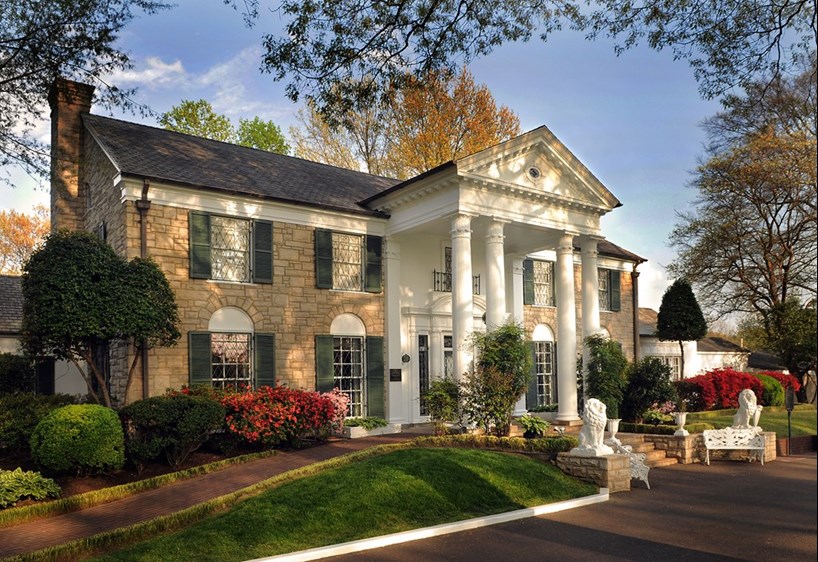 Graceland Graceland
Graceland, built in 1939 and bought by Elvis in 1957, is a Memphis must-see. Among the exhibits in the museum attached to the mansion (which boasts gold taps and a TV in every room) are a church hymnal dated 1869 and a white-bound Bible passed down to Elvis’s daughter, Lisa Marie. A memorial garden to the Presley family, with a large white crucifix and a statue of St Francis of Assisi, is treated reverently, as fans walk past in silence.
In a region famed for fried catfish and smoky BBQ pork, one of my standout meals is a superfood grain bowl in a booth at the Beauty Shop Restaurant, in the former beauty salon where Priscilla Presley used to have her hair done. Even over avocados in Memphis and Mississippi, the spirit of music and faith is omnipresent.
Travel details
SUSAN GRAY was on a group tour as a guest of Memphis Travel. She stayed at the Central Station Memphis, a Hilton hotel (hilton.com); the Alluvian, in Greenwood (thealluvian.com); and the Travelers Hotel, Clarksdale (stayattravelers.com/clarksdale).
The Mississippi Blues Trail (msbluestrail.org) offers a pdf map of locations to visit. The US Civil Rights Trail (civilrightstrail.com) (featuring 130-plus sites across 15 states) offers downloadable tourist itineraries by state, as well as an interactive map to build a bespoke trip. Alternatively, Bon Voyage Travel has a Mississippi Blues trail holiday.
memphistravel.com
visitgreenwood.com
visitclarksdale.com
TRAVEL AND RETREATS is edited by Christine Miles. Tours and holidays advertised are not guaranteed or underwritten by the Church Times or Hymns A&M. Readers should check for ATOL/ABTA guarantees and take out insurance. Details are correct at the time of publication. See also www.gov.uk/foreign-travel-advice